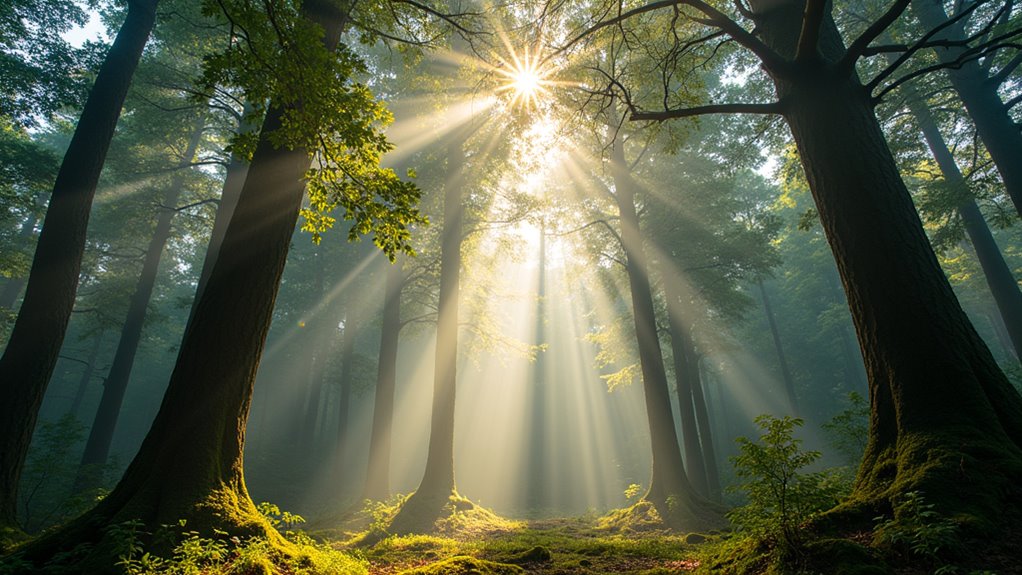

Forests act as Earth’s most powerful air purification system, with trees absorbing massive amounts of carbon dioxide and harmful pollutants through their leaves. A single mature tree can absorb 48 pounds of CO2 annually, while urban trees remove over 711,000 metric tons of air pollutants each year. Through natural processes like transpiration and rainfall, trees filter dangerous particles and gases from the atmosphere, creating cleaner air for communities. The mechanisms behind this natural filtration system reveal nature’s remarkable solution to air pollution.
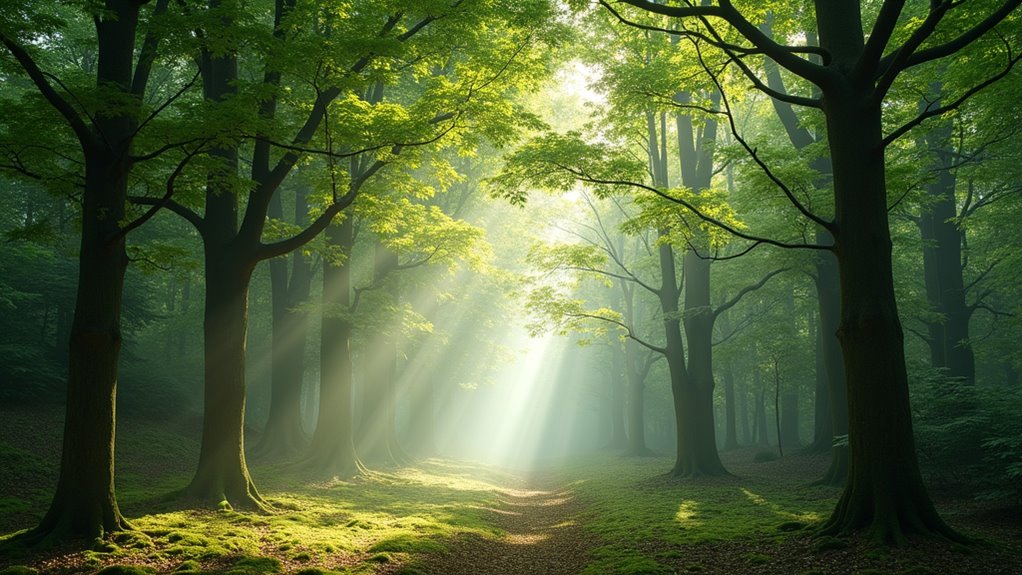
While the world grapples with air pollution and rising carbon emissions, forests stand as nature’s most efficient air purification system. These vast expanses of trees work tirelessly to clean our air through multiple natural processes, with mature trees capable of absorbing up to 48 pounds of carbon dioxide annually. In fact, forests may absorb and store approximately 30% of carbon emissions generated by human activities, making them essential allies in our fight against climate change.
Trees excel at removing various types of air pollution through their intricate biological mechanisms. Their leaves act as natural filters, intercepting and trapping harmful particulate matter on their surfaces. In urban areas alone, U.S. trees remove an impressive 711,000 metric tons of air pollutants each year. This process becomes particularly effective during rainfall, which washes these particles away, or during seasonal leaf fall when trees naturally shed their accumulated pollutants. Forests absorb 7.6 billion metric tons of CO2 annually, underscoring their vital role in mitigating climate change. The economic impact of these natural systems is significant, as rising insurance premiums in vulnerable areas reflect the financial stress caused by climate-related events. The effects of altered precipitation patterns due to climate change further challenge these natural systems, emphasizing the need for adaptive strategies. Extreme weather events like hurricanes and wildfires exacerbate these challenges by causing damage to tree populations and ecosystems, highlighting the urgency of addressing climate change impacts.
Trees serve as Earth’s natural air filters, capturing tons of pollutants through their leaves and cleansing our atmosphere with each rainfall.
The gaseous pollutant removal capabilities of forests are equally remarkable. Through tiny pores called stomata, trees absorb harmful gases like ozone, sulfur dioxide, and nitrogen dioxide. Sacramento County serves as a compelling example, with its trees removing 1,607 tons of air pollutants annually, including 665 tons of ozone. During heat waves, trees provide vital cooling effects that help regulate temperature and humidity levels. Trees with higher transpiration rates prove especially effective at removing these harmful gases from our atmosphere.
Forests also modify local climates in ways that enhance air quality. Through transpiration and shading, trees reduce air temperatures, which in turn decreases the formation of ground-level ozone. Their canopies create a protective barrier, preventing upper atmosphere pollution from reaching ground level. In urban settings, this cooling effect has the added benefit of reducing energy consumption for air conditioning, further decreasing pollution from power generation.
The economic and health benefits of forest-based air purification are substantial. The U.S. values its urban trees’ air pollution removal services at $3.8 billion annually. This natural air cleaning leads to fewer respiratory infections and heart diseases, particularly benefiting vulnerable populations such as children, the elderly, and communities in impoverished areas. Trees strategically planted near roadways can effectively reduce exposure to vehicle emissions, creating healthier environments in urban areas.
Perhaps most importantly, forests serve as significant carbon sinks, storing approximately 708 million tons of carbon in U.S. urban trees alone. This storage capacity increases as trees grow larger and older, highlighting the importance of preserving existing forests. Rainforests are particularly crucial as they create 20% of oxygen supply for the entire planet.
However, when deforestation occurs, this stored carbon is released back into the atmosphere, reversing years of beneficial carbon sequestration. This underscores the critical need to protect and expand our forest resources, as they continue to be one of our most powerful tools in maintaining clean, breathable air for future generations.
Frequently Asked Questions
Which Types of Trees Are Most Effective at Filtering Air Pollution?
Conifers excel at absorbing gaseous pollutants, with pine trees capturing twice the particulates of leafy trees. Their needles continue filtering air for several years, making them effective year-round air purifiers.
Broadleaf trees, especially silver birch and elder, effectively trap particle-bound pollution due to their large leaf surface area.
Urban-tolerant species like eastern red cedar and red maple remove multiple pollutants including ozone, NO2, and particulate matter.
How Long Does It Take for a Forest to Significantly Improve Air Quality?
Forests begin improving air quality almost immediately, with newly planted trees showing measurable benefits within their first growing season.
While initial impacts are localized, the full potential emerges over time. Within 1-5 years, maturing trees exponentially increase their pollution removal capacity.
After 10-20 years, mature forests can remove up to 20% of ambient air pollution nearby.
Even small increases in urban tree cover produce noticeable improvements within months.
Do Artificial Forests Clean Air as Effectively as Natural Forests?
Artificial forests demonstrate superior efficiency in specific air cleaning metrics – with systems like BioUrban 2.0 matching the pollution absorption of 368 trees and microalgae performing 10-50 times better than natural trees at CO2 absorption.
However, natural forests provide irreplaceable ecosystem services, hosting 80% of land biodiversity and sequestering up to 30% of fossil fuel emissions.
While artificial solutions excel in urban settings, they can’t fully replicate natural forests extensive benefits.
Can Indoor Plants Provide Similar Air-Cleaning Benefits as Forest Trees?
Indoor plants provide some air-cleaning benefits but cannot match the scale of forest trees.
While studies show houseplants can absorb toxins like formaldehyde and benzene, their impact is limited in typical home settings.
NASA research suggests hundreds of plants would be needed to greatly purify indoor air.
Plants do increase humidity and remove CO2, but they’re best viewed as a supplement to proper ventilation and air filtration systems, not a replacement.
What Percentage of Global Air Pollution Do Forests Currently Filter Out?
The exact global percentage of air pollution filtered by forests isn’t fully quantified, but research shows significant impacts.
Forests absorb roughly 100 gigatons of CO2 annually, though they release about half back. In the U.S., forests offset 10% of national CO2 emissions.
Urban forests alone remove 711,000 metric tons of pollutants yearly. When considering other pollutants like PM2.5, ozone, and sulfur dioxide, forests serve as Earth’s natural air purification system.