The Montreal Protocol continues to shield Earth’s ozone layer through global cooperation, successfully phasing out 99% of ozone-depleting CFCs since 1987. However, replacement chemicals like HFCs, rising 8% annually, pose new environmental risks. While 197 countries actively support ozone protection through legislation and public awareness campaigns, proper disposal of appliances and reduced emissions remain vital challenges. Understanding these evolving threats helps reveal the next steps toward complete ozone recovery.
The Montreal Protocol stands as humanity’s most successful environmental agreement, demonstrating how global cooperation can effectively tackle planetary challenges. Signed in 1987 and universally ratified by 197 countries, this landmark treaty has been instrumental in phasing out substances that threaten Earth’s protective ozone shield, which absorbs up to 99% of the sun’s harmful UV-B radiation.
The battle to protect the ozone layer gained urgency in the mid-1980s when scientists discovered an alarming “hole” over Antarctica. This revelation sparked unprecedented international action, leading to the systematic elimination of ozone-depleting substances like chlorofluorocarbons (CFCs), which were once common in aerosols, refrigerants, and solvents. The annual party meetings ensure successful implementation through continuous monitoring and adjustments. The protocol’s success is measurable – scientific evidence indicates the ozone layer is on track to recover by mid-century, between 2040 and 2066. A circular economy concept could further aid environmental efforts by reducing industrial emissions and promoting sustainability. Effective water conservation can further contribute to these efforts by maintaining the balance necessary for agricultural sustainability and survival. The increased evaporation rates due to climate change threaten water quality, highlighting the need for comprehensive environmental strategies.
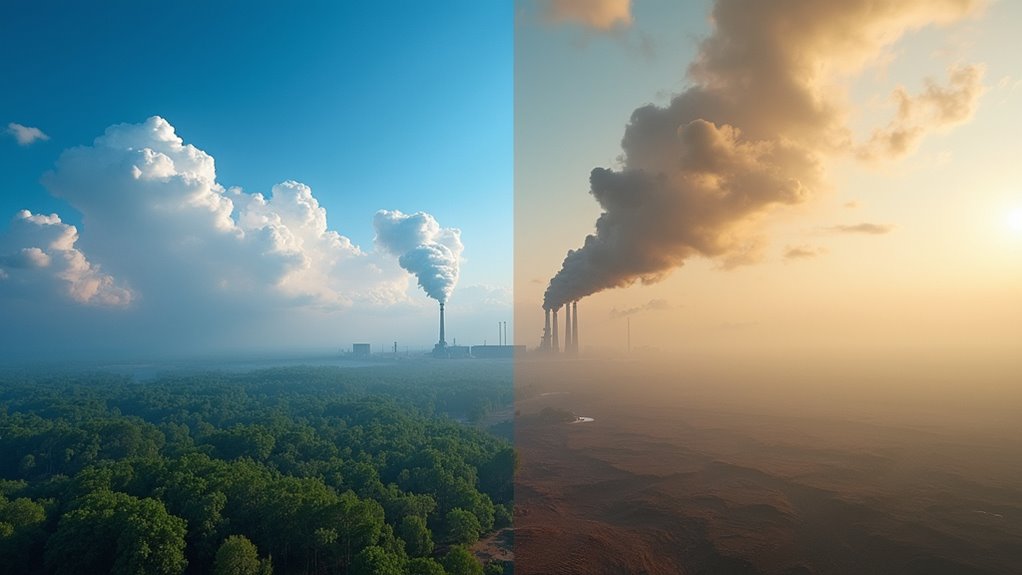
The discovery of Antarctica’s ozone hole in the 1980s catalyzed global environmental action, putting Earth’s protective shield on a path to recovery.
However, challenges persist. While CFCs have largely been phased out, their replacements – including hydrochlorofluorocarbons (HCFCs) and hydrofluorocarbons (HFCs) – pose their own environmental risks. The 2016 Kigali Amendment addresses this by targeting HFCs, which could help avoid a 0.4°C rise in global temperatures. The protocol’s implementation through EU-wide legislation with stricter measures shows how regional bodies can amplify international efforts. Global HFC emissions are increasing at 8% per year, causing growing concern among environmental scientists. Additionally, climate change exacerbates the geographic spread of infectious diseases, posing new challenges for global health.
The stakes couldn’t be higher. A compromised ozone layer means increased UV radiation reaching Earth’s surface, leading to higher rates of skin cancer, cataracts, and other health issues. The environmental impacts are equally severe, affecting everything from plankton populations to agricultural yields and even degrading materials like plastic and wood.
The international community has developed robust support systems to guarantee global participation. The Multilateral Fund, established in 1991, assists developing countries in meeting their protocol obligations. Annual World Ozone Day celebrations on September 16 maintain public awareness, while organizations like the Climate and Clean Air Coalition support ongoing efforts to reduce harmful emissions.
Individual actions complement these institutional efforts. Proper disposal of old refrigerators and air conditioners, reducing transportation emissions through public transit use, and careful selection of cleaning products all contribute to ozone protection. Regular maintenance of air conditioning units and choosing local products to minimize transport emissions represent simple yet effective personal contributions.
The protocol’s success proves that when science, policy, and public action align, environmental challenges can be overcome. While the ozone layer’s recovery isn’t complete, the progress made demonstrates how international cooperation, backed by individual responsibility, can protect Earth’s crucial systems. As we face other environmental challenges, the Montreal Protocol serves as a blueprint for effective global environmental action.
Frequently Asked Questions
How Long Does It Take for Ozone-Depleting Substances to Reach the Stratosphere?
Transport times for ozone-depleting substances to reach the stratosphere vary considerably.
While CFCs typically take 3-5 years, HCFCs need 1-3 years, and methyl bromide about 7 months.
Very short-lived substances can arrive within days or weeks in tropical regions.
The journey depends on factors like atmospheric circulation, chemical stability, and emission location.
Tropical emissions generally reach the stratosphere faster due to unique circulation patterns.
Can Volcanic Eruptions Affect the Ozone Layer’s Thickness?
Yes, volcanic eruptions can greatly impact ozone layer thickness.
When volcanoes erupt, they inject sulfur dioxide into the stratosphere, which forms sulfate aerosols. These aerosols provide surfaces for chemical reactions that accelerate ozone destruction, particularly in the presence of chlorine compounds.
Major eruptions like Mt. Pinatubo in 1991 caused approximately 2% global ozone loss lasting 2-3 years.
However, these effects are temporary as volcanic particles eventually settle out of the stratosphere.
Do Airplanes and Spacecraft Contribute to Ozone Layer Depletion?
Aircraft and spacecraft do impact ozone layer depletion, but their effects vary.
Regular commercial planes flying at lower altitudes (9-13 km) have minimal impact, though they release NOx that affects ozone chemistry.
Supersonic aircraft, cruising higher in the stratosphere (17-20 km), pose greater concerns and could reduce ozone by up to 10% if widely adopted.
Rocket launches currently cause about 0.1% of detectable ozone destruction, though increasing space activity may elevate this impact.
What Role Do Solar Cycles Play in Ozone Layer Fluctuations?
Solar cycles create natural fluctuations in ozone levels through two main mechanisms.
The 11-year cycle causes 1-2% variation in global ozone as UV radiation changes affect ozone production and breakdown.
Additionally, solar proton events during major storms can rapidly reduce ozone by up to 1% in the Northern Hemisphere.
While significant, these natural cycles can’t explain the dramatic ozone depletion observed since the 1980s, which is primarily caused by human activities.
Are There Natural Alternatives to Ozone-Depleting Chemicals Used in Industry?
Numerous natural alternatives have successfully replaced ozone-depleting chemicals across industries.
Hydrocarbons like propane and isobutane now serve in domestic refrigeration, while ammonia handles industrial cooling.
For cleaning, citrus-based solvents and supercritical CO2 offer effective solutions.
Fire suppression systems utilize water mist and inert gases.
Foam production has shifted to pentanes and CO2/water blowing agents.
These alternatives demonstrate industry’s ability to adapt while protecting the ozone layer.