

Renewable energy sources are reshaping global power generation, with solar and wind leading dramatic growth. Solar capacity hit 1,053 GW in 2022, while wind produced 435 billion KWh in the US alone. Though hydropower remains dominant at 1,392 GW, solar installations are projected to surpass fossil fuels by 2027. Each source offers unique advantages – solar requires minimal maintenance, wind creates local jobs, and hydro provides reliable baseload power. Understanding these dynamics reveals promising pathways toward sustainable energy independence.
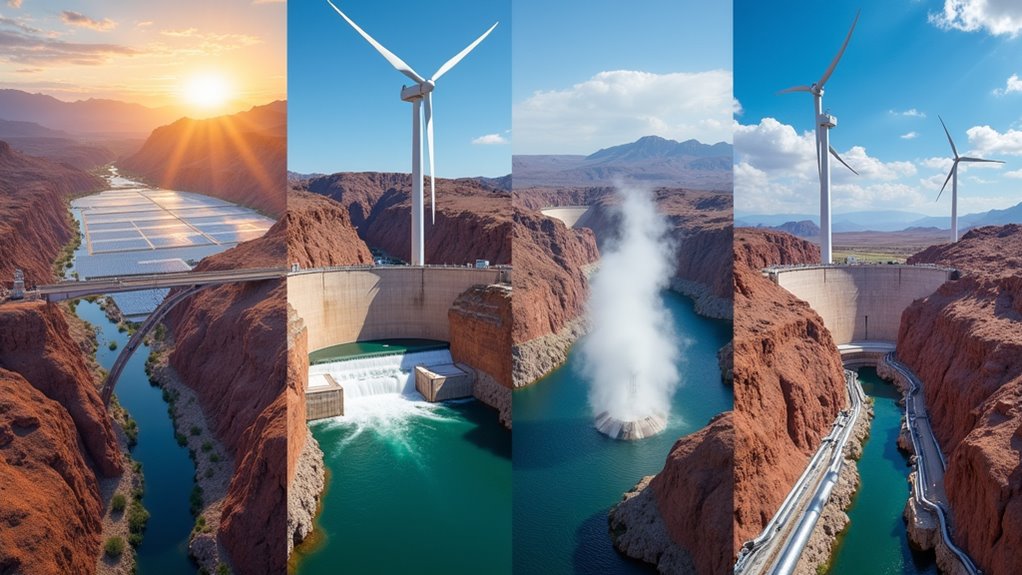
The global renewable energy landscape is undergoing a remarkable evolution, with total generation capacity reaching 3,372 GW in 2022 – more than double the 1,566 GW recorded in 2013. Asia leads this revolution, accounting for 48.33% of global renewable energy generation, while major economies like China, the EU, US, and India are rapidly advancing their renewable energy policies in response to growing environmental concerns and energy security needs.
Among renewable sources, hydropower maintains its position as the largest contributor with 1,392 GW capacity, followed by solar at 1,053 GW and wind at 899 GW. However, the hierarchy is shifting dramatically. Solar energy, now the fastest-growing renewable source, is projected to dominate new power installations over the next five years, potentially surpassing traditional energy sources like natural gas and coal by 2027. In the United States alone, solar generated 146 billion KWh in 2022, contributing 3.4% to total electricity generation. The shift to solar and other renewable sources has led to lower maintenance requirements compared to traditional fossil fuel power plants.
Wind energy has emerged as a formidable player in the renewable sector, generating 435 billion KWh in the US during 2022 and providing 10.2% of total electricity generation. Its success in countries like the UK and US demonstrates the viability of both onshore and offshore wind farms. Meanwhile, hydropower, despite its current dominance, faces natural limitations due to the availability of free-flowing water, generating 262 billion KWh and accounting for 6.2% of US electricity generation. The transition to clean energy sources also boosts local industries by fostering job creation and economic growth within communities. Innovations such as hybrid solar-wind farms are enhancing the efficiency and resilience of renewable energy systems.
The renewable energy evolution is gaining momentum through policy initiatives worldwide. The US Inflation Reduction Act is expected to catalyze significant investments, while the EU is accelerating solar PV and wind deployment in response to the energy crisis. The UK’s ambitious plans to increase renewable capacity to 86.21 GW by 2026 reflect a growing global commitment to sustainable energy solutions. This transition is particularly crucial as fossil fuel reserves continue to deplete and contribute to environmental degradation.
This shift towards renewables brings both opportunities and challenges. While creating jobs and reducing dependence on fossil fuels, renewable energy systems face hurdles such as intermittency and storage limitations. The initial investment costs can be substantial, though long-term financial benefits and environmental advantages often outweigh these expenses. Currently, renewables provide 9% of total U.S. energy consumption and 21.5% of electricity generation, highlighting significant room for growth.
The future of renewable energy appears increasingly promising, with forecasts being revised upward by an average of 30%. Smaller contributors like bioenergy (149 GW) and geothermal (15 GW) continue to play important supporting roles in the global energy mix. As technology advances and costs decline, the evolution to renewable energy sources represents not just an environmental imperative but an economic opportunity that’s reshaping the global energy landscape.
Frequently Asked Questions
How Quickly Can a Household Transition Completely to Renewable Energy Sources?
A typical household can fully convert to renewable energy within 3-5 years, though faster options exist.
The quickest path involves combining immediate solutions like switching to renewable electricity plans (1-7 days) with rapid installations of solar panels and battery storage (2-4 months).
Local regulations, available technologies, and financial resources impact timeline’s.
While some homes achieve conversion in under 6 months, most benefit from a gradual, strategic approach.
What Government Incentives Exist for Installing Renewable Energy Systems in Homes?
The federal government offers a robust 30% tax credit through 2032 for solar, wind, and geothermal installations in homes.
Additional incentives include annual limits of $2,000 for heat pumps and $1,200 for efficiency upgrades.
Many states provide extra rebates, tax credits, and sales tax exemptions.
Local utilities often offer rebates and net metering programs.
Rural homeowners can access USDA REAP grants covering up to 25% of renewable project costs.
Do Renewable Energy Installations Affect Property Values in Residential Areas?
Research shows renewable energy installations have varying effects on property values.
In rural areas, solar projects demonstrate minimal to no negative impact, with some studies suggesting modest value increases for land with solar leases.
However, suburban/urban properties within 0.5 miles of installations may experience temporary depreciation of 1.5-3.6%. These effects typically diminish after 3-5 years.
Proper siting, setbacks, and community engagement can effectively mitigate potential negative impacts on property values.
How Do Extreme Weather Conditions Impact Different Renewable Energy Systems?
Extreme weather notably impacts renewable energy systems in distinct ways.
Solar panels suffer efficiency losses of 10-25% during heat waves and can be damaged by large hail.
Wind turbines must shut down in winds over 55 mph and face reduced output from ice buildup.
Hydropower facilities struggle during droughts and irregular precipitation patterns.
However, strategic solutions like geographic distribution and improved storage systems help mitigate these challenges, ensuring reliable renewable energy generation.
Can Renewable Energy Systems Be Effectively Combined With Traditional Power Grids?
Renewable energy systems can be effectively integrated with traditional power grids through smart grid technologies and advanced energy management systems.
Modern infrastructure allows for seamless switching between renewable and conventional power sources, while energy storage solutions help balance supply fluctuations.
Grid operators increasingly utilize AI-powered forecasting to optimize this integration.
Despite initial challenges, many countries have successfully achieved high levels of renewable penetration in their existing grids.


