

Tackling greenhouse gas emissions requires a multi-pronged approach backed by promising data. Renewable energy costs have plummeted, with solar dropping 82% in a decade, while nature-based solutions like forests absorb 7.6 billion tons of CO2 yearly. Electric vehicles are revolutionizing transportation, and industrial innovations in steel and cement production could slash emissions by up to 90%. With carbon pricing expanding and green finance reaching $632 billion annually, practical solutions exist – they just need wider adoption to realize their full potential.
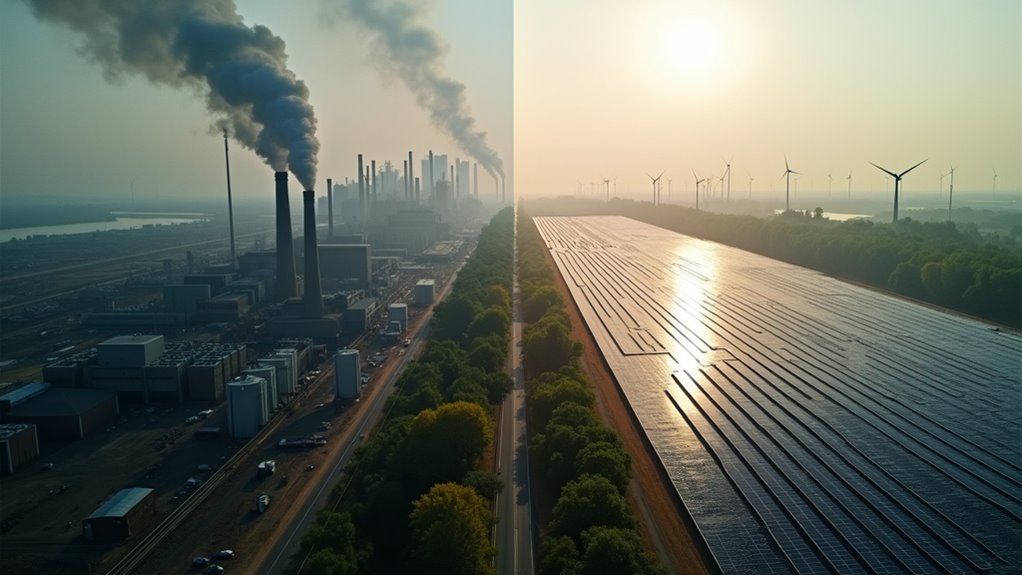
While global greenhouse gas emissions continue to pose significant challenges, an expanding toolkit of proven solutions offers hope for meaningful climate action. Technological advances have dramatically reduced the cost of renewable energy, with solar costs plummeting 82% in just a decade. Wind power‘s explosive growth, averaging 17% annually, demonstrates the viability of clean energy alternatives. Already, renewables generate 28% of global electricity, with studies showing many regions could achieve 100% renewable power by 2050. The importance of integrated efforts is underscored, as combined policy reforms and grassroots initiatives are vital in achieving these goals. Greener consumer habits can play a crucial role in driving demand for sustainable energy solutions, further accelerating the transition.
The shift away from fossil fuels is gaining momentum through multiple channels. Electric vehicles, which are 3-4 times more efficient than gas-powered cars, are seeing sales surge by 40% each year. Public transportation solutions like bus rapid transit can move up to 20 times more people than private vehicles, while high-speed rail offers a carbon footprint just one-quarter that of flying. Simple changes to urban design that prioritize walkability have been shown to reduce driving by up to 40%.
Nature itself provides powerful tools for carbon reduction. Forests currently absorb 7.6 billion metric tons of CO2 annually, while coastal wetlands sequester carbon 40 times faster than forests. Ambitious reforestation efforts targeting 350 million hectares could remove an additional 1.7 gigatons of CO2 yearly. Agricultural soils can act as significant carbon sinks through soil carbon management practices. In agriculture, improved cropland management and regenerative practices could offset nearly 10% of global emissions.
Industry is developing innovative solutions to address its substantial carbon footprint. Emerging green steel production methods could slash sector emissions by 90% by 2050, while new cement formulations reduce emissions by up to half. The circular economy concept, emphasizing reuse and recycling, has potential to cut industrial emissions by 40%. Meanwhile, carbon capture and storage technology could mitigate one-fifth of emissions by mid-century.
Policy mechanisms are evolving to support these shifts. Carbon pricing now covers 22% of global emissions across 64 jurisdictions, while the green bond market has exploded to $1.1 trillion. More than 70 countries have committed to achieving net-zero emissions, and climate finance flows have reached $632 billion annually.
Individual choices also play a vital role. Adopting plant-based diets can reduce food-related emissions by 70%, while addressing food waste could cut emissions by up to 10%. Simple switches like using LED lighting, which is 75-80% more efficient than incandescent bulbs, or installing smart thermostats that reduce energy use by 10-15%, add up to significant impacts. Even changes in business practices, like replacing travel with videoconferencing, can slash associated emissions by 94%.
The path to reducing greenhouse gas emissions requires action at every level – from international policy to individual choices. While the challenge is substantial, the expanding array of solutions shows that effective climate action is not only possible but increasingly cost-effective and technically feasible.
Frequently Asked Questions
How Do Greenhouse Gases Affect Marine Ecosystems and Ocean Acidification?
Greenhouse gases, especially CO2, trigger a devastating chain reaction in oceans. When absorbed by seawater, CO2 forms carbonic acid, making oceans more acidic.
This process has increased ocean acidity by 30% since the industrial revolution, severely impacting marine life. Coral reefs struggle to grow, shellfish can’t build strong shells, and entire food webs face disruption.
The oceans absorb about 22 million tons of CO2 daily, accelerating these harmful effects.
What Role Do International Carbon Trading Markets Play in Emissions Reduction?
International carbon trading markets serve as economic tools for reducing greenhouse gas emissions by putting a price on carbon pollution.
These markets enable companies to buy and sell emissions permits, creating financial incentives for cleaner operations. Operating in over 80 jurisdictions globally, they cover nearly a quarter of worldwide emissions.
While facing challenges like price volatility and verification issues, carbon markets remain a key mechanism for cost-effective climate action and technological innovation.
How Do Different Agricultural Practices Impact Greenhouse Gas Levels?
Agricultural practices greatly influence greenhouse gas levels through multiple pathways.
Conservation tillage reduces soil carbon loss and fuel emissions by up to 70% compared to conventional methods.
Precision fertilizer management can cut nitrogen oxide emissions by 20-40% through better timing and application.
For livestock, improved feed quality and manure management systems like anaerobic digesters help reduce methane emissions.
Smart grazing practices enhance soil’s natural ability to sequester carbon.
Can Individual Lifestyle Changes Actually Make a Difference to Global Emissions?
Individual lifestyle changes can indeed make a meaningful impact on global emissions.
Research shows personal choices like adopting plant-based diets, avoiding air travel, and living car-free can reduce individual carbon footprints by several tonnes annually.
While systemic change is essential, collective individual actions create market pressure and shift social norms.
When millions make sustainable choices, the cumulative effect is significant – potentially reducing global emissions by up to 70% by 2050.
What Emerging Technologies Show Promise for Capturing and Storing Atmospheric Carbon?
Several promising carbon capture technologies are emerging.
Direct Air Capture facilities are already operating, pulling CO2 straight from the atmosphere though costs remain high.
Enhanced weathering using crushed rocks shows potential for large-scale removal while improving soil health.
BECCS combines bioenergy with carbon storage, offering dual benefits.
Ocean-based solutions like seaweed farming could provide massive carbon sinks, but need more research on environmental impacts.
Each approach has unique advantages and challenges.


