

Climate change education empowers students and communities with essential knowledge to tackle environmental challenges. Through integrated learning across subjects, hands-on projects, and real-world data collection, students develop critical thinking skills and environmental awareness. Modern tools like AI modeling and virtual reality make complex concepts accessible, while youth-led initiatives drive positive change. Teachers receive specialized training to effectively guide discussions and manage eco-anxiety. This foundation of knowledge opens doors to deeper understanding of our planet’s future.
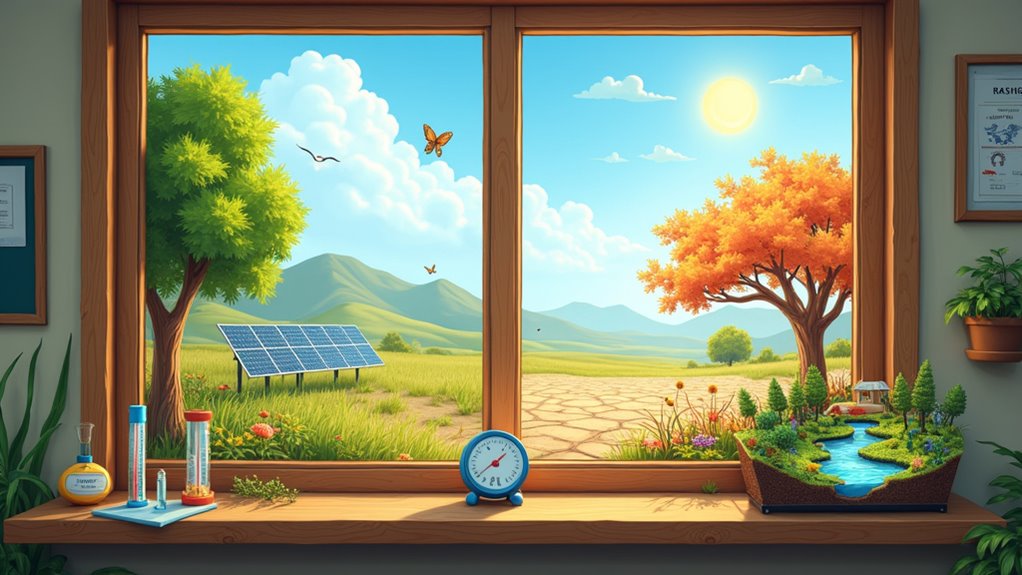
While climate change poses one of humanity’s greatest challenges, effective education stands as an essential tool for preparing future generations to understand and address this global crisis. Research consistently shows that well-designed climate education programs increase student knowledge, develop problem-solving abilities, and foster positive environmental behaviors. Middle school education serves as a critical period for introducing climate change concepts. By focusing on personally relevant information and employing active teaching methods, educators can help students grasp complex climate concepts while building vital skills for the future.
The integration of climate education across multiple subjects proves particularly effective. When teachers incorporate climate topics into science, social studies, mathematics, and even literature courses, students develop a more thorough understanding of the interconnected nature of climate change. Local examples and real-world data collection make these lessons more meaningful, while project-based learning enables students to tackle climate challenges in their own communities. Incorporating indigenous knowledge into climate education enriches understanding and provides valuable traditional perspectives on environmental stewardship. Furthermore, integrating renewable energy sources into these lessons highlights practical steps students can support to combat climate change.
However, successful implementation requires adequate teacher preparation and support. Many educators lack confidence in teaching climate science or struggle with managing controversial discussions. Professional development programs, peer support networks, and access to up-to-date resources are vital for building teacher capacity. Additionally, teacher preparation programs must include climate education components to guarantee new educators enter the classroom ready to address this essential topic. Innovative solutions, such as AI-driven climate modeling, offer educators new ways to engage students and visualize climate data effectively.
Despite its importance, climate education faces several obstacles. Political controversy in some regions has led to pushback against climate curriculum, while competing priorities and time constraints limit classroom coverage. Students may experience eco-anxiety when learning about climate impacts, making it imperative for teachers to balance urgency with hope and emphasize solutions-oriented approaches. Access to current, localized climate data and overcoming widespread misconceptions present ongoing challenges.
Emerging trends in climate education offer promising solutions. Technology and data visualization tools help make complex concepts more accessible, while youth-led initiatives empower students to take active roles in climate action. Virtual and augmented reality experiences provide immersive learning opportunities, and an increased focus on climate justice connects environmental issues to social equity concerns.
Additionally, emphasis on green skills prepares students for future careers in sustainability and clean energy sectors.
The implementation of extensive climate education policies remains essential for widespread impact. Countries that mandate climate change in national curricula and establish clear literacy standards show greater success in preparing students for climate challenges. Partnerships between schools and climate experts enhance program effectiveness, while regular monitoring and evaluation help identify best practices.
Through thoughtful integration, proper support, and innovative approaches, climate education can equip students with the knowledge and skills needed to address one of the defining challenges of their generation.
Frequently Asked Questions
How Can Individuals Measure Their Personal Carbon Footprint Accurately?
Individuals can accurately measure their carbon footprint using online calculators from trusted organizations like the EPA, WWF, or UC Berkeley’s CoolClimate tool.
These calculators require specific data about home energy usage, transportation habits, food choices, and consumer behavior. Users input their annual electricity consumption (kWh), vehicle mileage, flight frequency, and dietary preferences.
The results help identify major emission sources and guide targeted reductions through lifestyle adjustments.
What Careers Are Emerging Specifically Due to Climate Change Challenges?
The climate crisis has created numerous emerging career paths across diverse sectors.
Environmental data scientists analyze climate patterns, while carbon capture specialists develop CO2 removal technologies.
Coastal resilience planners help communities adapt to rising seas, and ESG analysts evaluate corporate sustainability.
Clean energy jobs like solar installers and wind technicians are growing rapidly.
Climate risk managers assess financial impacts, while green architects design sustainable buildings that minimize environmental impact.
How Do Different Religious Beliefs Approach Climate Change Education?
Different religions approach climate change education through their unique theological frameworks.
Christians emphasize stewardship and creation care, while Islamic teachings focus on khalifah (environmental guardianship).
Buddhist and Hindu traditions highlight interconnectedness with nature and sacred duty.
Interfaith initiatives like Power & Light and Faith for Earth bring these perspectives together, organizing educational programs in congregations.
Religious institutions increasingly integrate environmental themes into their teaching curricula and community outreach efforts.
When Will Climate Change Become Irreversible for Earth?
Some climate changes are already irreversible on human timescales, like certain sea level rises and ocean acidification.
However, the most catastrophic tipping points could still be avoided. Scientists warn that crossing 1.5°C warming (likely between 2030-2052) risks triggering multiple irreversible changes, including Greenland ice sheet collapse and Amazon rainforest die-off.
While we can’t reverse all changes, immediate emissions reductions could prevent the worst scenarios from becoming permanent.
Which Countries Have Mandatory Climate Change Education in Their School Curriculum?
Several countries have implemented mandatory climate change education in their schools.
Italy led the way in 2019, requiring 33 hours annually for students aged 6-19.
New Jersey became the first US state to mandate climate education across all subjects in 2020, followed by Connecticut in 2022.
Cambodia integrated climate studies into their earth science curriculum in 2020, while Brazil has announced plans to make climate education compulsory nationwide by 2025.


