

Climate justice recognizes that environmental challenges disproportionately impact vulnerable communities, particularly in developing nations and low-income areas. While industrialized countries have historically contributed most to climate change, its effects burden those least responsible. The Paris Agreement and grassroots initiatives now promote equitable solutions through renewable energy, community adaptation projects, and fair resource distribution. International cooperation, combined with local action, creates pathways for all people to access clean air, water, and sustainable futures. Understanding these connections reveals powerful opportunities for positive change.
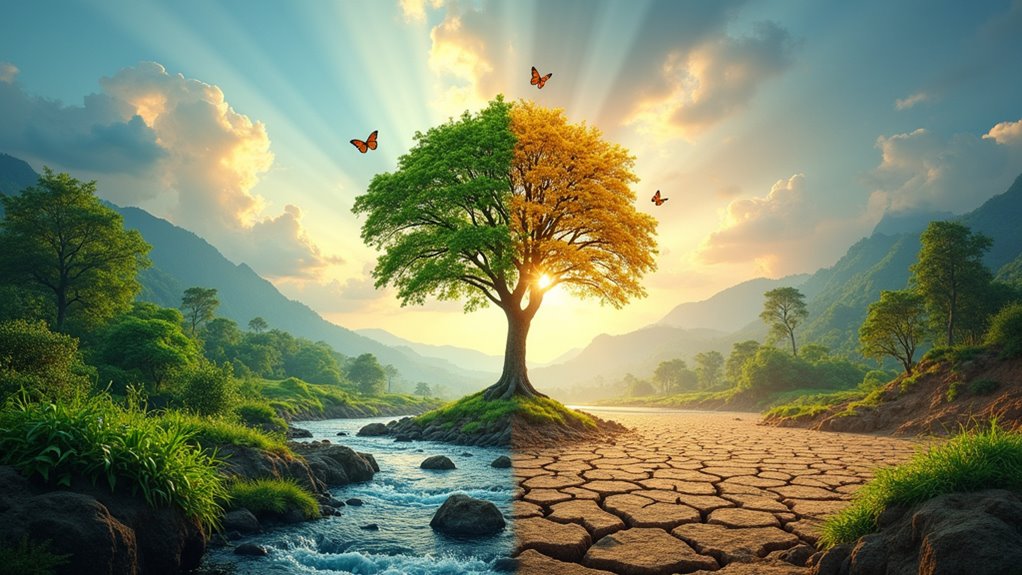
While climate change affects all of humanity, its impacts fall disproportionately on those least responsible for creating the crisis. Low-income communities, developing nations, indigenous peoples, and vulnerable populations bear the heaviest burden of environmental degradation, extreme weather events, and resource scarcity. This fundamental inequity lies at the heart of climate justice, a framework that connects human rights and sustainable development with climate action. Corrective justice requires addressing historical climate impacts through recovery and compensation measures.
The concept of climate justice recognizes that addressing climate change isn’t just about reducing emissions – it’s about guaranteeing fairness in how we distribute both the burdens and benefits of climate action. Historical responsibilities play a key role, as industrialized nations that benefited from unrestricted carbon emissions now have a moral obligation to lead the shift to sustainable practices and support developing countries’ adaptation efforts. Integrated efforts, such as transitioning to renewable energy sources, are crucial for achieving long-term sustainability. Communities are adapting infrastructure and disaster response systems to cope with rising temperatures and extreme weather, showcasing the importance of proactive planning.
Climate justice demands fair distribution of climate burdens and benefits, with wealthy nations leading sustainable change after centuries of unrestricted emissions.
International policy has begun to reflect these principles, albeit imperfectly. The Paris Agreement explicitly acknowledges climate justice, while the Green Climate Fund provides financial support for vulnerable nations. The concept of “common but differentiated responsibilities” enshrined in climate treaties recognizes that countries must act according to their capabilities and historical contributions to the problem.
Communities worldwide are taking action to advance climate justice through grassroots initiatives. Local organizations are implementing climate resilience projects, creating green jobs in disadvantaged areas, and guaranteeing that vulnerable populations have a voice in climate policy decisions. These efforts demonstrate that effective climate solutions must be inclusive and equitable to succeed. The rights of nature are increasingly being recognized in legal frameworks to protect ecosystems alongside human rights to a healthy environment.
However, significant obstacles remain in achieving true climate justice. Power imbalances continue to influence climate negotiations, while funding for adaptation in developing countries falls short of what’s needed. The challenge of quantifying and addressing historical emissions creates further complications in implementing equitable solutions.
Progress toward climate equity can be measured through various metrics, including vulnerability indices, climate finance distribution, and participation in decision-making processes. These measurements help guarantee that climate actions deliver tangible benefits to those most affected by environmental changes while promoting a just shift to a sustainable future.
The path forward requires a fundamental shift in how we approach climate action. It means creating inclusive policies that protect vulnerable populations, guaranteeing equal access to clean energy solutions, and recognizing the unique challenges faced by different communities. Success depends on understanding that environmental justice and social justice are inseparable – we cannot achieve one without the other.
As the world grapples with accelerating climate impacts, the principles of climate justice become increasingly important. By embracing these principles and implementing equitable solutions, we can work toward a future where everyone has access to a healthy, sustainable environment, regardless of their socioeconomic status or geographic location.
The challenge is immense, but the alternative – leaving vulnerable populations to bear the brunt of climate change – is simply unacceptable.
Frequently Asked Questions
How Do Developed Nations Compensate Indigenous Communities Affected by Climate Change?
Developed nations currently provide compensation to Indigenous communities through various mechanisms, including the COP27 loss and damage fund. However, less than 1% reaches Indigenous groups directly.
Some countries offer grants-based financing and debt forgiveness to climate-vulnerable regions. Compensation also includes funding for environmental services provided by Indigenous lands.
Despite these efforts, the current $250 billion pledge falls markedly short of the estimated $1.3 trillion needed for adequate support.
What Role Do Gender Inequalities Play in Climate Vulnerability?
Gender inequalities greatly amplify climate change vulnerability.
Women globally earn 16% less than men and have limited access to resources, making adaptation harder.
In developing regions, women’s roles in agriculture and household management expose them disproportionately to climate impacts.
Their reduced mobility and decision-making power increases risk during disasters, where 80% of displaced people are female.
Limited representation in climate leadership (33% at COP26) further compounds these challenges.
Can Climate Justice Be Achieved Without Addressing Global Wealth Disparities?
Addressing global wealth disparities is fundamental to achieving climate justice.
The stark reality shows wealthy nations and individuals generate the majority of emissions while vulnerable populations bear the heaviest impacts.
Without tackling economic inequality, climate solutions risk perpetuating existing injustices.
Effective climate action requires redistributive policies, technology transfer, and increased adaptation funding for developing countries.
Simply put, climate justice cannot exist in a world of extreme wealth concentration and poverty.
How Are Climate Refugees Protected Under International Law?
Currently, climate refugees lack explicit protection under international law. The 1951 Refugee Convention doesn’t recognize climate change as grounds for refugee status, leaving millions vulnerable.
While regional agreements like the Cartagena Declaration offer limited coverage, most climate-displaced people remain in legal limbo.
Some initiatives, like the Platform on Disaster Displacement, are working to fill this protection gap, but no extensive global framework exists to safeguard climate refugees’ rights.
What Metrics Measure the Fairness of Carbon Emission Reduction Targets?
Several key metrics assess fairness in emission reduction targets.
Per capita emissions compare individual carbon footprints across nations, revealing disparities between high-emitting countries like Qatar and lower-emitting ones like India.
Historical cumulative emissions track total contributions since industrialization, with the US accountable for 25% since 1751.
Carbon intensity measures emissions per GDP, while reduction from peak year considers different development stages and starting points between countries.


