

Five sectors deliver maximum impact in fighting climate change: renewable energy deployment, natural carbon capture, sustainable transportation, industrial decarbonization, and policy mechanisms. Recent data shows dramatic progress – global solar capacity jumped 22% in 2022, forests absorb 7.6 billion tonnes of CO2 yearly, and EV sales surged 55%. With carbon pricing now covering 23% of emissions and green bonds hitting $522 billion, coordinated action across these key areas offers the most promising path forward.
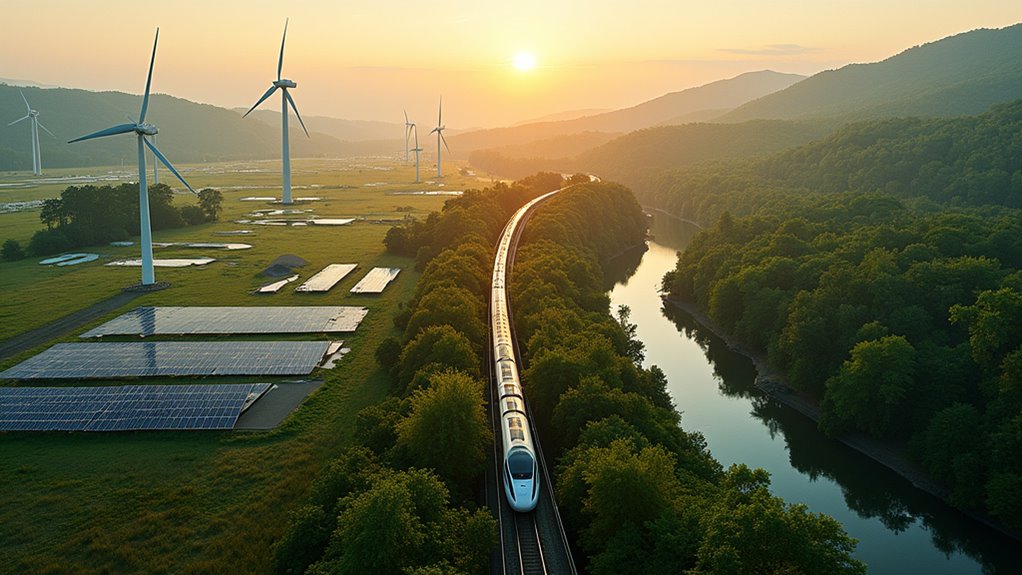
While global greenhouse gas emissions continue to rise, an array of powerful climate change mitigation strategies is gaining momentum across sectors and regions. The rapid growth of renewable energy stands out as a beacon of progress, with solar capacity surging 22% to reach 1047 GW globally in 2022, while wind power grew by 9% to 899 GW. These clean energy sources dominated new power additions, accounting for an impressive 83% of fresh capacity. The CCPI evaluates performance across 63 countries and EU, providing critical transparency in tracking global climate action progress. Meaningful change can also start small, with energy-efficient homes playing a crucial role in reducing emissions.
Nature itself offers some of the most effective solutions for carbon sequestration. Forests currently absorb 7.6 billion tonnes of CO2 annually – one and a half times human emissions. The potential for expanding these natural carbon sinks is enormous, with initiatives to restore 350 million hectares of forest capable of sequestering an additional 1.7 Gt CO2e yearly. Coastal wetlands punch above their weight, sequestering carbon 40 times faster than tropical forests. Renewable energy projects, such as hydropower installations, are transforming power grids worldwide, helping to slash carbon footprints.
Transportation evolution is accelerating, led by the electric vehicle revolution. EV sales jumped 55% in 2022, putting 10.5 million new units on roads worldwide. With over 130 countries now having EV deployment targets, this trend shows no signs of slowing. Meanwhile, high-speed rail networks demonstrate remarkable efficiency, using just one-twelfth the energy of air travel per passenger-kilometer. Expanding urban public transit systems could help avoid 6.6 gigatons of emissions by 2050 through reduced private vehicle use.
Electric vehicles and high-speed rail showcase the tremendous potential of sustainable transport to revolutionize how we move across the planet.
Industrial decarbonization is making strides through innovative technologies and commitments. Green steel production could slash sector emissions by 90% by 2050, while the cement industry has pledged a 25% emissions cut by 2030. Carbon capture and storage projects grew 44% between 2020 and 2021, offering hope for hard-to-abate sectors.
The circular economy presents another powerful tool for emissions reduction. Global recycling rates could nearly double to 60% by 2030, while food waste reduction alone could prevent 8-10% of greenhouse gas emissions. Simple but effective measures like remanufacturing can save up to 90% of energy and materials compared to new production.
Policy instruments are providing vital support for these transformations. Carbon pricing now covers 23% of global emissions across 75 countries, while green bond issuance reached $522 billion in 2022. The financial sector’s growing engagement is evident in climate finance flows, which hit $632 billion in 2019-2020.
Energy efficiency improvements continue to deliver substantial gains across sectors. Building retrofits can reduce energy consumption by 30-50%, while industrial energy management systems typically cut costs by 5-15%. Even simple solutions like LED lighting deliver impressive results, using 75% less energy than traditional incandescent bulbs.
These diverse strategies, working in concert, demonstrate that effective climate action is not only possible but already underway, with multiple pathways to accelerate progress toward a sustainable future.
Frequently Asked Questions
How Do Individual Carbon Footprint Calculations Account for Indirect Emissions?
Individual carbon footprint calculations incorporate indirect emissions through consumption-based accounting methods that track emissions embedded in products and services people use daily.
This includes analyzing supply chain emissions from food production, manufacturing, transportation, and waste disposal. While complex to measure, these indirect (Scope 3) emissions typically represent 70-80% of personal carbon footprints.
Calculation tools use standardized emission factors and life-cycle assessments to estimate these hidden impacts.
What Role Do Developing Nations Play in Global Climate Change Solutions?
Developing nations play a dual critical role in addressing climate change. While they currently contribute over half of global emissions due to rapid growth, they also hold immense potential for implementing clean energy solutions.
Their vast forests serve as crucial carbon sinks, and their developing infrastructure presents opportunities to “leapfrog” directly to sustainable technologies. However, they face significant challenges including limited resources and competing socioeconomic priorities, making international support essential for success.
How Quickly Can Renewable Energy Infrastructure Replace Existing Fossil Fuel Systems?
The shift to renewable energy infrastructure is expected to take 20-30 years for complete fossil fuel replacement, based on current growth rates and infrastructure lifespans.
While renewable capacity is growing rapidly – reaching 320 GW in 2022 – significant challenges remain.
Grid integration, upfront costs, and supply chain constraints affect deployment speed.
However, falling costs, improved storage technologies, and supportive policies are accelerating the shift timeline in many regions.
Which Carbon Capture Technologies Show the Most Promise for Immediate Implementation?
Post-combustion capture technology shows the strongest potential for immediate deployment, with proven commercial applications and the ability to retrofit existing facilities.
Already capturing 1.6+ million tons of CO2 annually at facilities like Petra Nova, PCC offers a practical bridge solution despite its energy penalties.
While direct air capture holds long-term promise, its current high costs and limited scale make it better suited for future implementation as the technology matures.
How Do International Carbon Credit Trading Systems Actually Benefit the Environment?
International carbon credit trading systems benefit the environment in several concrete ways.
They create financial incentives for emissions-reducing projects like forest conservation and renewable energy development. By putting a price on carbon, these markets encourage companies to improve efficiency.
When properly verified, carbon credits channel funds directly to environmental initiatives that might otherwise lack financing.
The system also enables hard-to-abate industries to support climate action while adapting their operations.


