

Historical climate records tell a stark story: Earth is warming faster now than at any point in the past 125,000 years. Data from ice cores, tree rings, and ocean sediments show greenhouse gas levels have skyrocketed since 1750 – CO2 up 47%, methane up 156%. The planet has warmed 1.1°C since pre-industrial times, driving sea level rise and extreme weather. These ancient climate archives offer critical context for understanding today’s unprecedented changes and what may lie ahead.
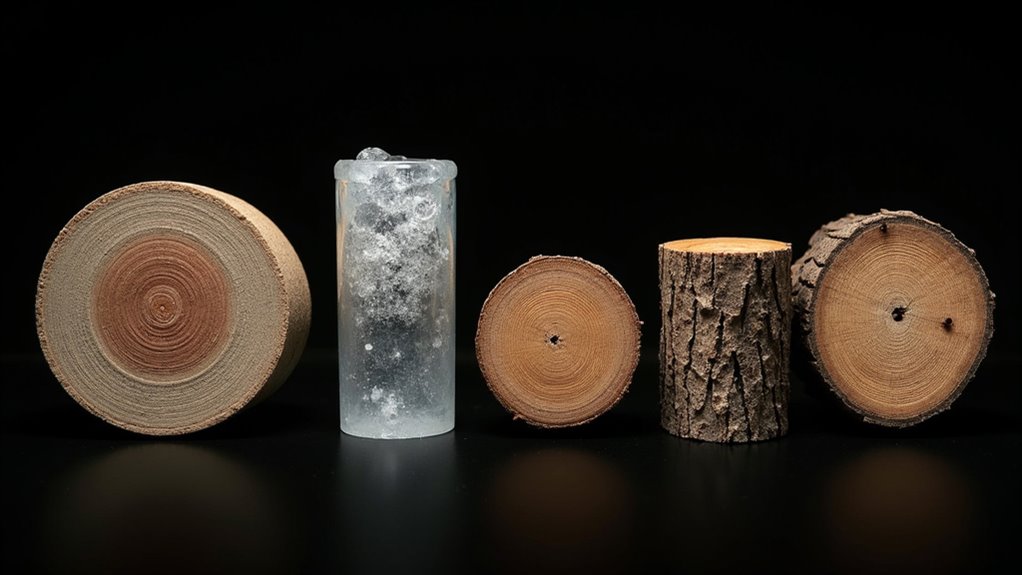
Through centuries of scientific investigation and data collection, researchers have assembled a remarkable archive of Earth’s climate history, piecing together evidence from diverse sources that span hundreds of thousands of years. Ice cores extracted from polar regions serve as time capsules, preserving atmospheric data reaching back 800,000 years, while tree rings provide detailed climate records for the past 11,000 years. Ocean sediment cores and coral reefs add layers to this rich tapestry of climate information, offering glimpses into temperature patterns and atmospheric composition across millennia. Modern climate analysis relies heavily on GISS ModelE output for understanding historical patterns and future projections.
Scientists have meticulously woven Earth’s climate narrative using ice cores, tree rings, and ocean sediments spanning hundreds of millennia.
The evidence reveals a planet in transformation, with current greenhouse gas levels surpassing anything observed in the past 800,000 years. Carbon dioxide concentrations have surged by 47% since 1750, reaching 414 parts per million by 2020. Even more striking is the pace of this increase – approximately 100 times faster than any natural changes recorded in Earth’s recent geological history. Similar dramatic increases are evident in methane and nitrous oxide levels, which have risen by 156% and 23% respectively since pre-industrial times. Greenhouse gases emitted by various sectors like transportation and agriculture have been significant contributors to these rising levels.
Temperature reconstructions paint a vivid picture of our warming world. The planet has warmed 1.1°C since pre-industrial times, with the last decade marking the warmest period in at least 125,000 years. While Earth has experienced previous warm periods, such as the Medieval Warm Period from 950-1250 CE, the current rate of warming since 1970 exceeds any comparable 50-year period in the past two millennia. During the Eocene epoch, no large ice sheets existed when carbon dioxide levels reached 1,000 parts per million. The rise in global temperatures is linked to a surge in extreme weather events, including hurricanes, floods, droughts, and wildfires.
The oceans tell their own story of change. Sea levels have risen 20 centimeters over the past century, with the rate of increase doubling since the 1990s to 3.6 millimeters per year. Historical records show that during the last interglacial period, roughly 125,000 years ago, sea levels stood 6-9 meters higher than today, offering a sobering glimpse of what substantial warming might bring.
Climate models, validated against this wealth of historical data, have proven remarkably accurate in predicting warming trends since the 1970s. These models demonstrate that natural factors alone cannot explain recent temperature increases, pointing clearly to human influence. Looking forward, they project reaching 1.5°C of warming between 2030-2052 under current emission scenarios.
The historical record also shows intensifying patterns in extreme weather. Since the 1950s, heat waves have become more frequent and severe, while heavy precipitation events have increased in both frequency and intensity. The North Atlantic has seen enhanced tropical cyclone activity since the 1970s, and many regions face increased drought severity and longer wildfire seasons.
This extensive climate history, pieced together from ice cores, tree rings, ocean sediments, and other sources, serves as both a warning and a guide. It shows us how Earth’s climate can change dramatically and helps us understand the unprecedented nature of current changes, while providing essential data to refine our predictions of future climate impacts.
Frequently Asked Questions
How Do Scientists Determine Earth’s Temperature From Millions of Years Ago?
Scientists determine ancient Earth temperatures through multiple proxy data sources. Ice cores trap ancient air bubbles containing temperature clues, while tree rings, sediment layers, and coral skeletons preserve climate records.
What Role Did Ancient Volcanic Activity Play in Historical Climate Changes?
Ancient volcanic activity played an essential dual role in Earth’s climate shifts. Large eruptions like the Siberian Traps released massive amounts of CO2, causing long-term warming and contributing to mass extinctions.
However, major eruptions also injected sulfate aerosols into the stratosphere, triggering short-term cooling periods. The Deccan Traps eruptions 66 million years ago coincided with the dinosaur extinction, while other volcanic events triggered ice ages through complex climate feedbacks.
How Accurate Are Ice Core Samples in Measuring Past CO2 Levels?
Ice core samples provide remarkably accurate measurements of ancient CO2 levels, with uncertainty margins of only about 3% or 3 parts per million.
Their reliability is confirmed by multiple independent cores showing consistent results and perfect alignment with direct atmospheric measurements since the 1950s.
Antarctic cores are especially trustworthy, offering continuous climate records spanning 800,000 years.
While deeper ice presents some challenges, scientific techniques effectively account for potential distortions.
Can Tree Rings Reveal Information About Prehistoric Rainfall Patterns?
Tree rings serve as powerful natural records of prehistoric rainfall patterns. Through analysis of ring width and isotope ratios within the wood, scientists can reconstruct precipitation history spanning thousands of years.
Wide rings typically indicate wet periods, while narrow rings suggest droughts. By studying multiple trees across regions and combining this data with other climate proxies, researchers have revealed detailed information about ancient rainfall cycles, including evidence of major droughts and wet periods.
What Caused the End of Earth’s Previous Ice Ages?
Earth’s previous ice ages ended through a complex interplay of factors.
Milankovitch cycles initially triggered warming by changing Earth’s orbital patterns and solar radiation exposure. This warming sparked powerful feedback loops: melting ice reduced Earth’s reflectivity, while warming oceans released greenhouse gases like CO2 and methane.
Ocean circulation changes amplified these effects by redistributing heat globally. These combined forces worked together, pushing Earth’s climate system from glacial to interglacial conditions.


