
Water conservation stands as a critical global priority due to stark realities: only 1% of Earth’s water is drinkable, while 2.2 billion people lack access to safe drinking water. The crisis threatens both human societies and ecosystems, with freshwater wildlife populations declining by 84% since 1970. Water scarcity could cost nations up to 6% of GDP by 2050, affecting agriculture, industry, and public health. Solutions exist through smart management systems, rainwater harvesting, and international cooperation – the path forward awaits those ready to act.
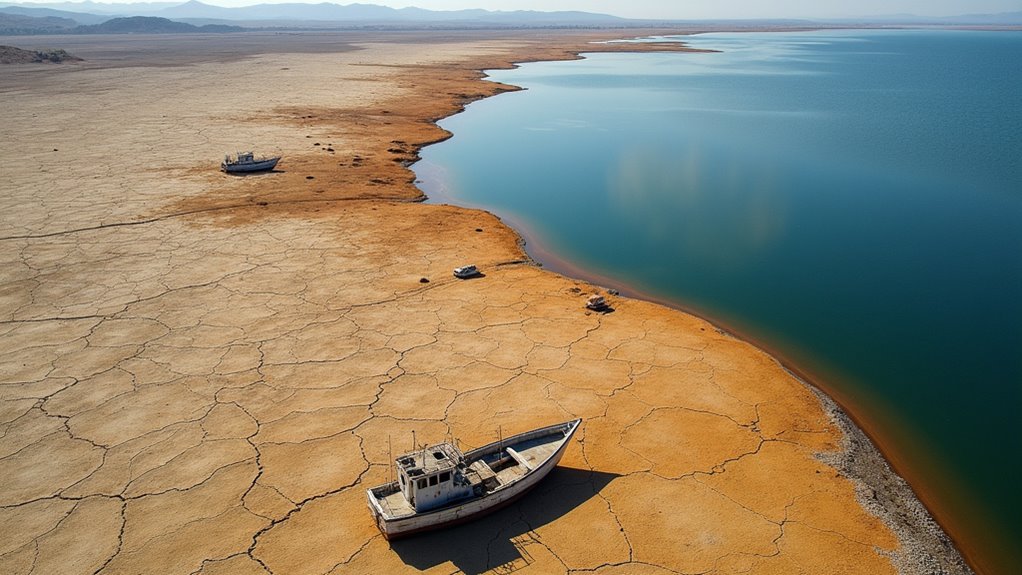
Every drop of water on Earth tells a story of survival, yet our planet faces an unprecedented water crisis that threatens both human societies and natural ecosystems. The stark reality is that 2.2 billion people lack access to safely managed drinking water, while 3.5 billion struggle without proper sanitation facilities. With only 3% of Earth’s water being freshwater and less than 1% actually usable for drinking, the mathematics of our global water supply paint a concerning picture. Water-borne diseases claim approximately one million lives annually.
Water is Earth’s most precious resource, yet billions lack access while our limited freshwater supplies face mounting pressures and growing scarcity.
The economic implications of water scarcity are staggering. Water and freshwater ecosystems contribute an estimated $58 trillion in annual value to the global economy. Agriculture depends heavily on water resources, consuming 70% of global withdrawals, while industrial use in high-income countries accounts for 39%. Global investment needs in the water sector exceed 1.37 trillion dollars. By 2050, water scarcity could cost some nations up to 6% of their GDP, highlighting the pressing need for better resource management. Rising temperatures further exacerbate these challenges by increasing evaporation rates and altering precipitation patterns. Governments are encouraged to adopt national and local policies that aim to improve water security and equity. The political, environmental, and humanitarian risks associated with water scarcity demand urgent global cooperation and strategic planning.
Environmental degradation compounds these challenges. Since 1970, wildlife populations in freshwater habitats have plummeted by 84%. Wastewater contributes considerably to climate change, generating 1.57% of global greenhouse gas emissions. Despite this, only 11% of domestic and industrial wastewater is currently being reused, representing a massive missed opportunity for conservation. Cities are adopting innovative urban strategies to manage water sustainably, such as green infrastructure and smart metering.
Fortunately, global initiatives are gaining momentum. The 30×30 initiative aims to protect 30% of land and water by 2030, while over 190 countries have embraced the Kunming-Montreal Global Biodiversity Framework. These efforts build upon existing protections, which currently cover 17% of land and 8% of marine areas. However, meeting water supply and sanitation Sustainable Development Goals requires annual investments of $131-140 billion.
Technological solutions offer hope for addressing these challenges. Simple innovations like rainwater harvesting can collect 600 gallons per inch of rain from a 1,000-square-foot roof. Commercial car washes demonstrate efficiency by using 65% less water than home washing. Smart water management systems create new job opportunities while improving resource utilization.
Public awareness and engagement remain vital factors in addressing water conservation. While 74% of consumers believe businesses should prioritize water conservation, only 25% think companies are taking appropriate action. This disconnect highlights the need for better education and transparency about water usage and conservation efforts.
The path forward requires a multi-faceted approach combining policy reform, technological innovation, and public engagement. Water pricing must reflect true environmental and social costs, while improved government execution rates can strengthen the sector. Community education campaigns and rebate programs can support conservation efforts, while transboundary cooperation guarantees effective management of shared resources.
Frequently Asked Questions
How Much Money Can Households Save Annually Through Water Conservation Practices?
Households can achieve substantial annual savings through water conservation practices.
Installing WaterSense fixtures and ENERGY STAR appliances saves an average family $350 annually.
Combined utility savings from efficient indoor fixtures range from $242-$408 per year.
Simple habit changes like fixing leaks, running full dishwasher loads, and shorter showers add up considerably.
A WaterSense showerhead alone provides $65 in yearly savings across water, wastewater, and energy bills.
What Role Do Corporations Play in Global Water Conservation Efforts?
Corporations play a major role in global water usage, consuming nearly two-thirds of the world’s water resources.
While 75% of companies have established water reduction targets, significant gaps remain.
Leading corporations like Coca-Cola and PepsiCo have launched ambitious water conservation programs, aiming for net-positive impact by 2030.
However, only 35% consider local contexts in risk assessment, and just 13% have specific ecosystem protection goals.
Corporate water stewardship remains a critical area for improvement.
Which Countries Have the Most Successful Water Conservation Programs?
Several nations stand out for their innovative water conservation achievements.
Singapore leads with its “Four National Taps” strategy, achieving remarkable water self-sufficiency through diversified sources.
Israel excels in wastewater recycling, repurposing 86% for agriculture.
Denmark’s capital Copenhagen pioneered sustainable urban water management with extensive green infrastructure.
Australia implements practical solutions like mandatory rainwater tanks.
These countries’ success stems from combining smart policies, advanced technology, and public engagement.
How Does Climate Change Affect Water Availability in Different Regions?
Climate change dramatically alters water availability across regions through multiple mechanisms.
In Mediterranean areas and the Middle East, rising temperatures intensify droughts and reduce rainfall.
Mountain regions face diminishing snowpack and glacial retreat, disrupting traditional water supplies.
Meanwhile, some tropical areas experience more intense but erratic rainfall patterns.
Coastal regions suffer from saltwater intrusion into aquifers due to rising sea levels, while groundwater depletion accelerates in arid zones.
What Innovative Technologies Are Being Developed for Water Conservation?
Several groundbreaking technologies are revolutionizing water conservation.
Smart water management systems use IoT sensors and AI analytics to detect leaks and optimize distribution.
Advanced filtration methods like reverse osmosis and graphene membranes remove contaminants more efficiently.
Innovative irrigation solutions, including drip systems and AI-powered controllers, reduce agricultural water usage by up to 50%.
Recycling technologies like greywater systems and the Bhungroo method help communities reuse wastewater effectively.