

Severe water scarcity impacts over two billion people globally, hitting hardest in Africa’s Sahel, the Middle East, and Central Asia. Countries are responding with innovative solutions: Israel leads in water-efficient farming, Singapore pioneers wastewater recycling, and India implements rainwater harvesting. Smart irrigation systems, desalination plants, and policy reforms show promise in addressing shortages. While challenges remain significant, technological advances and collaborative efforts reveal pathways toward sustainable water management that could reshape our future.
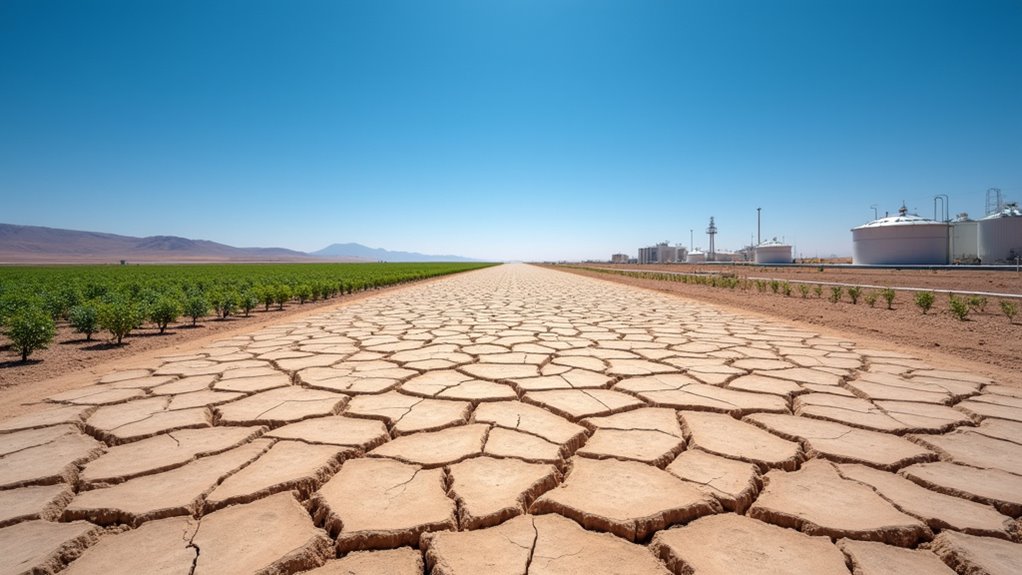
As global populations surge and climate patterns shift, innovative solutions to water scarcity are emerging at an unprecedented pace, offering hope for regions grappling with dwindling water resources. The most severe water shortages currently affect arid regions across Africa, the Middle East, and parts of Asia, where traditional water management approaches are being revolutionized through technology and policy reforms. The importance of water conservation is not limited to these regions, as it is a global issue intertwined with climate change and agriculture, demanding worldwide attention and action.
Technological innovation offers new hope for water-scarce regions as traditional management systems evolve to meet growing global challenges.
In these water-stressed regions, drip irrigation systems have emerged as a game-changing solution, delivering water directly to plant roots and reducing waste through evaporation by up to 80%. This technology, combined with smart water management systems that utilize data analytics to detect leaks and optimize distribution, is transforming agricultural practices in countries like Israel, which has become a global leader in water-efficient farming despite its desert climate. Irrigation scheduling practices help farmers determine the precise timing and duration of water application to maximize efficiency. In areas with unreliable power grids, solar water pumps are providing a sustainable solution for consistent water access. Precision irrigation techniques are also being implemented to further enhance the efficiency of water usage in agriculture. Cities are also exploring green infrastructure solutions, such as permeable pavements and green roofs, to manage urban water runoff sustainably and reduce strain on existing systems.
Coastal regions facing freshwater shortages are increasingly turning to desalination technologies, though the high energy costs remain a significant challenge. Countries like Saudi Arabia and the United Arab Emirates have invested heavily in desalination plants, while simultaneously exploring more sustainable power sources to operate them. Government policies on water have been crucial in driving these investments and ensuring their sustainability.
Meanwhile, Singapore has pioneered wastewater recycling systems, demonstrating how treated wastewater can be safely reused for industrial processes and even drinking water after advanced purification.
Rainwater harvesting initiatives are gaining traction in regions with adequate rainfall but poor infrastructure. In India, both urban and rural communities are implementing collection systems that capture monsoon rains, reducing reliance on depleted groundwater resources. These systems, when combined with water-efficient agriculture techniques like drought-resistant crops and conservation tillage, are helping farmers maintain productivity while using less water.
Policy reforms are playing a vital role in addressing water scarcity. Transboundary water-sharing agreements, such as those along the Nile River basin, are becoming increasingly important as countries work to manage shared water resources fairly. Public-private partnerships are also emerging to invest in water infrastructure and maintenance, particularly in developing nations where aging systems contribute to significant water losses.
The implementation of integrated water resources management has shown promising results in various regions. Cities like Cape Town, which faced severe drought in 2018, have successfully reduced water consumption through extensive programs combining smart metering, price incentives, and public education campaigns.
Similar approaches are being adopted in California’s agricultural sector, where precision agriculture techniques and improved soil health management are helping farmers adapt to recurring droughts.
These solutions demonstrate that while water scarcity poses a serious challenge, technological innovation and policy reform can effectively address the issue. The key lies in implementing these solutions at scale while ensuring they remain accessible and affordable for communities most affected by water stress.
As these technologies continue to evolve and become more cost-effective, there’s growing optimism about our ability to manage water resources more sustainably for future generations.
Frequently Asked Questions
How Much Water Does the Average Person Waste per Day?
The average person wastes approximately 30 gallons of water daily through various household activities. This number can triple to 90 gallons per day in a typical home setting.
Common culprits include leaky toilets (60 gallons daily), running taps while brushing teeth (8 gallons daily), and dripping faucets (5 gallons daily).
When combined with inefficient irrigation systems and other household leaks, annual waste can reach staggering levels.
Which Countries Have the Most Advanced Water Conservation Technologies?
Israel, Singapore, and the Netherlands lead globally in water conservation technology.
Israel recycles 85% of wastewater and pioneers drip irrigation, while Singapore’s NEWater system sets standards for water recycling through advanced filtration.
The Netherlands excels with innovative solutions like smart dikes and floating architecture.
The United States is catching up with AI-powered management systems and sophisticated desalination plants, particularly in drought-prone regions like California.
Can Desalination Solve Water Scarcity Problems in Landlocked Regions?
Desalination alone cannot fully solve water scarcity in landlocked regions due to significant challenges.
The high costs of transporting desalinated water inland and intensive energy requirements make it impractical as a standalone solution.
However, when combined with other approaches like brackish water treatment, wastewater recycling, and rainwater harvesting, desalination can be part of an integrated strategy.
Success depends on developing localized solutions tailored to each region’s specific resources and constraints.
What Percentage of Water Scarcity Is Caused by Climate Change?
While the exact percentage of water scarcity caused by climate change isn’t definitively known, research shows it’s a significant contributor that amplifies existing water stress.
Climate change impacts about 19% of global watersheds through unpredictable water supplies.
By 2050, it’s expected to push an additional 1 billion people into extreme water stress, while global water demand increases by 20-25%.
These effects vary dramatically by region, with some areas facing more severe impacts than others.
How Long Can Humans Survive in Areas With Extreme Water Scarcity?
Human survival in extreme water scarcity depends on multiple factors. While people can generally survive 3 days without water, actual survival times vary greatly based on climate conditions, physical activity, and individual health.
In hot, arid regions, survival time may decrease to 1-2 days due to rapid dehydration. However, humans can extend survival through adaptive behaviors like minimizing physical activity, seeking shade, and utilizing traditional water-finding techniques passed down through generations.


