

Successful urban water management combines proven approaches that deliver measurable results. Smart technologies like IoT sensors slash water main breaks by 75%, while green infrastructure elements reduce stormwater runoff by up to 90%. Low-flow fixtures and smart metering cut household water use by 20-30%. Nature-based solutions like green roofs retain nearly half of annual rainfall. When integrated thoughtfully, these strategies create resilient water systems that help cities thrive – and the possibilities for improvement keep expanding.
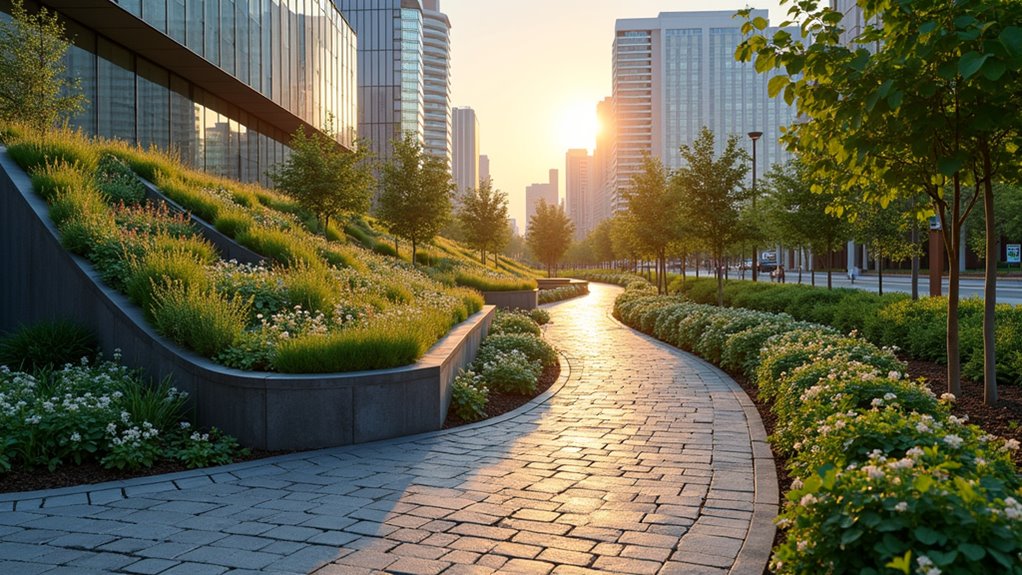
Urban water management has evolved far beyond simple infrastructure maintenance into a sophisticated network of integrated solutions that shape the future of sustainable cities. Modern approaches recognize that managing urban water requires a holistic view that connects water supply, sanitation, stormwater management, and wastewater treatment into one cohesive system. This integrated approach has proven remarkably effective, with cities worldwide demonstrating significant improvements in water efficiency and resilience.
The implementation of smart technologies has revolutionized how cities handle their water resources. IoT sensors and advanced analytics now enable utilities to detect leaks and predict maintenance needs with unprecedented accuracy, reducing water main breaks by up to 75%. Real-time monitoring systems provide invaluable data that helps optimize distribution networks, while AI-powered demand forecasting has improved supply management by 10-20%. These technological solutions don’t just save water – they save money and enhance system reliability. Advanced leak detection systems have become essential tools for municipalities to identify and address water losses promptly. Additionally, rainwater harvesting systems are increasingly being utilized to save resources and cut costs by collecting and repurposing rainwater for non-potable uses.
Nature-based solutions have emerged as powerful tools in urban water management. Green infrastructure elements like permeable pavements reduce stormwater runoff by 70-90%, while green roofs retain 40-60% of annual rainfall. Urban wetlands and bioswales not only manage flood risks but also filter out 80-90% of pollutants from stormwater. Cities like Philadelphia have implemented stormwater treatment fees to manage urban runoff and encourage sustainable infrastructure installations. These solutions work with nature rather than against it, providing multiple benefits beyond water management, including improved air quality and enhanced urban biodiversity. Policies on water that support these initiatives are crucial for ensuring long-term success and adaptation to evolving environmental challenges. Additionally, the importance of water conservation is emphasized globally, highlighting its critical role in addressing climate change and ensuring survival.
Water conservation and efficiency measures have shown remarkable results in reducing consumption. Simple solutions like low-flow fixtures can cut water use by 20-30%, while smart metering helps identify waste and optimize usage patterns. Outdoor water consumption has been dramatically reduced through xeriscaping and drought-tolerant landscaping, saving 50-75% of traditional landscape water requirements. Greywater recycling systems have proven particularly effective, reducing indoor water use by up to 30%. In agriculture, practices like precision irrigation have been adopted to maximize water efficiency, ensuring that crops receive the exact amount of water needed, thus reducing waste and conserving resources.
The success of these strategies relies heavily on effective governance and stakeholder engagement. Public-private partnerships have emerged as essential mechanisms for implementing large-scale water management solutions, while community-based approaches guarantee local buy-in and long-term sustainability. Water-sensitive urban planning has become increasingly important, integrating water management considerations into every aspect of city development.
Climate resilience has become a central focus of urban water management strategies. Cities are implementing detailed drought management plans, diversifying their water sources, and developing flood-resistant infrastructure. Managed aquifer recharge has proven particularly effective for storing excess water during wet periods for use during droughts. These adaptive approaches guarantee cities can maintain water security even as climate patterns become more unpredictable and extreme weather events more frequent.
Frequently Asked Questions
How Much Does Implementing a City-Wide Water Management System Typically Cost?
Implementing an extensive city-wide water management system typically costs between $900 million to $1.2 billion, depending on city size and existing infrastructure.
Major expenses include water main replacements ($48-114.5 million annually), treatment plant upgrades ($30-72.6 million), and smart technology integration ($75,000-195,000 annually).
Additional costs cover operational expenses like energy (30-40% of budget), staff salaries (30-50%), and ongoing maintenance ($10,000-50,000 yearly).
What Qualifications Do Urban Water Management Specialists Need?
Urban water management specialists typically need a bachelor’s degree in engineering, hydrology, or environmental science, with many positions preferring a master’s degree.
They must have 5-7 years of experience managing water resources and strong technical skills in system modeling and SCADA systems.
Essential qualifications include knowledge of water quality regulations, GIS proficiency, and project management capabilities.
Strong analytical and communication skills are vital for stakeholder collaboration.
How Long Does It Take to See Results From Water Conservation Policies?
Water conservation policies show results across different timeframes.
Initial effects emerge within months, with 5-15% drops in water usage and quick wins from leak detection.
More substantial changes occur within 1-2 years, including 10-20% reductions in per capita consumption.
The most significant impacts take 5+ years to materialize, resulting in 30-40% decreased drought vulnerability and sustainable water use in nearly half of participating cities.
Which Cities Have the Most Successful Water Management Programs Worldwide?
Copenhagen, Singapore, Melbourne, and Tokyo stand out as global leaders in urban water management.
Singapore’s “Four National Taps” strategy and 65% reduction in water usage showcases exceptional results.
Melbourne’s implementation of WSUD principles led to an impressive 70% drop in per capita consumption.
Copenhagen’s blue-green infrastructure and Tokyo’s advanced recycling systems demonstrate how major cities can revolutionize water conservation while maintaining urban functionality and sustainability.
Can Water Management Strategies Work in Areas With Limited Technological Infrastructure?
Yes, effective water management is possible with limited technology. Low-tech solutions like rainwater harvesting, manual pumps, and community-based distribution systems have proven successful in many regions.
Natural treatment methods such as constructed wetlands and sand filtration can purify water without complex equipment. The key is adapting strategies to local conditions and resources while empowering communities through water user associations and participatory decision-making processes.


