Industries are dramatically reducing water waste through innovative management strategies and circular economy approaches. Major corporations like Intel and PepsiCo showcase impressive results, with Intel saving 9.3 billion gallons annually through recycling programs. Advanced treatment technologies, including reverse osmosis and bio-organic polymers, enable facilities to reuse process water for cooling and heating. Industrial symbiosis and rainwater capture further maximize efficiency. These solutions create economic opportunities while protecting essential resources – and there’s much more to discover about this transformative approach.
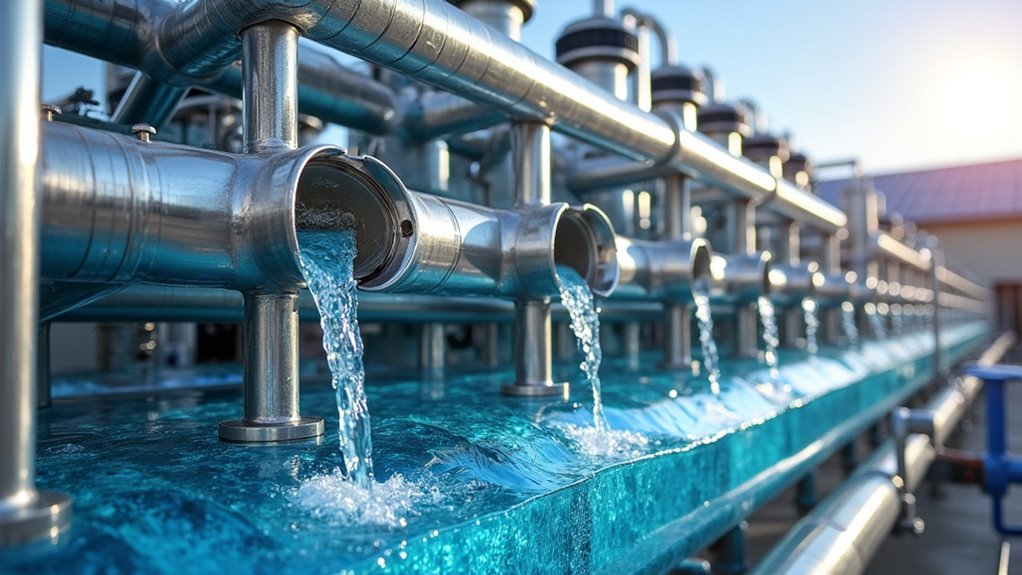
Innovative water management strategies are revolutionizing how industries and municipalities tackle water waste, with recycling and reuse initiatives delivering dramatic reductions in freshwater consumption. Major corporations are leading the way, with Intel saving an astounding 9.3 billion gallons annually through water recycling programs, while PepsiCo’s Frito-Lay facility has slashed water usage by 75% through innovative reuse solutions. Ford has even achieved zero water withdrawals at one of its production plants, demonstrating that ambitious water conservation goals are attainable. Rising temperatures disrupt global water resources, highlighting the urgent need for industries to adapt to changing environmental conditions. The transition from a linear take-make-waste model to circular water management is transforming industrial practices. Successful case studies around the world showcase how community effort combined with policy and innovation can lead to significant water savings.
Advanced treatment technologies are making these achievements possible. Reverse osmosis systems effectively remove complex contaminants, while bio-organic polymers like Zeoturb enhance treatment efficiency. Shifting Bed Bioreactors produce high-quality effluent suitable for reuse, and emerging solutions like Supercritical Water Oxidation are tackling persistent challenges such as PFAS contamination. The integration of renewable energy sources is making desalination processes more sustainable and cost-effective. These technologies, combined with smart monitoring systems, enable real-time water quality tracking and optimize treatment processes through data-driven decision making. National and local policies are also playing a crucial role in advancing water security by encouraging the adoption of these innovative technologies.
The circular economy approach to water management is proving both environmentally and economically beneficial. By keeping water resources in use for longer periods, industries are finding it cheaper than sourcing fresh water supplies. This approach aligns perfectly with sustainability goals while greatly reducing operational costs. The implementation of minimal and zero liquid discharge systems further promotes this circular economy, helping facilities comply with increasingly strict environmental regulations while conserving precious water resources. Implementing agricultural water efficiency practices can also provide a valuable framework for industries to further enhance water conservation efforts.
Industrial symbiosis is emerging as a powerful strategy, where facilities collaborate to maximize water efficiency. Process water is reused for cooling or heating, and rainwater is captured for non-potable purposes. This collaborative approach has led to remarkable results – globally, wastewater reuse has the potential to reach 320 billion cubic meters annually. Even more impressive, treated wastewater can generate five times more energy than required for treatment, potentially providing electricity for 500 million people each year.
The economic benefits of better water management extend beyond immediate cost savings. The shift to circular economy practices could generate 8 million new jobs by 2030, while nature-positive investments may create an impressive 395 million jobs in the same timeframe. These figures highlight how smart water management isn’t just about conservation – it’s about creating economic opportunities while protecting essential resources.
As industries continue to innovate in water management, the potential for reducing waste while improving efficiency becomes increasingly clear. With technologies advancing and successful case studies multiplying, the path forward involves scaling these solutions across sectors and regions. The combination of economic benefits, environmental stewardship, and regulatory compliance makes better water management not just an ethical choice, but a strategic imperative for modern industry.
Frequently Asked Questions
What Certifications Are Required for Industrial Water Management Specialists?
Industrial water management specialists typically require multiple certifications, with requirements varying by location and role.
Core credentials include state water treatment operator licenses, CWS or MWS certification from the Water Quality Association, and relevant engineering degrees.
Many specialists also pursue specialized certifications like the CWEP or PMP.
Environmental engineering certifications (PE, CEE) add valuable expertise.
OSHA safety certifications are often mandatory for plant operations.
How Much Does Implementing a Water Management System Typically Cost?
Implementing industrial water management systems varies greatly in cost, typically ranging from $50,000 for basic setups to $3 million for complex installations.
Engineering fees usually comprise 10-15% of total costs, while equipment ranges from $45,000 to several million dollars. Installation adds another 5-10% for freight and setup.
Ongoing operational expenses include labor (30-50% of costs), maintenance ($10,000-$50,000 annually), and utilities ($20,000-$100,000 yearly).
Insurance and software fees contribute additional annual expenses.
Can Smaller Industries Benefit From Advanced Water Recycling Technologies?
Yes, smaller industries can definitely benefit from advanced water recycling technologies.
Modern membrane filtration and modular systems are increasingly affordable and scalable to suit smaller operations. With ROI typically achieved in 2-5 years through water bill savings, these systems make economic sense.
Government subsidies and financing options help offset initial costs, while smart monitoring reduces maintenance expenses.
Small manufacturers can effectively recycle cooling water and implement closed-loop systems for process waters.
What Are the Legal Consequences of Non-Compliance With Water Management Regulations?
Non-compliance with water management regulations carries severe consequences.
Companies face substantial daily fines ranging from $25,000 to $32,500 per violation, with penalties escalating for repeat offenders.
Legal actions can include civil lawsuits, criminal charges with potential imprisonment, and cease-and-desist orders.
Organizations may also face permit revocations, mandatory facility upgrades, and damaged reputations.
These penalties serve as powerful incentives for businesses to maintain proper water management practices.
How Long Does It Take to See Return on Investment From Water-Saving Initiatives?
Return on investment for water-saving initiatives varies by industry and project scope.
Most low-hanging fruit like fixing leaks and installing efficient fixtures pays back within 6-12 months.
Larger infrastructure projects typically show returns in 2-5 years.
Advanced technologies like water recycling systems may take 3-7 years but offer substantial long-term savings.
Smart metering and monitoring solutions generally break even within 18 months while reducing consumption by 15-30%.