
Leading global environmental education models demonstrate measurable success through hands-on, student-led initiatives. The Eco-Schools Program, operating in 68 countries, awards Green Flags to schools achieving sustainability goals. UNESCO’s Education for Sustainable Development integrates ecological principles across curricula, while programs like Jane Goodall’s Roots & Shoots empower youth to create local solutions. These proven frameworks combine practical action with rigorous learning, fostering a generation equipped to tackle environmental challenges. The key elements behind their effectiveness reveal surprising insights.

As environmental challenges continue to mount globally, educational models focused on sustainability and ecological awareness have emerged as essential tools for empowering future generations. Several successful programs have demonstrated the effectiveness of hands-on, experiential learning approaches in cultivating environmental stewardship among young people.
The Eco-Schools Program stands out as the world’s largest sustainable schools initiative, operating in 68 countries through an extensive seven-step framework. This student-led program empowers young learners to tackle environmental challenges within their school communities, addressing everything from waste reduction to biodiversity conservation. Schools that successfully implement these initiatives earn the prestigious Green Flag award, creating a sense of achievement and momentum for continued environmental action. The program’s success relies heavily on community partnerships to enhance and support sustainability initiatives. Environmental NGOs play a crucial role in providing resources and programs that support the implementation of such initiatives in schools.
Eco-Schools transforms education through student-led environmental initiatives, rewarding successful programs with the coveted Green Flag certification.
UNESCO’s Education for Sustainable Development program takes a broader approach, integrating sustainability principles across educational systems. By emphasizing experiential learning and action-oriented pedagogies, the program helps students develop critical thinking skills while connecting classroom learning to real-world environmental challenges. The initiative directly supports SDG Target 4.7 by ensuring learners acquire knowledge and skills needed for sustainable development. Environmental education is crucial for developing informed citizens who can effectively tackle climate and ecological challenges.
Furthermore, integrating sustainability into school curricula from kindergarten to high school has become a transformative approach to fostering lifelong environmental awareness. This integration ensures that sustainability principles become a natural part of students’ everyday learning experiences, reinforcing the importance of ecological responsibility from a young age. Effective measurement tools help evaluate the impact of education programs on students’ environmental knowledge and behavior.
The Global Environmental Education Partnership (GEEP) complements these efforts by fostering collaboration among environmental education leaders worldwide, sharing best practices and organizing regional forums to develop effective action plans.
Project Learning Tree has emerged as another powerful model, reaching over 138,000 educators annually with its innovative curriculum focusing on forests and environmental topics. The program’s success lies in its ability to use trees and forests as gateways to understanding broader environmental concepts, while emphasizing STEM education and community engagement.
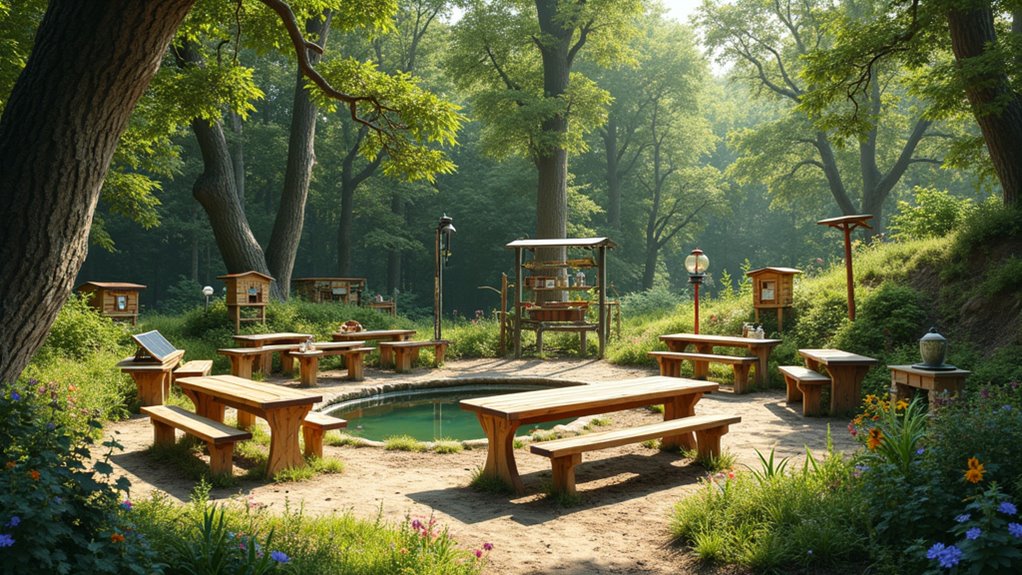
Similarly, Earth Education Programs offer immersive, sensory-rich outdoor experiences that help students develop deeper connections with nature through unique approaches like “magic spots” for solitary reflection and creative storytelling.
Jane Goodall’s Roots & Shoots program has proven particularly effective in mobilizing youth for environmental action. With more than 150,000 members across 60 countries, the program empowers young people to design and implement their own solutions to environmental challenges.
The Green Schools Alliance takes a different but complementary approach, creating a network of schools committed to sustainability through measurable climate action pledges and professional development resources.
These successful models share common elements: they emphasize hands-on learning, empower youth leadership, and connect local actions to global impacts. Their effectiveness stems from combining rigorous environmental education with practical action opportunities, allowing students to see the tangible results of their efforts.
As these programs continue to evolve and expand, they’re creating a new generation of environmentally conscious citizens equipped with the knowledge and skills to address our planet’s most pressing challenges.
Frequently Asked Questions
How Much Funding Is Typically Required to Implement Environmental Education Programs Globally?
Effective global environmental education programs typically require diverse funding levels based on scope and location.
Small-scale initiatives need $50,000-$100,000 annually, while extensive national programs demand millions.
The EPA provides $2-3.7 million yearly for grants, while UNESCO offers up to $22,000 per project.
Large-scale international programs often require substantial funding through public-private partnerships, with total global education spending reaching $5.8 trillion in 2022.
What Qualifications Do Teachers Need to Teach Environmental Education Effectively?
Effective environmental educators need a strong academic foundation, typically including a bachelor’s degree in environmental science, ecology, or related fields.
Many positions require teaching certification, while advanced roles often prefer master’s degrees.
Essential qualifications include mastery of ecological principles, teaching methods, and field study techniques.
Professional competencies like communication skills, project management, and grant writing abilities are vital.
Ongoing professional development helps educators stay current with evolving environmental issues and teaching methods.
How Can Schools Measure the Long-Term Impact of Environmental Education?
Schools can measure environmental education’s long-term impact through multiple assessment strategies.
Longitudinal studies track students’ behaviors and attitudes over several years through surveys and interviews. Pre and post-program evaluations gauge knowledge retention.
Schools also monitor tangible outcomes like increased recycling rates, community involvement, and career choices in environmental fields.
Digital storytelling and photovoice projects capture qualitative impacts, while ecological footprint calculations provide quantitative measurements of lifestyle changes.
Which Countries Have Shown the Most Successful Adoption of Environmental Curricula?
Nordic countries consistently lead global environmental education efforts, with Denmark, Finland, Sweden, and Norway setting exemplary standards. Their thorough approach integrates sustainability across subjects from early childhood.
Germany has achieved remarkable success through innovative programs like “One Student, One Tree,” while Argentina’s recent national law mandates environmental education at all levels.
Cambodia stands out among developing nations for its practical climate-smart curriculum and pilot school projects. These nations demonstrate how systematic implementation yields measurable results.
What Role Do Local Communities Play in Supporting Environmental Education Initiatives?
Local communities serve as essential pillars in environmental education by providing real-world context and hands-on learning opportunities.
They contribute through sharing traditional ecological knowledge, facilitating student engagement in citizen science projects, and offering mentorship from local environmental experts.
Communities also create pathways for practical application of environmental concepts through local initiatives, while building networks that connect schools with resources and expertise for enhanced learning experiences.