
Current environmental education policy blends global commitments with local implementation challenges. While UNESCO targets environmental education as core curriculum by 2025, with 80+ ministers backing sustainability learning reforms, more than half of countries still lack climate change in their curricula. Modern approaches emphasize hands-on problem-solving and systems thinking over traditional textbook methods. Teacher training programs and funding remain critical hurdles, though innovative solutions continue emerging. The path forward reveals promising developments in this evolving landscape.

Environmental education stands at a pivotal turning point as global leaders and policymakers push for sweeping reforms to integrate sustainability into core curricula worldwide. UNESCO‘s call for environmental education as a core curriculum component by 2025 has gained significant momentum, with over 80 ministers committing to transform learning for the planet. The Berlin Declaration now provides an extensive framework for implementing these ambitious changes across education systems globally.
The current policy landscape reflects a growing recognition that environmental education must go beyond mere information transfer. Modern approaches emphasize cognitive skills, social-emotional learning, and real-world problem-solving abilities. Schools are being urged to adopt systems thinking and interdisciplinary approaches, with climate change and biodiversity serving as central themes that connect various subjects. The analysis of educational plans reveals that more than half of countries make no reference to climate change in their curricula. Countries with mandatory climate change education, like Italy, show greater success in student preparedness, highlighting the importance of integrating environmental education into core learning. Environmental education is being integrated into school curricula for all ages, ensuring that sustainability becomes part of everyday learning from kindergarten to high school.
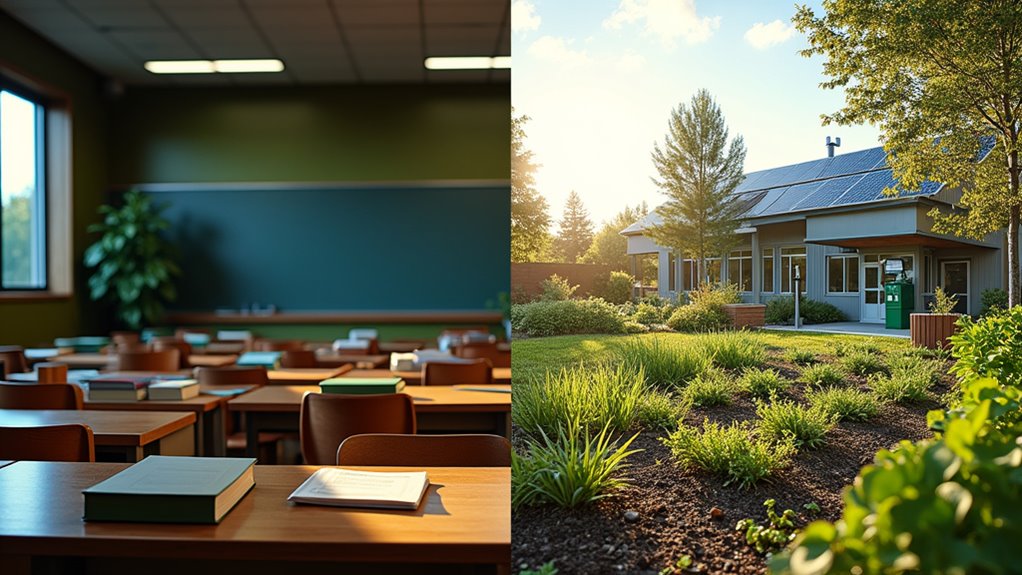
However, the journey from policy to practice faces several obstacles, including insufficient funding, limited teacher involvement in curriculum design, and an over-reliance on traditional textbook-based instruction. Measuring education’s impact on environmental awareness involves various tools and strategies that assess changes in environmental knowledge and behavior. Environmental education plays a crucial role in shaping informed citizens equipped to tackle climate and ecological challenges.
Despite ambitious policy goals, real-world implementation struggles with budget constraints, teacher exclusion, and outdated teaching methods.
Teacher training has emerged as a vital factor in successful implementation. Professional development programs are being developed to help educators integrate environmental principles across subjects and facilitate outdoor and experiential learning opportunities. These initiatives aim to equip teachers with the tools and confidence needed to move beyond conventional classroom instruction and embrace more engaging, hands-on approaches to environmental education.
Assessment methods are evolving to match these new educational goals. Rather than simply testing students’ ability to memorize environmental facts, evaluation systems are shifting toward measuring concept understanding, critical thinking, and problem-solving capabilities. Long-term follow-up studies are being implemented to track environmental literacy and assess the impact of these educational programs on behavior change and lifestyle choices.
Looking ahead, environmental education policy is increasingly focused on creating pathways for lifelong learning and civic engagement. The integration of environmental justice perspectives and the development of green career pathways demonstrate a broader understanding of sustainability education’s role in preparing students for future challenges. The U.S. Environmental Protection Agency’s 2025 environmental awards program exemplifies efforts to recognize and encourage innovative approaches in this field.
Despite these positive developments, significant gaps remain between policy directives and classroom realities. Success will require sustained commitment to providing adequate resources, supporting teachers, and maintaining flexibility to adapt to local contexts.
The transformation of environmental education from a peripheral subject to a core component of modern education represents both a challenge and an opportunity to equip the next generation with the knowledge and skills needed to address pressing environmental challenges.
Frequently Asked Questions
How Do Schools Measure the Success of Environmental Education Programs?
Schools employ multiple methods to evaluate environmental education success. Pre- and post-program testing measures knowledge gains, while standardized assessments track environmental literacy.
Behavioral changes are monitored through metrics like increased recycling participation and reduced energy use. Academic performance indicators show improved critical thinking and problem-solving skills.
Qualitative methods, including interviews and teacher observations, provide deeper insights into student engagement and program effectiveness. Long-term follow-up studies validate lasting behavioral impacts.
What Funding Options Exist for Implementing Environmental Education in Private Schools?
Private schools can access diverse funding streams for environmental education programs. Federal grants from agencies like EPA and NOAA provide substantial support, while private foundations such as Captain Planet and Toyota offer targeted funding opportunities.
Schools can also leverage their operating budgets, implement program fees, and build partnerships with local businesses. Additionally, state-level grants and community foundation support remain viable options for sustaining environmental initiatives.
Can Parents Opt Their Children Out of Environmental Education Curricula?
Parents’ ability to opt their children out of environmental education varies by location and school policy.
While some states and districts allow opt-outs based on religious or personal beliefs, others mandate participation.
When permitted, opt-out requests are typically evaluated individually, with schools often providing alternative assignments.
The process requires balancing parental rights with educational standards, though courts have generally supported schools’ authority to maintain curriculum requirements.
How Often Should Environmental Education Policies Be Updated and Reviewed?
Environmental education policies should undergo thorough reviews every 3-5 years, with annual assessments for emerging issues like climate change.
Rapid scientific developments, technological advances, and shifting environmental challenges demand regular updates. While formal reviews follow this timeline, policies should remain flexible enough to incorporate urgent updates when necessary.
Task forces of educators, scientists, and policy experts should continuously monitor developments to guarantee curricula stays current and effective.
What Qualifications Do Teachers Need to Teach Environmental Education Courses?
Teachers need specific qualifications to teach environmental education courses effectively. A bachelor’s degree in environmental science, education, or related fields is typically required, while a master’s degree is often preferred for advanced positions.
State teaching certification may be necessary, and many pursue specialized environmental educator certifications through programs like NAAEE.
Essential skills include ecological systems knowledge, curriculum development abilities, and strong communication skills for explaining complex environmental concepts to diverse audiences.