Gamification revolutionizes environmental education by transforming complex concepts into interactive experiences that boost retention by up to 19%. Through dopamine-triggering game elements like points, badges, and competitive challenges, students develop emotional connections to sustainability topics while mastering real-world problem-solving skills. Research shows gamified approaches yield considerably higher test scores compared to traditional methods, with an effect size of 0.822. The intersection of play and purpose creates powerful pathways for lasting eco-awareness and action.
Nearly every environmental educator faces the challenge of making complex sustainability concepts engaging and memorable for students. Recent research reveals that gamification may be the key to revealing deeper, more lasting environmental education outcomes. Studies show that students exposed to gamified learning environments score an impressive 19 points higher on ESG exams compared to traditional teaching methods.
The science behind this success lies in the brain’s response to game-like elements. When students engage with environmental concepts through games, their brains release dopamine, creating a natural reward system that enhances motivation and learning retention. This neurological response doesn’t just make learning more enjoyable – it fundamentally improves how information is encoded and retrieved in the brain. The integration of storytelling elements helps students develop emotional connections with environmental topics. Environmental education plays a crucial role in shaping informed citizens who are equipped to tackle climate and ecological challenges. While both traditional and gamified methods showed learning benefits, the digital book approach demonstrated slightly better outcomes in knowledge retention. Educators looking to build eco-friendly curriculum can empower themselves by incorporating gamification to promote active learning. Environmental NGOs play a vital role in providing resources and programs that further support educators in this endeavor.
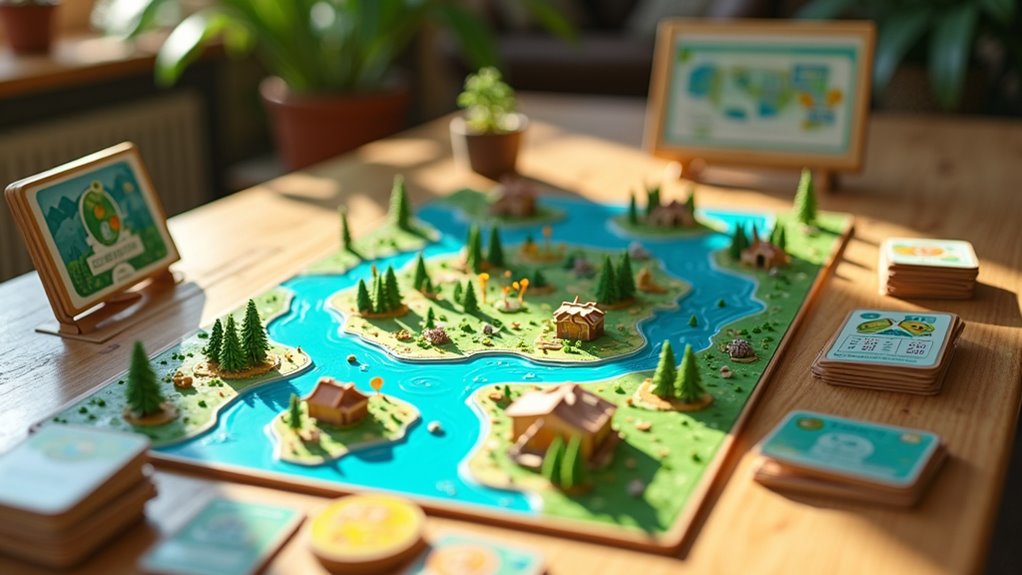
Real-world applications of environmental gamification are already showing remarkable results. Games like the “Oil Springs” expansion for Catan and the climate change-focused “Keep Cool” board game have demonstrated measurable improvements in participants’ understanding of environmental challenges. Mobile apps that turn energy conservation into a competitive challenge have successfully motivated users to reduce their consumption, while augmented reality games help visualize abstract concepts like air quality in tangible ways. Effective measurement tools are crucial for evaluating the impact of education programs on environmental knowledge and behavior.
The implementation of game elements such as point systems, badges, and leaderboards creates a structured framework for environmental learning. These mechanics aren’t just superficial additions – they’re carefully designed tools that facilitate problem-solving and critical thinking. When students compete to earn points for completing eco-focused tasks or reveal new features by mastering sustainability concepts, they’re simultaneously developing deeper psychological ownership of environmental issues.
Research demonstrates the effectiveness of this approach with a large effect size of 0.822 on learning outcomes. This significant impact is particularly remarkable in teaching complex environmental topics that might otherwise seem abstract or disconnected from daily life. Through gamified scenarios, students can experience the consequences of environmental decisions in a safe, engaging environment that promotes active learning and collaboration.
However, successful implementation requires careful consideration. Educators must balance the entertainment aspect with meaningful educational objectives to avoid shallow engagement focused solely on point accumulation. A user-centered design approach is essential, as is the development of strategies that maintain long-term engagement with the material.
The future of environmental education increasingly points toward gamified approaches that make sustainability concepts stick. By combining the natural appeal of games with scientifically-backed learning principles, educators can create powerful learning experiences that not only teach environmental concepts but inspire lasting behavioral change. As our understanding of both environmental challenges and educational psychology continues to evolve, gamification stands out as a promising tool for creating the next generation of environmentally conscious citizens.
Frequently Asked Questions
How Much Does It Cost to Implement Environmental Gamification in Schools?
Implementing environmental gamification in schools requires significant upfront investment.
Initial costs typically range from $265,000-$835,500 for a mid-sized school, including hardware ($200-500/student), software licensing ($5-20/student annually), teacher training ($1,000-5,000/educator), and IT infrastructure ($50,000-200,000).
However, schools can offset expenses through reduced textbook costs, decreased paper usage, and improved energy efficiency.
Annual maintenance costs average 15-25% of initial investment.
Can Gamification Techniques Work Effectively for Elderly Environmental Learners?
Research shows gamification techniques are highly effective for elderly environmental learners.
Studies demonstrate that point systems, badges, and leaderboards increase engagement while improving cognitive function in older adults. When properly designed with clear instructions and adapted interfaces, these tools boost environmental awareness and knowledge retention.
Social elements combat isolation, while immediate feedback and progress tracking help seniors stay motivated.
Virtual assistants and personalized challenges make eco-learning both accessible and enjoyable for elderly participants.
What Technology Requirements Are Needed for Environmental Learning Games?
Environmental learning games require robust technology infrastructure to deliver engaging experiences.
Basic requirements include computers with modern processors (i3/Ryzen 3 or better), 8GB+ RAM, and dedicated graphics cards.
Additional needs encompass stable internet connectivity (25Mbps+), updated operating systems, and proper display resolution (1080p minimum).
For enhanced immersion, VR headsets, motion controllers, and quality audio systems can be beneficial, though not always essential for basic environmental education games.
How Long Does It Take to See Results From Gamified Environmental Education?
Results from gamified environmental education emerge in distinct phases.
Immediate effects show within days, with increased engagement and up to 41% higher recycling rates.
Short-term impacts (1-3 months) reveal improved retention and problem-solving skills.
Medium-term results (3-6 months) demonstrate sustained behavioral changes and environmental stewardship.
Long-term effects (6+ months) manifest as lifestyle transformations, reduced carbon footprints, and enhanced community involvement in conservation efforts.
Are There Cultural Barriers to Using Gamification in Environmental Education?
Yes, significant cultural barriers exist in gamified environmental education. Language limitations and digital access gaps can exclude certain populations, while cultural differences affect how gamification elements are perceived and valued.
Research shows US and Brazilian audiences respond differently to various game mechanics, with Brazilians favoring sensation-based elements.
Additionally, the risk of cultural insensitivity and appropriation requires careful consideration in design. User-centered approaches and local stakeholder collaboration help overcome these challenges.