Modern outdoor air monitoring devices combine sophisticated sensors to track key pollutants like particulate matter, VOCs, and harmful gases. Popular tools include the PurpleAir PA-II ($249), which measures PM2.5/PM10, and the AirVisual Pro with NDIR sensors for CO2 detection. These devices use Wi-Fi and Bluetooth to transmit real-time data to smartphones and cloud platforms, enabling instant air quality alerts and trend analysis. Understanding the technology behind these tools reveals their vital role in protecting public health.
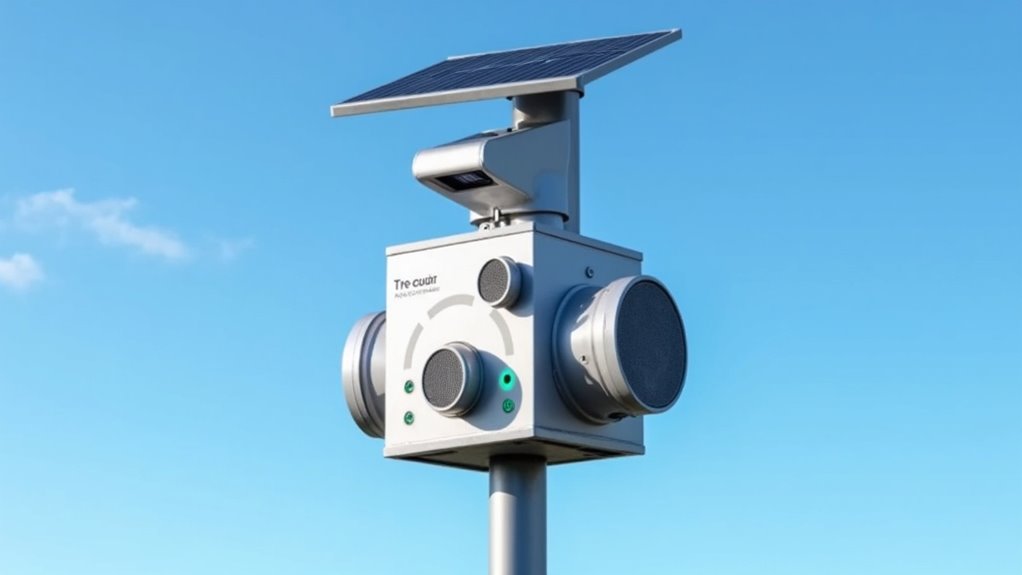
As air quality concerns continue to shape public health discussions worldwide, outdoor air monitoring tools have emerged as vital instruments for tracking and understanding atmospheric conditions. The market now offers several sophisticated devices that enable both individuals and communities to measure various air quality parameters with impressive accuracy. Leading the pack is the PurpleAir PA-II, which at $249 provides reliable measurements of particulate matter, specifically PM2.5 and PM10, making it a popular choice for community-based monitoring networks. Due to high user demand, there are often extended waiting periods for PurpleAir device orders. Regular monitoring helps control pollution effects and protect public health through timely interventions.
These modern monitoring tools employ an array of advanced sensing technologies to detect different types of air pollutants. Laser particle counters form the backbone of particulate matter detection, while electrochemical sensors track gases such as carbon monoxide and nitrogen dioxide. For measuring carbon dioxide levels, devices like the AirVisual Pro utilize non-dispersive infrared (NDIR) sensors, complemented by metal oxide semiconductor sensors that detect volatile organic compounds (VOCs). It’s crucial to understand that breathing in toxins from polluted air can adversely affect not just the lungs but also the heart and brain. As air quality solutions become more essential, distinguishing between effective policies and empty promises is critical for meaningful progress. Addressing air pollution can also mitigate climate change, as both issues are interconnected and require synchronized efforts for effective resolution.
The effectiveness of these monitoring devices relies heavily on their ability to collect and transmit data. Most contemporary units feature Wi-Fi connectivity for real-time data transmission, while others incorporate Bluetooth Low Energy for seamless smartphone integration. The Airthings View Plus, for instance, offers thorough monitoring capabilities, detecting everything from radon to particulate matter, while maintaining constant connectivity to cloud-based storage platforms. Water recycling programs have been effectively adopted to manage unpredictable water availability in various regions.
Accuracy remains a critical factor in air quality monitoring, and manufacturers address this through regular calibration requirements and comparison with reference-grade equipment. The South Coast AQMD and AirLab conduct rigorous accuracy testing to guarantee reliable measurements. Environmental conditions can affect sensor accuracy, which is why many devices, like the Davis Instruments AirLink, incorporate multiple sensors to improve overall reliability.
Power options vary across different models, accommodating diverse installation needs. While some units require AC power for continuous operation, others offer battery-powered portability or solar-powered capabilities for off-grid installations. These devices typically come housed in weather-resistant enclosures, guaranteeing durability in outdoor conditions, with various mounting options for walls, poles, or tripods.
The collected data is presented through sophisticated visualization tools that calculate real-time air quality index (AQI) values and display them in color-coded formats for easy interpretation. Many devices offer historical data trending, customizable alerts, and integration capabilities with smart home systems. This thorough approach to data presentation enables users to make informed decisions about their outdoor activities and take appropriate action when air quality deteriorates.
These monitoring tools serve multiple purposes, from supporting community-based air quality networks to facilitating environmental impact studies for urban planning. Their applications extend to educational institutions, research projects, and even wildfire smoke detection, making them invaluable tools in our collective effort to understand and improve air quality.
Frequently Asked Questions
How Often Should Outdoor Air Quality Monitors Be Calibrated?
Outdoor air quality monitors require regular calibration based on their specific sensor types and usage conditions.
Particle monitors typically need calibration every 12-24 months, while gas sensors should be calibrated every 6-12 months.
Some advanced monitors feature automatic baseline calibration every 7-14 days.
Environmental factors like temperature, humidity, and pollutant exposure can affect calibration intervals.
The EPA recommends annual calibration for regulatory monitoring stations to maintain data accuracy and reliability.
Can Weather Conditions Affect the Accuracy of Air Monitoring Results?
Weather conditions greatly affect air monitoring accuracy.
Temperature and humidity impact sensor performance, while wind patterns influence how pollutants disperse and concentrate in the atmosphere.
Precipitation can wash pollutants from the air, altering readings.
Thermal inversions trap pollutants near ground level, causing elevated measurements.
These meteorological factors must be carefully considered when interpreting air quality data to guarantee reliable results and actionable insights.
What’s the Average Lifespan of a Portable Air Quality Monitor?
The average lifespan of portable air quality monitors typically ranges from 2-5 years, though high-quality models can last up to 10 years with proper care.
Their longevity depends heavily on usage patterns, environmental conditions, and maintenance. Most manufacturers recommend sensor replacement after 2 years to maintain accuracy.
Regular calibration every 6-12 months and proper storage in sealed containers when not in use can greatly extend a monitor’s operational life.
Are Smartphone-Connected Air Quality Monitors as Reliable as Professional Equipment?
While smartphone-connected air quality monitors show strong correlations with professional equipment, they aren’t quite as reliable.
Recent studies indicate consumer-grade monitors can achieve up to 0.99 R2 correlation in controlled settings, but real-world performance varies. Factors like sensor drift, cross-sensitivity to gases, and environmental conditions affect accuracy.
However, these monitors are rapidly improving with better sensors and machine learning, making them increasingly valuable for personal air quality monitoring.
How Do Indoor Air Pollutants Differ From Outdoor Air Pollutants?
Indoor and outdoor air pollutants differ primarily in their sources and concentration patterns.
Indoor pollutants typically come from household products, building materials, and combustion sources, often accumulating in confined spaces due to poor ventilation.
Outdoor pollutants mainly originate from industrial emissions, vehicle exhaust, and natural sources, dispersing more widely through atmospheric processes.
While outdoor pollution affects broader areas, indoor air quality can be 2-5 times worse according to EPA studies.