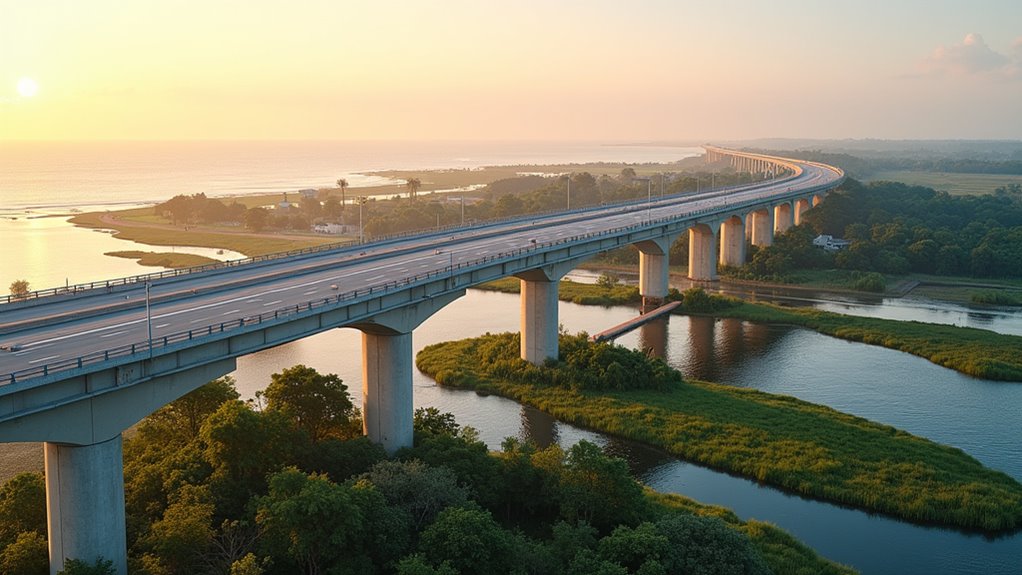

Building disaster-resilient infrastructure combines strategic engineering, smart technology, and sustainable design. Key elements include earthquake-resistant construction, elevated foundations for flood protection, and hurricane-proof materials that withstand extreme weather. Smart sensors and AI enable real-time monitoring, while digital twins test disaster scenarios virtually. For just 3% more in construction costs, these features save $6 in recovery expenses for every dollar invested. The principles are straightforward – the solutions await exploration.
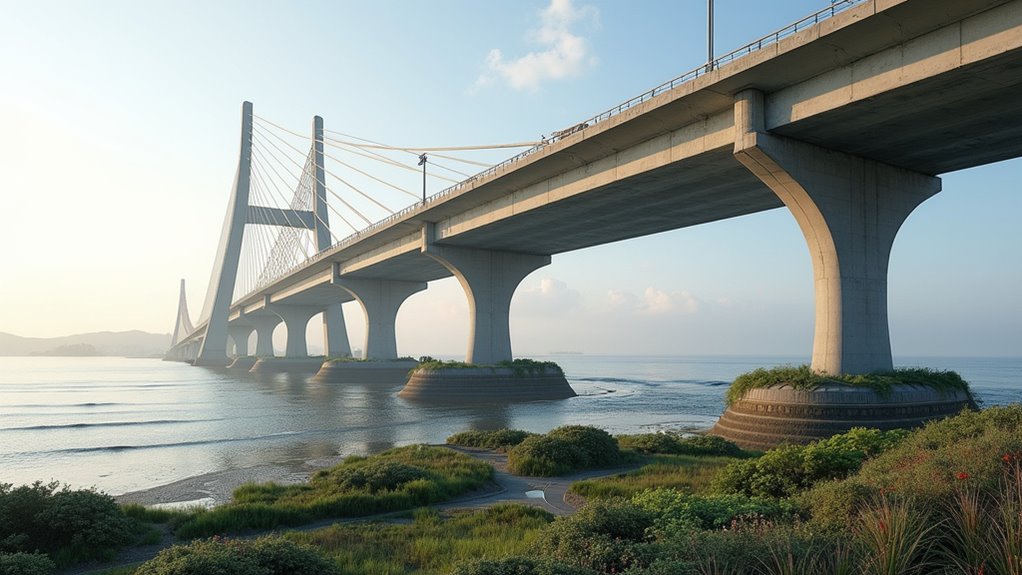
Infrastructure’s resilience against natural disasters has emerged as a critical cornerstone of modern civilization‘s survival and progress. As climate-related disasters intensify and population centers grow, the need for robust infrastructure systems that can withstand nature’s fury has become more urgent than ever. With developing countries facing annual losses between $391-647 billion from infrastructure failures during disasters, the imperative to build stronger, smarter, and more adaptable systems cannot be ignored. Innovative strategies such as early warning systems play a crucial role in effective flood risk management, enhancing infrastructure resilience.
The good news is that creating disaster-resilient infrastructure only adds approximately 3% to total construction costs while delivering a remarkable return on investment – every dollar spent yields $4 in benefits. Modern studies have shown that each dollar invested in disaster preparedness saves approximately $6 in recovery costs. This investment manifests in various forms, from earthquake-resistant buildings with specialized seismic features to flood-resilient structures boasting elevated foundations and sophisticated drainage systems. Modern disaster-resistant infrastructure also incorporates hurricane-proof construction techniques and materials designed to withstand extreme temperatures and wildfires. Smart sensors enable continuous monitoring of structural health and early detection of potential failures. Essential tips for hurricane and storm surge preparedness can further support communities in minimizing damage and ensuring swift recovery. In addition to these measures, land management practices can significantly reduce the risk of wildfires by implementing controlled burns and maintaining vegetation around critical infrastructure.
Building resilient infrastructure costs just pennies on the dollar while providing four-fold returns through enhanced protection against earthquakes, floods, and storms.
Technology plays a pivotal role in this evolution towards resilient infrastructure. Digital twins enable virtual testing of different disaster scenarios, while AI and machine learning help assess and manage risks more effectively. Smart sensors provide real-time monitoring and early warning capabilities, and advanced materials offer unprecedented durability. Building Information Modeling (BIM) and Geographic Information Systems (GIS) have revolutionized how we plan and design these critical systems, and green infrastructure solutions are transforming power grids by integrating renewable energy sources to reduce carbon footprints.
The principles underlying disaster-resilient infrastructure are straightforward yet powerful. Redundancy guarantees multiple backup systems are in place when primary systems fail. Robustness provides the inherent strength to withstand disaster forces, while flexibility allows adaptation to changing conditions. Perhaps most importantly, modern resilient infrastructure integrates with natural systems, leveraging green infrastructure solutions that work in harmony with the environment.
However, implementing these solutions isn’t without its challenges. Many regions face significant funding gaps and lack technical expertise. Cross-sector collaboration often proves difficult, and balancing immediate needs with long-term resilience goals can be tricky. Additionally, addressing vulnerable infrastructure in already developed areas presents unique challenges that require careful planning and substantial resources.
Global standards like the Principles for Resilient Infrastructure are helping guide this transformation, while risk-informed decision-making ensures infrastructure investments deliver maximum impact. The benefits extend far beyond immediate disaster protection – resilient infrastructure helps maintain essential services, protects critical supply chains, and enhances economic stability by boosting investor confidence.
As our world faces increasingly unpredictable natural disasters, the investment in resilient infrastructure represents not just a safety measure but a fundamental requirement for sustainable development. The technology exists, the principles are proven, and the economic benefits are clear. The challenge now lies in scaling these solutions and guaranteeing their implementation across both developing and developed nations, creating a more resilient future for all.
Frequently Asked Questions
How Much Does It Cost to Retrofit Existing Infrastructure for Disaster Resilience?
Retrofitting costs vary greatly based on protection level and hazard type. Basic effective modifications typically range from $2,000-$15,000, while extensive protection can reach $100,000 per structure.
The investment yields considerable returns: every $1 spent saves $6 in recovery costs. Specific hazard retrofits show impressive savings ratios – earthquakes (13:1), floods (6:1), and wildfires (2:1).
Various financing options exist, including grants, tax credits, and insurance incentives for property owners.
What Role Does Artificial Intelligence Play in Designing Disaster-Resistant Infrastructure?
Artificial intelligence plays a transformative role in designing disaster-resistant infrastructure through advanced predictive modeling and real-time monitoring.
AI systems analyze vast datasets of climate patterns, geological info, and historical disasters to optimize building designs and materials. The technology enables engineers to simulate extreme weather scenarios, identify structural vulnerabilities, and develop more resilient solutions.
AI-powered tools like IBM’s PAIRS Geoscope and xView2 accelerate damage assessment and guide strategic infrastructure planning.
How Long Does It Take to Complete Disaster-Resilient Infrastructure Projects?
Disaster-resilient infrastructure projects typically span 3-5 years from start to finish, though timelines vary considerably based on scope and complexity.
Large-scale initiatives require 6-18 months for planning and design, while construction periods fluctuate widely.
Smaller community projects may complete within 6-12 months.
Modern accelerators like digital twin technology and modular construction can reduce timelines by 20-50%.
Environmental studies and permitting processes often add 9-18 months to overall duration.
Which Countries Have the Most Advanced Disaster-Resilient Infrastructure Systems?
Based on thorough infrastructure resilience assessments, Japan and the Netherlands lead globally in disaster-resistant systems.
Japan excels in earthquake and tsunami protection, while the Netherlands masters flood defense technology.
Singapore follows closely with innovative coastal protection and urban planning.
The United States maintains strong regional systems, particularly in areas like Florida’s hurricane resistance and California’s wildfire management infrastructure, tho implementation varies by state.
Can Disaster-Resilient Infrastructure Completely Prevent Damage From Extreme Natural Events?
No infrastructure system can completely prevent damage from extreme natural events.
While resilient design considerably reduces impacts, there are inherent limitations due to the unpredictable and increasingly intense nature of disasters.
Even the most robust systems face residual risks, especially as climate change pushes hazards beyond historical norms.
However, resilient infrastructure has proven highly effective, reducing economic losses and saving lives while adding only 3% to construction costs.


