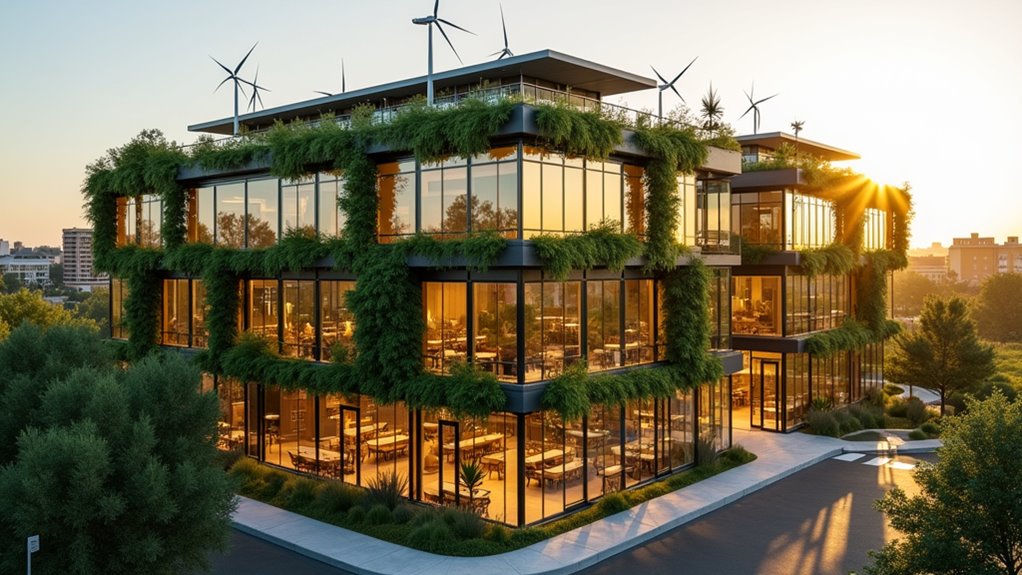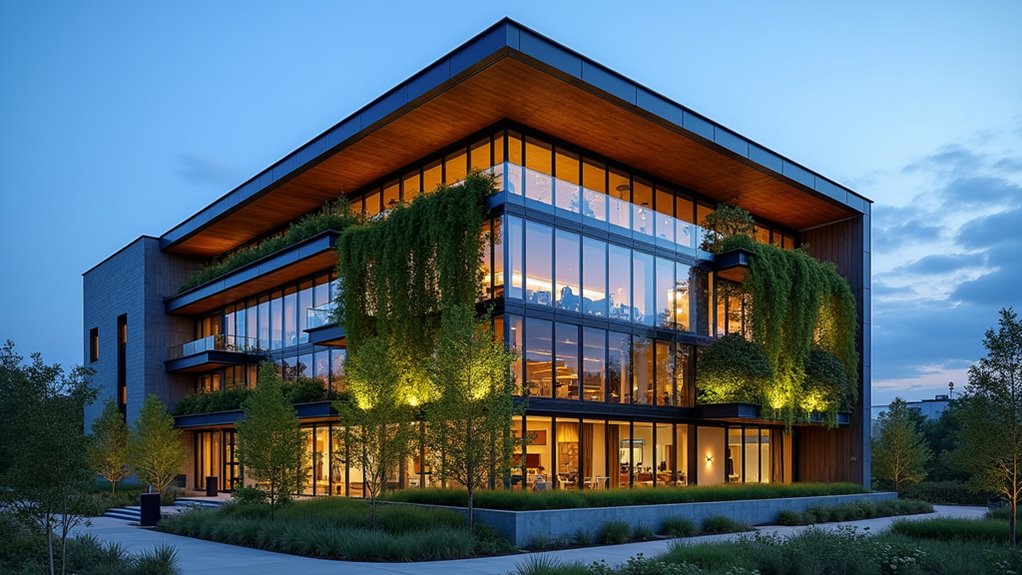

Leading green buildings worldwide demonstrate what’s achievable in sustainable architecture. The Edge in Amsterdam uses 28,000 sensors to achieve a 98.4% sustainability score, while Seattle’s Bullitt Center operates completely self-sufficiently. Milan’s Bosco Verticale absorbs 30 tons of CO2 annually through its 900 trees, and Sydney’s One Central Park features vertical gardens that reduce emissions by 190,000 tons over 25 years. The Shanghai Tower’s double-skin facade cuts energy use by 21%. These innovative structures reveal the transformative potential of green design principles.
As innovative architecture continues reshaping skylines worldwide, a new generation of green buildings stands as living proof that sustainability and stunning design can coexist. Leading this revolution is Amsterdam’s The Edge, which achieved an unprecedented 98.4% BREEAM sustainability score. With 28,000 sensors monitoring everything from occupancy to temperature, and a smartphone app giving workers control over their environment, it represents the pinnacle of smart building technology. The economic benefits of renewable energy are increasingly evident as green buildings reduce operational costs and enhance property value.
In Seattle, the Bullitt Center demonstrates complete self-sufficiency through rooftop solar panels and an ingenious net-zero water system. The building’s composting toilets and rainwater collection showcase how modern design can dramatically reduce resource consumption while maintaining full functionality. The Enterprise Centre exemplifies this commitment to sustainability, achieving both Passivhaus and BREEAM Outstanding certifications through innovative design approaches. Net zero energy buildings are designed to generate as much energy as they consume, making them an essential part of sustainable urban development.
Seattle’s Bullitt Center proves green buildings can thrive independently, using smart design to slash resource use while delivering modern comfort.
Similarly, Sydney’s One Central Park turns heads with its stunning vertical gardens covering half the building’s facade, while its trigeneration plant slashes carbon emissions by 190,000 tons over 25 years. These sustainable innovations contribute to significant reductions in energy and water consumption compared to conventional buildings.
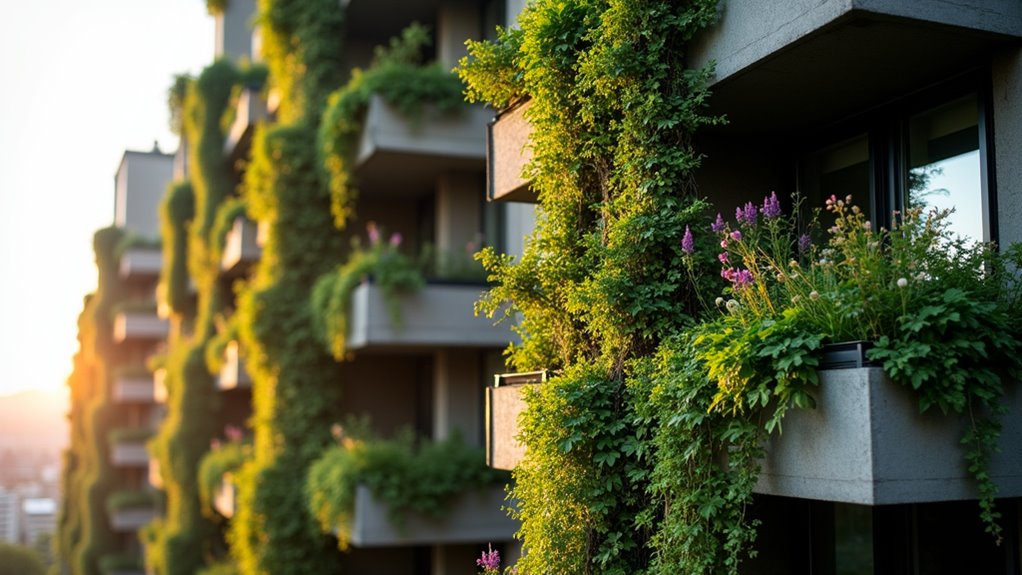
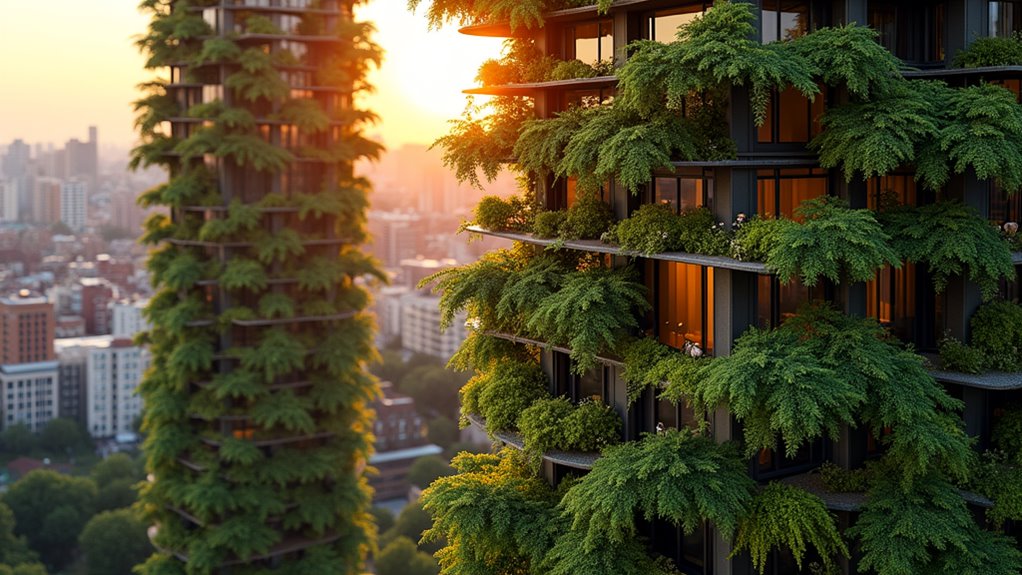
Milan’s Bosco Verticale takes urban greening to new heights – literally. These residential towers host an incredible 900 trees and 20,000 plants, absorbing 30 tons of CO2 annually while creating a thriving ecosystem for urban biodiversity. The vegetation doesn’t just look pretty; it reduces energy consumption for heating and cooling by 7-8% and filters harmful dust particles from the air. Green roofs and walls not only enhance the aesthetic appeal of buildings like Bosco Verticale but also contribute to purifying urban air and boosting biodiversity.
The Shanghai Tower, China’s green giant, proves that even mega-structures can be sustainable. Standing 632 meters tall, it employs a double-skin facade that cuts energy use by 21%, while its wind turbines generate 350,000 kWh of electricity each year. The building’s innovative rainwater recycling system saves an impressive 29 million liters annually. Solar thermal systems can further enhance the sustainability of buildings like the Shanghai Tower by providing efficient heating and cooling solutions.
India’s CII Sohrabji Godrej Green Business Centre blazed trails as the country’s first LEED Platinum rated building, achieving 35% energy savings and reducing potable water use by the same percentage. Meanwhile, Australia’s Pixel Building took sustainability further by becoming the nation’s first carbon-neutral office building, featuring 100% water self-sufficiency and an anaerobic digester that processes organic waste onsite.
These buildings aren’t just architectural showpieces – they’re working proof that radical sustainability is achievable today. From the Edge’s thousands of sensors to Bosco Verticale’s living facade, each project demonstrates unique approaches to reducing environmental impact while enhancing occupant comfort and wellbeing.
The technologies and strategies they employ – from solar power and rainwater harvesting to smart building systems and green facades – are increasingly being adapted for use in smaller-scale projects worldwide. As these innovations become more mainstream and cost-effective, they’re setting new standards for what’s possible in sustainable architecture and inspiring the next generation of green buildings.
Frequently Asked Questions
What Is the Average Return on Investment for Green Building Renovations?
Green building renovations deliver compelling financial returns, with existing buildings averaging a 19.2% ROI.
Over a building’s lifetime, returns can reach up to 40%. The typical payback period ranges from 3-5 years, while property values increase by approximately 10% for upfront green investments.
These returns stem from reduced energy costs, lower maintenance expenses, and improved operational efficiency.
New green construction projects see a slightly lower but still significant 9.9% ROI.
How Long Does It Take to Obtain Green Building Certifications?
The timeline for obtaining green building certifications varies by program.
LEED certification typically takes 6-18 months but can extend to 2+ years for complex projects.
Green Globes offers a faster path at 3-6 months, with expedited options available.
EDGE certification usually requires 6-12 months to complete.
Most certification processes involve distinct phases: registration (1-2 weeks), design review (2-3 months), and construction review (3-6 months).
Recertification is typically needed every 3-5 years.
Are There Government Incentives Available for Sustainable Building Projects?
Yes, substantial government incentives exist for sustainable building projects at federal, state, and local levels.
The federal 45L Tax Credit offers up to $5,000 per unit for energy-efficient homes, while the Business Energy Investment Tax Credit provides 10-30% credits for renewable systems.
Many states offer property tax exemptions and expedited permitting.
Local incentives include density bonuses, grants, and rebates from utility companies for green building initiatives.
Which Green Building Materials Have the Longest Lifespan?
Based on the provided data, rammed earth construction demonstrates exceptional longevity, lasting over 1,000 years when properly built.
Recycled steel and reclaimed wood structures follow, with lifespans exceeding 100 years under proper maintenance.
While bamboo’s 50-80 year lifespan is shorter, it’s still impressive for an organic material.
The key to maximizing any material’s durability lies in proper construction techniques and regular maintenance, regardless of the chosen material.
What Maintenance Costs Should Be Expected With Green Building Systems?
Green building systems typically reduce maintenance costs by about 20% compared to conventional buildings over their lifetime.
While initial setup may be higher, operating costs decrease by roughly 17% over a 5-year period.
Smart building technologies enable predictive maintenance, reducing unexpected repairs.
Specialized upkeep may be needed for features like green roofs and sustainable landscaping, but durable materials and efficient systems generally result in fewer repairs and replacements long-term.