

Solar energy technologies have revolutionized clean power generation through three main approaches. Photovoltaic panels convert sunlight directly to electricity with 15-22% efficiency, while concentrated solar power uses mirrors to generate heat for power production. Solar thermal systems provide cost-effective heating and cooling, reducing water heating costs by up to 80%. Emerging innovations like perovskite cells and quantum dots push efficiency boundaries, with next-gen technologies aiming beyond 30%. The future of solar holds even more promising breakthroughs.
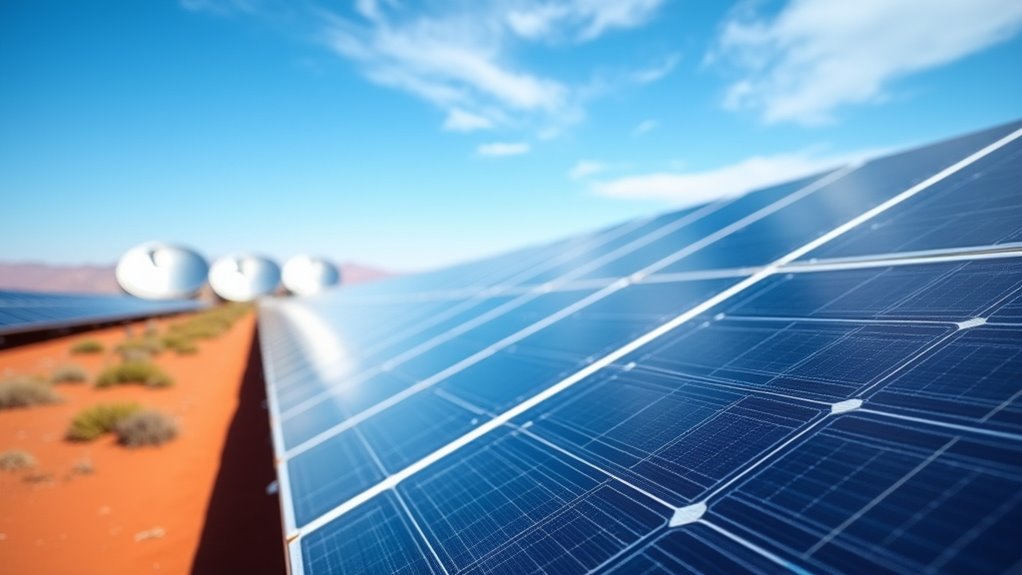
Solar energy technologies represent one of humanity’s most powerful tools in the change to clean, renewable power. At the forefront stands photovoltaic (PV) technology, which directly converts sunlight into electricity using semiconductor materials, mainly silicon-based cells that currently command 98% of the market. Commercial PV panels achieve efficiencies between 15-22%, while laboratory tests have pushed the boundaries to an impressive 50%, demonstrating the tremendous potential for future advancements. True south orientation ensures optimal energy capture for solar installations in the Northern Hemisphere.
Photovoltaic technology leads the solar revolution, transforming sunlight into clean electricity with ever-increasing efficiency and market dominance.
The solar landscape extends beyond traditional PV systems to include Concentrated Solar Power (CSP), which employs mirrors to focus sunlight and generate heat for electricity production. With global CSP capacity approaching 7 GW as of 2020, this technology offers a unique advantage through its ability to store thermal energy, enabling 24-hour power generation. Parabolic trough collectors have emerged as the most widely deployed CSP technology, proving particularly effective in regions with abundant direct sunlight. Hybrid systems that combine both solar and wind sources are also emerging breakthroughs in the renewable energy sector, increasing reliability and energy production. Managing the fluctuating power sources of solar and wind on traditional grids has led to innovative grid-balancing strategies that stabilize energy systems.
Solar thermal systems have revolutionized building energy management by harnessing the sun’s heat for water heating, space heating, and cooling applications. These systems can slash water heating bills by 50-80%, while both active and passive solar heating solutions provide cost-effective alternatives for building climate control. The integration of thermal storage systems allows for extended use beyond daylight hours, maximizing the technology’s practical benefits. The incorporation of molten salt storage enables CSP systems to generate electricity for up to 12 hours after sunset.
Innovation continues to drive the solar sector forward, with emerging technologies pushing efficiency boundaries. Perovskite solar cells have shown remarkable progress, with tandem perovskite-silicon cells achieving an impressive 34.6% efficiency in 2024. Quantum dot solar cells and bifacial panels, which capture light from both sides, represent promising advances in solar technology. Meanwhile, organic solar cells offer new possibilities through their flexible applications.
The solar energy landscape is rapidly evolving, with global PV capacity projected to reach 1000 GW by 2030. China leads the charge, having added an extraordinary 260 GW of solar capacity in 2023, while the European Union contributed 61 GW. Energy storage solutions, including battery systems, pumped hydro storage, and emerging technologies like flow batteries, play an essential role in addressing intermittency challenges and ensuring grid stability.
The economics of solar power have become increasingly compelling, with utility-scale solar PV now representing the least costly option for new electricity generation in many countries. This cost-effectiveness, coupled with continued efficiency improvements and innovative storage solutions, positions solar energy as a cornerstone of the global energy change.
As commercial panel efficiency has improved from 6% in the 1950s to today’s 22%, with next-generation technologies aiming to surpass the 30% efficiency barrier, the future of solar energy appears increasingly bright, supported by strong policy frameworks worldwide.
Frequently Asked Questions
What Is the Average Lifespan of a Photovoltaic Thermal Hybrid System?
Photovoltaic thermal hybrid systems typically last 25-30 years, matching the lifespan of standard PV panels.
These systems experience a gradual decline in performance, with annual degradation rates of 0.5-1%. Most manufacturers provide performance warranties guaranteeing 80% output after 25 years.
Regular maintenance, quality components, and proper installation can maximize system longevity, while environmental factors like temperature and humidity affect durability over time.
How Do Weather Conditions Affect the Efficiency of Solar Thermal Collectors?
Weather conditions considerably impact solar thermal collector efficiency.
High temperatures above 25°C reduce panel output by 0.5-0.7% per degree, while cloud cover and shading can slash performance by up to 50%.
Wind offers a dual effect – cooling panels to improve efficiency but potentially accumulating dirt.
Humidity slightly decreases performance, though rainfall helps maintain efficiency by cleaning panels.
Snow accumulation in winter poses challenges by blocking sunlight and reducing energy production.
Can Solar Panels Generate Electricity During Cloudy Days?
Yes, solar panels can generate electricity during cloudy days, though at reduced efficiency.
They typically produce 10-25% of their normal output when heavily overcast. Modern panels utilize diffuse light that penetrates clouds, while some technological advances like bifacial panels and anti-reflective coatings help maximize cloudy day performance.
Smart energy management strategies, including battery storage and oversized arrays, help compensate for lower production during overcast conditions.
What Maintenance Is Required for Residential Solar Energy Systems?
Residential solar systems require regular maintenance to guarantee peak performance.
Key tasks include cleaning panels 2-4 times yearly with mild soap and water, monitoring system output through inverter displays, and conducting visual inspections for damage.
Professional maintenance should be scheduled every 3-5 years to check electrical connections and replace inverters when needed.
Many issues can be prevented through routine monitoring of energy production and electricity bills.
How Much Roof Space Is Needed for an Effective Solar Installation?
A typical residential solar installation requires 400-600 square feet of unobstructed roof space to be effective.
Most homes need 18-24 panels, with each panel measuring approximately 18 square feet. The exact space requirements depend on household energy consumption, roof orientation, and panel efficiency.
South-facing roofs with a 30-40 degree angle are ideal. A minimum of 300 square feet of clear space is recommended, excluding the required 3-foot safety perimeter.


