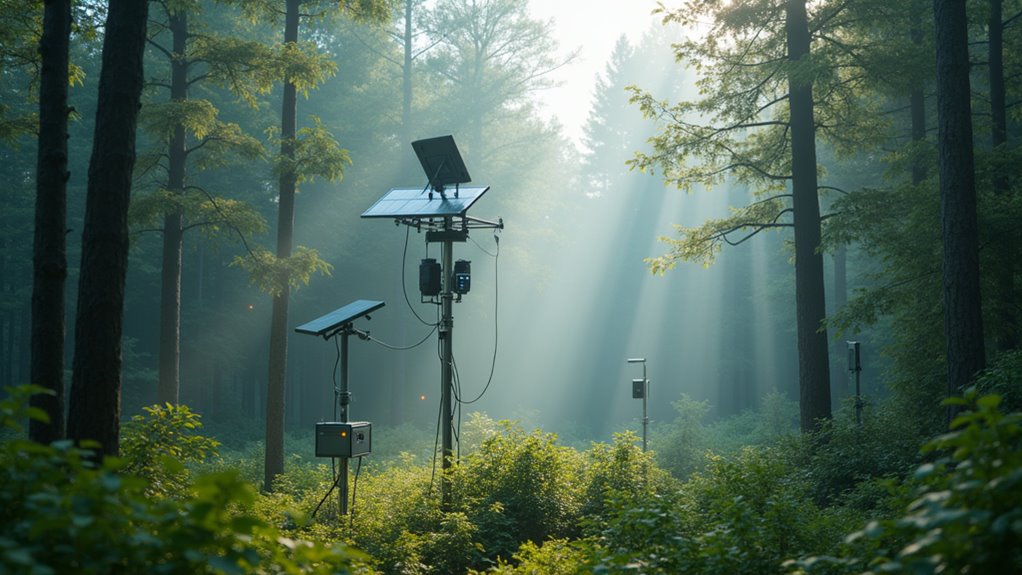

Artificial intelligence is transforming environmental science through powerful data analysis capabilities. AI systems process massive datasets from satellites, sensors, and field observations to monitor ecological changes in real-time. Machine learning algorithms detect deforestation, predict extreme weather, and optimize resource management across agriculture, water, and energy sectors. From tracking wildlife populations to enhancing climate models, AI accelerates scientific discovery and informs environmental policy. This technological revolution offers unprecedented insights into our planet’s complex systems.

As environmental challenges grow increasingly complex in the 21st century, artificial intelligence has emerged as a powerful ally in understanding and protecting our planet’s ecosystems. From tracking endangered species to predicting climate patterns, AI technologies are revolutionizing how scientists monitor and respond to environmental changes. These sophisticated systems analyze vast amounts of data from satellites, sensors, and field observations, providing unprecedented insights into our planet’s health. Remote sensing data now enables scientists to monitor environmental changes without direct surface contact.
The impact of AI on climate science has been particularly transformative. Machine learning algorithms process enormous datasets to enhance the accuracy of climate models, enabling scientists to better forecast extreme weather events and long-term climate trends. These models simulate future scenarios, helping communities and policymakers develop more effective climate adaptation strategies. By analyzing historical climate data, AI systems identify subtle patterns and anomalies that might otherwise go unnoticed, deepening our understanding of complex climate system interactions. For instance, JASMIN supercomputer processes satellite data to deliver timely information about earthquakes and volcanic activity. Green investments are reaching unprecedented levels, supporting the integration of AI in developing sustainable solutions for environmental challenges.
Environmental monitoring has reached new levels of sophistication through AI-powered systems. Computer vision algorithms scan satellite imagery to detect deforestation, track land use changes, and identify illegal logging operations in real-time. Networks of IoT sensors, enhanced by AI analytics, continuously monitor air quality, water pollution, and soil health. In wildlife conservation, AI helps process millions of camera trap images, counting and identifying species while tracking their migration patterns with unprecedented accuracy. Innovations continue to boost efficiency and lower costs for solar power, further advancing renewable energy solutions. Energy storage systems provide flexibility to balance supply and demand, ensuring stability in power grids as renewable energy sources are integrated.
Advanced AI systems revolutionize environmental tracking, from satellite monitoring of deforestation to wildlife identification through automated camera networks.
The technology’s applications in resource management are equally impressive. AI algorithms optimize renewable energy production and distribution, improve agricultural efficiency through precise crop yield predictions, and enhance water resource allocation. In fisheries management, AI-driven stock assessments help maintain sustainable fish populations, while in forestry, machine learning models improve inventory systems and resource planning.
Perhaps most importantly, AI is transforming how environmental policies are developed and enforced. The technology analyzes complex environmental data to simulate policy outcomes, assess the environmental impact of development projects, and improve regulatory enforcement. AI-powered communication tools are also enhancing public engagement in environmental issues, making scientific data more accessible and actionable for citizens and decision-makers alike.
The integration of AI into environmental research has accelerated scientific discovery in remarkable ways. By processing large-scale environmental datasets and identifying novel patterns in ecological systems, AI helps researchers understand complex environmental relationships that were previously difficult to detect. This has led to breakthroughs in species identification, remote sensing capabilities, and the integration of diverse data sources across scientific disciplines.
As environmental challenges continue to mount, the role of AI in environmental science becomes increasingly essential, offering powerful tools for understanding and protecting our planet’s natural systems.
Frequently Asked Questions
Can AI Predict Natural Disasters With Better Accuracy Than Traditional Methods?
Yes, AI demonstrates superior accuracy in predicting natural disasters compared to traditional methods. By rapidly processing vast amounts of environmental data, AI systems can detect subtle patterns that humans might miss.
For example, AI hurricane tracking is 6 times faster than conventional approaches, while earthquake prediction models analyze complex seismic data with unprecedented precision.
However, AI’s effectiveness still depends on data quality and requires human expertise for interpretation and validation.
How Much Energy Do Environmental AI Systems Consume During Operation?
Environmental AI systems consume significant energy during operation, with data centers accounting for 1-1.5% of global electricity use.
While AI-specific workloads represent about 15% of data center energy consumption, environmental monitoring systems tend to be less intensive than large language models.
A typical environmental AI application might use 1/10th the energy of ChatGPT interactions, though exact figures vary based on complexity and runtime requirements.
What Privacy Concerns Exist When AI Collects Environmental Data From Private Properties?
When AI collects environmental data from private properties, several privacy risks emerge.
IoT sensors and monitoring systems can inadvertently capture sensitive information about residents’ daily routines, behaviors, and personal activities. This data could reveal patterns like energy usage, occupancy times, and lifestyle habits.
There’s also concern about unauthorized access, data breaches, and the potential for combining environmental metrics with other datasets to create detailed profiles of property owners without their explicit consent.
Does Ai-Driven Environmental Monitoring Reduce the Need for Human Scientists?
AI enhances but doesn’t replace human scientists in environmental monitoring.
While AI excels at processing vast datasets and identifying patterns, human expertise remains essential for algorithm development, data interpretation, and complex decision-making.
Scientists provide vital context, validate findings through fieldwork, and make ethical judgements that AI cannot.
The technology serves as a powerful tool that amplifies human capabilities rather than diminishing the need for scientific expertise.
How Reliable Are AI Predictions for Long-Term Climate Change Scenarios?
AI climate predictions show mixed reliability for long-term scenarios.
While models like Spherical DYffusion can project 100-year patterns much faster than traditional methods, they struggle with unprecedented climate events and complex system dynamics.
The most effective approach combines AI with physics-based models, improving accuracy while maintaining computational efficiency.
However, data gaps, model interpretability issues, and the challenge of capturing unfamiliar climate conditions remain significant limitations for long-term forecasting.


