

Ocean acidification poses a mounting challenge for marine ecosystems worldwide. Since the Industrial Revolution, ocean acidity has increased 30% as waters absorb rising atmospheric CO2, forming carbonic acid. This chemical shift threatens shell-building organisms like corals and mollusks, disrupting entire food webs. The impacts ripple through coastal economies dependent on fishing and tourism. While concerning, coordinated global action and local management efforts offer paths toward protecting our oceans’ delicate balance. The depths of this crisis reveal surprising solutions.
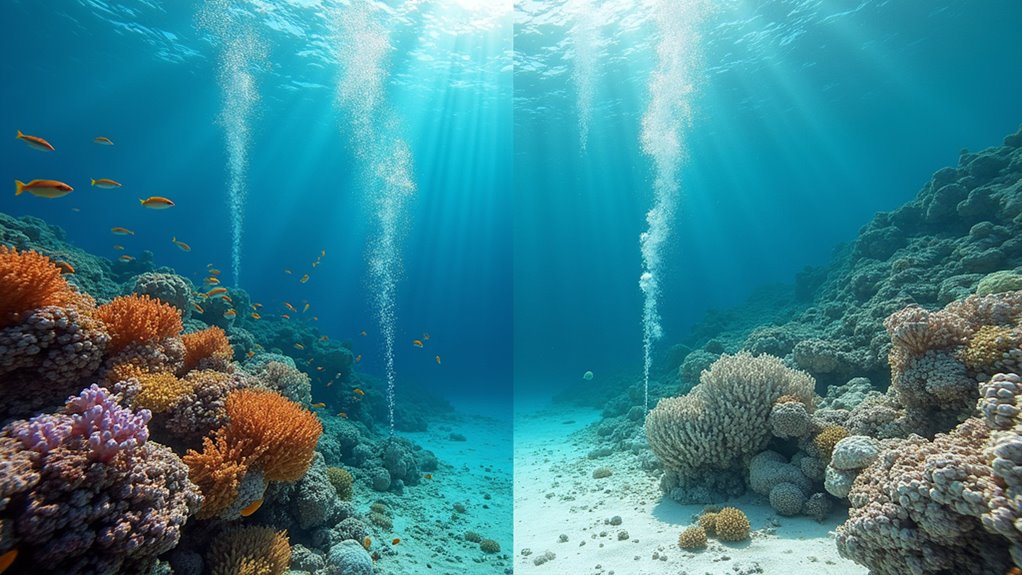
A silent but profound transformation is reshaping Earth’s oceans. Over the past two centuries, our seas have undergone a dramatic change in their chemical composition, becoming increasingly acidic as they absorb massive amounts of carbon dioxide from the atmosphere. Since the Industrial Revolution, ocean acidity has increased by 30%, with pH levels dropping from 8.2 to 8.1 – a change that might seem small but represents a fundamental shift in marine chemistry.
Earth’s oceans face an invisible crisis as rising carbon dioxide levels transform their chemistry, threatening marine life’s delicate balance.
This process, known as ocean acidification, occurs when carbon dioxide combines with seawater to form carbonic acid. The oceans currently absorb between 25% and 30% of atmospheric CO2, acting as an essential buffer against climate change. However, this protective role comes at a significant cost to marine ecosystems. The rate of acidification is now happening 100 times faster than any period in the last 55 million years, giving marine life little time to adapt. Deforestation and land use changes continue to amplify the problem by reducing natural carbon sinks. Research shows that oceans absorb an astounding 94 percent of CO2 from the atmosphere, making them crucial regulators of global carbon levels. Sustainable seafood choices can also aid in reducing the pressures on ocean ecosystems by protecting fish populations and promoting biodiversity.
Scientists tracking these changes through monitoring stations like Hawaii’s Aloha facility have documented concerning trends. Global atmospheric CO2 levels exceeded 417 parts per million in 2022, pushing ocean pH levels down to 8.05 by 2021. If current trends continue, researchers project a further decrease of 0.15 to 0.5 pH units by 2100, with the North Atlantic experiencing even more severe acidification than the global average. Extreme weather events, such as hurricanes, also exacerbate the situation by impacting marine habitats and species. Sustainable fisheries management plays a critical role in balancing human demands with the health of ecosystems, ensuring marine life has a fighting chance against changing ocean chemistry.
The impacts on marine life are already evident and far-reaching. Many organisms, particularly those that build shells and skeletons from calcium carbonate, are struggling to survive in increasingly acidic waters. Cold-water corals in the North Atlantic face severe challenges, while tropical coral reefs, mollusks, and certain plankton species show signs of stress. These changes ripple through marine food webs, affecting everything from the smallest organisms to the largest predators. Efforts focused on safeguarding fisheries are crucial in maintaining biodiversity and supporting the ecosystem’s resilience.
The economic and social implications are equally sobering. Coastal communities relying on fishing and tourism face uncertain futures as acidification threatens their livelihoods. Coral reefs, which provide natural storm protection and support tourism, are particularly vulnerable to these chemical changes. Food security concerns loom large for populations dependent on seafood as their primary protein source.
However, solutions exist and action is being taken. The European Green Deal and various climate laws aim to reduce greenhouse gas emissions, while the Marine Strategy Framework Directive works to restore marine ecosystems. Scientists worldwide are collaborating to monitor and understand these changes, developing strategies to help marine ecosystems adapt.
Local management efforts focus on reducing additional stressors like pollution and overfishing, giving marine life a better chance of surviving these chemical changes. Through understanding and addressing ocean acidification, we can work towards preserving the delicate balance of our marine ecosystems for future generations.
The challenge is significant, but with coordinated global action and continued scientific research, there’s hope for maintaining the health of our oceans.
Frequently Asked Questions
Can Ocean Acidification Affect Human Health Directly?
Ocean acidification directly impacts human health through multiple pathways.
It degrades coastal air quality, triggering respiratory issues and irritation. The process increases harmful algal blooms that release airborne toxins.
Additionally, it alters seafood nutrition, reducing essential nutrients like omega-3s while increasing toxin concentrations in marine life.
Coastal communities face heightened risks, with potential long-term effects on respiratory function and overall well-being still being studied by researchers.
How Long Does It Take for Ocean Ph Levels to Return to Normal?
The recovery of ocean pH levels is a remarkably slow process that can take anywhere from 10,000 to 100,000 years for complete restoration.
While surface waters might begin recovering within centuries once atmospheric CO2 stabilizes, deep ocean pH recovery lags behind by several hundred years.
The ocean’s natural buffering system, which involves chemical reactions with carbonate minerals, simply can’t keep pace with today’s rapid acidification rates.
Which Marine Species Are Most Resistant to Ocean Acidification?
Several marine species show remarkable resistance to ocean acidification. Crustaceans like lobsters and crabs actually exhibit enhanced shell growth in acidic conditions.
Seagrasses and certain algae species thrive with higher CO2 levels, benefiting from increased photosynthesis rates.
Some fish species demonstrate adaptability through internal pH regulation, while organisms with phenotypic plasticity can adjust their physiology and shell composition over time.
These resilient species may help maintain ecosystem balance despite changing ocean chemistry.
Are There Any Regions Where Ocean Acidification Is Not Occurring?
Ocean acidification is occurring universally across Earth’s marine waters, with no regions completely immune to this chemical change.
While the rate and severity vary geographically, all ocean areas are experiencing declining pH levels due to increasing atmospheric CO2.
Some regions, like deeper waters or areas with natural buffering systems, show slower acidification rates.
However, the fundamental chemical process affects all marine waters, making it a truly global phenomenon.
What Role Do Marine Plants Play in Reducing Ocean Acidification?
Marine plants play an essential role in combating ocean acidification through photosynthesis and natural pH buffering.
Seagrasses and kelp forests absorb substantial amounts of CO2 from seawater, creating carbon sinks that temporarily deacidify surrounding waters. Their presence can increase aragonite saturation by up to 2.9 units in seagrass meadows and 1 unit in kelp farms.
This process helps protect vulnerable shell-forming organisms like clams and oysters, while supporting diverse marine ecosystems.


