

Healthy oceans form Earth’s life support system, covering 71% of the surface and generating up to 80% of our oxygen through phytoplankton. They absorb 25% of carbon emissions and 90% of excess heat, regulating global climate. Supporting over 250,000 species and providing primary protein for 3 billion people, oceans contribute $2.5 trillion annually to the global economy. From coastal protection to medical breakthroughs, the ocean’s significant role makes its preservation essential. There’s much more beneath the surface of this important ecosystem.
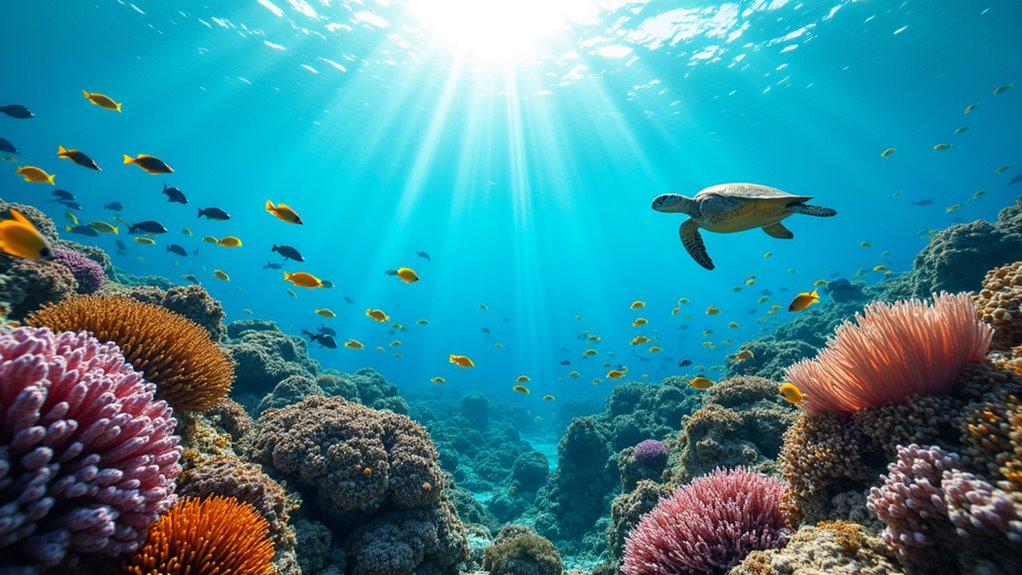
Life on Earth pulses to the rhythm of our oceans. Covering 71% of our planet’s surface and containing 97% of its water, these vast blue expanses are far more than mere bodies of water – they are the very foundation of life as we understand it. Through the countless microscopic phytoplankton that drift in their waters, oceans generate between 50% and 80% of Earth’s oxygen, literally helping us breathe while simultaneously absorbing a quarter of our carbon emissions and 90% of excess heat.
The ocean’s role as a global life support system extends far beyond these essential functions. Its waters are home to an astounding array of life, with over 250,000 known species and countless more awaiting discovery. Scientists warn that over 50% of species could face extinction by 2100 if current trends continue. Coral reefs, though occupying less than 1% of the ocean floor, support a quarter of all marine life. Meanwhile, coastal ecosystems like mangroves and seagrass meadows act as nature’s shield, protecting shorelines from storms while storing massive amounts of carbon – up to five times more than terrestrial forests. Marine Protected Areas (MPAs) are strategic conservation zones that help safeguard biodiversity and boost ocean resilience against environmental stresses. Sustainable fisheries management is crucial to maintaining the delicate balance between human consumption needs and the health of these marine ecosystems. By making sustainable seafood choices, we can help protect fish populations and support the recovery of ocean ecosystems.
The significance of healthy oceans to human wellbeing cannot be overstated. More than three billion people rely on marine and coastal resources as their primary source of protein, while the ocean economy generates $2.5 trillion annually and supports 57 million jobs in fisheries alone. In some areas, up to 1000 species can be found in a single square meter of coral reef habitat. Coastal communities worldwide depend on these waters for their livelihoods, while marine organisms hold untapped potential for medical breakthroughs. A global campaign focused on marine conservation emphasizes the importance of preserving these vital ecosystems for current and future generations.
Healthy oceans are vital lifelines, feeding billions, driving economies, and holding the keys to tomorrow’s medical advances.
Perhaps most important is the ocean’s role in regulating our planet’s climate. By absorbing 26% of human-produced carbon dioxide each year and distributing heat through its currents, the ocean acts as Earth’s thermostat. Coastal habitats serve as natural buffers against increasingly extreme weather events, while marine biodiversity enhances the ocean’s capacity to store carbon and maintain ecological balance.
Yet the value of our oceans extends beyond mere numbers and statistics. These waters have shaped human culture for millennia, inspiring art, literature, and spiritual practices across civilizations. With 80% of the ocean still unexplored, it continues to drive scientific innovation and discovery, offering new insights into our changing planet and potential solutions to global challenges.
The health of our oceans is inextricably linked to our own survival and prosperity. From food security to climate stability, from economic opportunities to cultural heritage, healthy oceans matter for countless reasons. As we face unprecedented environmental challenges, understanding and protecting these essential waters isn’t just an environmental imperative – it’s an investment in humanity’s future.
Through sustainable management and conservation efforts, we can guarantee that future generations continue to benefit from the countless services that healthy oceans provide.
Frequently Asked Questions
How Do Plastic-Eating Bacteria Affect Marine Ecosystems?
Plastic-eating bacteria show promising potential for reducing marine pollution by breaking down plastics into harmless compounds.
While these microorganisms could help tackle the 14 million tons of ocean plastic annually, their ecological impact remains complex. They may disrupt existing food webs, release toxic byproducts during degradation, and compete with native bacteria for resources.
Scientists continue studying these organisms’ long-term effects on marine biodiversity before implementing large-scale solutions.
What Role Do Deep-Sea Thermal Vents Play in Ocean Chemistry?
Deep-sea hydrothermal vents function as Earth’s natural chemical processing plants.
These underwater geysers regulate ocean chemistry by removing elements like magnesium and sulfur from seawater while adding minerals leached from seafloor rocks.
The entire ocean volume cycles through these vents every 10-20 million years, making them essential for maintaining chemical balance.
They also generate deep-sea currents through mineral-driven reactions and help absorb atmospheric heat and CO2.
Can Artificial Reefs Effectively Replace Damaged Natural Coral Reef Systems?
Artificial reefs can partially replace damaged coral systems but cannot fully replicate natural reef complexity.
Research shows artificial structures support similar fish populations and biodiversity levels, with some studies indicating higher fish densities than natural reefs.
When combined with coral restoration, artificial reefs achieve impressive coral survival rates exceeding 90%.
However, they require ongoing maintenance and monitoring, making them a valuable supplement to, rather than complete replacement for, natural reef systems.
How Do Changing Ocean Currents Impact Global Weather Patterns?
Ocean currents function as Earth’s climate engineers, moving heat and moisture across the globe.
When these currents shift, they trigger cascading effects on weather patterns worldwide. Strong currents transport warm tropical waters toward the poles, while cold waters flow back toward the equator.
These movements influence rainfall distribution, storm intensity, and regional temperatures. Changes in current strength or direction can lead to significant weather anomalies, affecting everything from monsoon patterns to drought cycles.
What Is the Relationship Between Ocean Acidification and Marine Biodiversity?
Ocean acidification fundamentally disrupts marine ecosystems by interfering with calcifying organisms‘ ability to build and maintain their shells and skeletons.
This triggers cascading effects throughout food webs, as species like corals, mollusks, and plankton struggle to survive. The rapid pH changes force marine life to adapt or perish, leading to shifts in species distribution and abundance.
Some organisms thrive in more acidic conditions, while others face declining populations, ultimately reshaping biodiversity patterns across ocean ecosystems.


