

Modern technology is transforming waste management and product reuse through five key innovations. Blockchain creates transparent supply chain tracking, while IoT sensors monitor product conditions in real-time. Waste-to-energy systems convert garbage into valuable resources, and 3D printing enables localized parts production. Digital twins paired with machine learning optimize product lifecycles and predict maintenance needs. These interconnected technologies are revolutionizing how businesses approach sustainability, with exciting developments on the horizon.
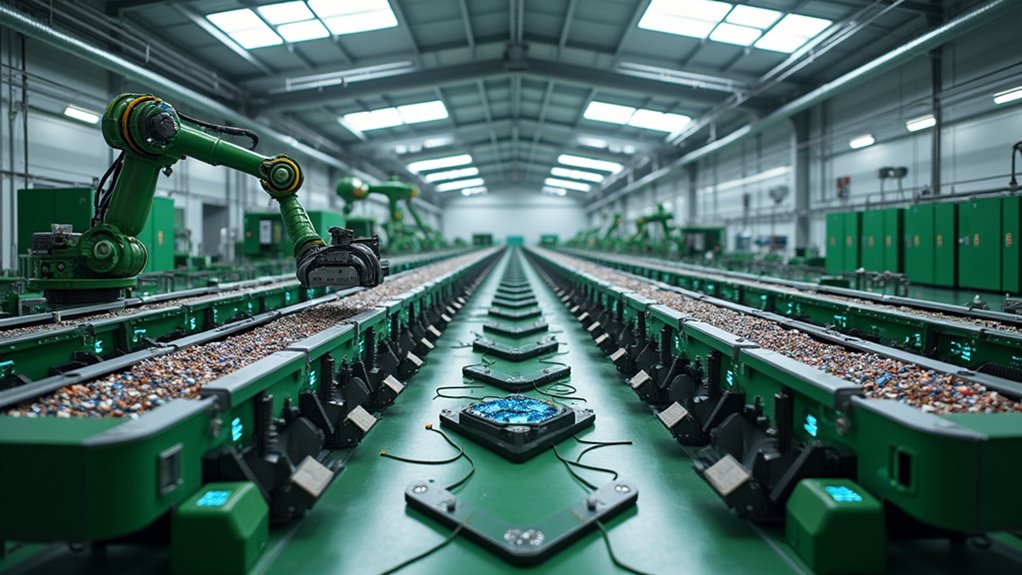
As technology continues to reshape industrial practices, innovative digital solutions are revolutionizing the circular economy landscape and transforming how businesses approach sustainability. At the forefront of this revolution is blockchain technology, which creates an unbreakable digital chain of custody for products from raw material extraction through distribution. This transparency allows companies and consumers to verify product authenticity and sustainability claims while promoting accountability throughout the supply chain. A key focus remains on implementing practices that prevent waste generation at every stage of production.
Blockchain revolutionizes supply chain transparency, enabling businesses and consumers to track products from source to shelf while verifying sustainability claims.
The Internet of Things (IoT) has emerged as another game-changing technology, with smart sensors embedded in products collecting real-time data about their usage and condition. These devices optimize maintenance schedules, predict failures before they occur, and ascertain materials can be effectively recovered during recycling. When combined with artificial intelligence, this data becomes even more powerful, as AI systems analyze vast datasets to identify patterns that improve product design for circularity. Furthermore, sustainable product solutions are being showcased on platforms dedicated to highlighting circular economy products designed for reuse and repair. The technology evolution supports a closed-loop system that replaces traditional linear models. By embracing this shift, companies are not only slashing trash volumes but also bolstering economic and environmental resilience.
Waste-to-energy technologies are proving invaluable in reducing landfill dependency while generating valuable resources. Through processes like incineration, anaerobic digestion, and pyrolysis, otherwise worthless garbage is transformed into biogas and energy, creating a virtuous cycle of resource recovery. This approach considerably reduces the environmental impact of waste disposal while providing sustainable energy sources. By converting garbage into electricity, waste-to-energy converters support the circular economy and reduce reliance on landfills. These technologies also address challenges and controversies by producing energy from waste, which can be a contentious issue.
3D printing technology is revolutionizing manufacturing by enabling on-demand, localized production. This eliminates the need for large inventories and long-distance transportation while allowing for easy customization and repair of products. The ability to quickly produce spare parts extends product lifespans and reduces waste, while the precise nature of additive manufacturing minimizes material waste during production.
Digital twins are providing unprecedented insights into product lifecycles through virtual simulations. These digital replicas enable companies to analyze and optimize their products’ environmental impact throughout their entire journey, from design to disposal. Meanwhile, machine learning algorithms are extending product lifespans through predictive maintenance, analyzing usage patterns to anticipate repairs before failures occur and reducing unnecessary waste.
The combination of these technologies is creating a more efficient, sustainable circular economy. By leveraging blockchain for transparency, IoT for monitoring, AI for design optimization, and advanced manufacturing techniques for resource efficiency, businesses can dramatically reduce their environmental impact while improving operational efficiency.
As these technologies continue to evolve and become more accessible, they’re enabling a future where waste is minimized, resources are used more effectively, and products are designed for multiple lifecycles. The result is a more sustainable economic model that benefits both businesses and the environment, while providing practical solutions to some of our most pressing environmental challenges.
Frequently Asked Questions
How Can Small Businesses Afford to Implement Circular Economy Technologies?
Small businesses can affordably adopt circular economy technologies through several practical approaches.
They can start small with cost-effective solutions like product-as-service models and sharing platforms. Government grants, tax incentives, and green financing options make implementation more feasible.
Phased implementation allows businesses to test and scale circular initiatives gradually.
Partnerships and collaborations with other companies help share costs and maximize resource efficiency while reducing initial investments.
What Skills Are Needed to Work in Circular Economy Tech?
Working in circular economy tech requires a blend of technical and soft skills.
Professionals need programming abilities for data analysis, expertise in lifecycle assessment, and knowledge of recycling technologies.
Business acumen, including understanding circular business models and supply chain management, is vital.
Essential soft skills involve systems thinking, stakeholder collaboration, and creative problem-solving.
Knowledge of sustainable manufacturing, waste management, and environmental regulations rounds out the skillset.
Are There Government Incentives for Adopting Circular Economy Solutions?
Governments worldwide offer substantial incentives to drive circular economy adoption.
These include tax breaks for repair services and recycling initiatives, grants for innovative projects, and low-interest loans for sustainable business practices.
Financial subsidies support eco-design and product longevity efforts, while regulatory measures like right-to-repair laws and extended producer responsibility schemes create additional motivation.
Economic instruments such as deposit-refund systems round out the extensive support framework available to businesses and individuals.
How Long Does It Take to See ROI From Circular Tech Investments?
Return on investment for circular tech varies greatly based on the specific solution.
Simple implementations like digital waste tracking and AI-powered waste reduction can show ROI within 6-12 months.
More complex transformations like remanufacturing equipment typically take 2-3 years to pay off.
The average payback period ranges from 3-5 years, though some projects may take up to 9 years.
Starting with pilot projects and targeting “low-hanging fruit” can help accelerate returns.
Which Industries Benefit Most From Implementing Circular Economy Technologies?
Manufacturing and electronics show the strongest ROI from circular technologies.
Manufacturing benefits from 90% material cost reductions through remanufacturing, while electronics capture value from precious metal recovery and extended product life.
The automotive sector sees 40-50% savings with remanufactured parts, and textiles benefit from 98% water reduction using recycled materials.
These industries also leverage IoT, AI, and blockchain to optimize operations and improve resource efficiency.


