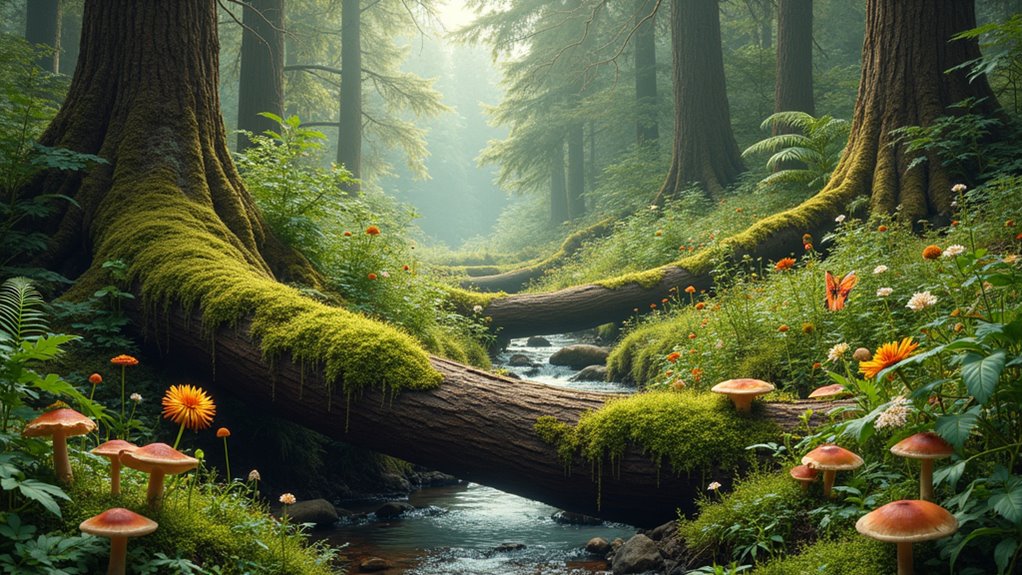

Deep ecology, coined by philosopher Arne Naess in 1973, fundamentally rejects the notion that human beings are superior to other species. This environmental philosophy recognizes the intrinsic worth of all living organisms, from microscopic bacteria to complex mammals, viewing them as equal participants in Earth’s interconnected web of life. The movement draws inspiration from indigenous wisdom and Eastern philosophies, promoting a radical shift away from anthropocentric thinking toward biocentric equality. Understanding these principles reveals deeper truths about humanity’s role in nature’s grand tapestry.

As environmental crises continue to mount worldwide, deep ecology has emerged as a radical philosophical movement that challenges humanity’s relationship with nature at its core. Coined by Norwegian philosopher Arne Naess in 1973, deep ecology advocates for the inherent worth of all living beings, regardless of their utility to humans. This bold perspective stands in stark contrast to conventional environmental approaches, which often remain focused on managing nature primarily for human benefit.
At its heart, deep ecology promotes the concept of biocentric equality – the revolutionary idea that no species holds greater importance than another. This philosophy, developed further through the Deep Ecology Platform created by Naess and George Sessions in 1984, draws inspiration from Eastern philosophies, indigenous worldviews, and pioneering environmental thinkers like Rachel Carson. Through practices like mindful hiking, practitioners develop a deeper connection to the natural world. The movement’s fundamental premise challenges the anthropocentric worldview that has dominated Western thought for centuries. The publication of Carson’s Silent Spring in 1962 marked a pivotal moment that helped launch the contemporary deep ecology movement.
Unlike shallow ecology, which addresses environmental symptoms like pollution and resource depletion, deep ecology seeks to confront root causes by questioning the very foundations of modern industrial society. It calls for radical societal and economic changes, promoting what Naess termed “ecosophy” – a personal ecological wisdom that recognizes humans’ fundamental interconnectedness with nature. This perspective rejects the traditional human-nature dualism, instead viewing humans as inseparable from and wholly dependent on the natural world. Renewable energy initiatives, such as the widespread adoption of solar and wind power, align with deep ecology’s vision for sustainable and harmonious living. Indigenous leadership in conservation efforts exemplifies the power of traditional knowledge and stewardship in achieving environmental goals. Furthermore, the expansion of sustainable transportation options, such as electric vehicles and urban public transit, demonstrates a commitment to reducing emissions and promoting eco-friendly mobility. Climate change adaptation measures also play a crucial role in fostering economic stability and enhancing public health.
The movement’s influence has been far-reaching, inspiring radical environmental groups like Earth First! and contributing to the development of bioregionalism and green politics. Deep ecology has also shaped conservation biology through its emphasis on wilderness preservation and biodiversity protection. Its principles have found practical expression in approaches like voluntary simplicity, plant-based diets, and regenerative design.
However, deep ecology isn’t without its critics. The movement has faced accusations of misanthropy for its advocacy of human population reduction, and some argue its vision is too utopian for modern societies. Questions persist about the interpretation of “vital needs” – the only justification deep ecology accepts for human interference with nature. Critics also point to tensions between deep ecology’s biocentric focus and social justice movements centered on human welfare.
Despite these controversies, deep ecology’s core message about the intrinsic value of all life forms remains increasingly relevant in an era of accelerating environmental degradation. Its emphasis on experiential understanding of human-nature unity offers a powerful alternative to conventional environmental thinking. As we grapple with unprecedented ecological challenges, deep ecology’s radical vision of environmental harmony and its call for fundamental societal transformation continue to inspire and challenge environmentalists worldwide.
Frequently Asked Questions
How Does Deep Ecology Address Human Population Control and Reduction?
Deep ecology advocates for significant human population reduction through non-coercive means.
It promotes voluntary measures like education, family planning, and contraception access to gradually decrease population levels.
The movement argues that current human numbers exceed Earth’s carrying capacity and threaten biodiversity.
While supporting population control, deep ecology emphasizes voluntary approaches rather than forced measures, aiming to restore balance between human and non-human life.
Can Deep Ecology Principles Be Integrated Into Modern Urban Development?
Deep ecological principles can be effectively integrated into modern urban development through strategic planning and design.
Cities worldwide are already implementing biophilic architecture, green corridors, and urban wildlife habitats. Vertical gardens, permeable surfaces, and restored wetlands demonstrate practical applications.
While challenges exist, particularly in dense urban cores, successful examples like Singapore’s Gardens by the Bay show how nature and development can coexist harmoniously in contemporary cityscapes.
What Role Does Technology Play in Deep Ecology’s Vision?
Technology plays a complex and nuanced role in deep ecology’s vision.
While deep ecologists critique technological excess as harmful to nature, they don’t completely reject technology. Instead, they advocate for appropriate technologies that support ecological balance and enhance environmental awareness.
The movement emphasizes simple, small-scale solutions over high-tech fixes, while recognizing that some technologies can help foster connection with nature and monitor ecosystem health.
How Does Deep Ecology View Domesticated Animals Versus Wild Ones?
Deep ecology draws a sharp distinction between wild and domesticated animals.
Wild animals are viewed as free, natural beings that embody nature’s autonomy and contribute to ecosystem balance. In contrast, domesticated animals are often seen as human-modified creatures with diminished wildness and dependency on human care.
However, deep ecology still affirms their inherent worth, while questioning the ethics of domestication and advocating for more natural living conditions for all animals.
What Are the Economic Implications of Implementing Deep Ecology Principles?
Implementing deep ecology principles would require a fundamental restructuring of the global economy.
This involves shifting from growth-based models to sustainable, steady-state economics that respect ecological limits. Industries would need to convert toward renewable resources, while consumption patterns would dramatically decrease.
Local economies, sharing systems, and ecological restoration would become priorities. Job markets would evolve to emphasize conservation, repair, and environmental stewardship over resource extraction.