

Ports and shipping companies are adopting innovative green technologies to reduce their environmental footprint. The maritime industry, currently responsible for 940 million tons of CO2 annually, is shifting toward sustainability through renewable energy adoption, digitalization, and cleaner fuel alternatives like LNG. Major initiatives include solar power installations, waste recycling programs that recover up to 60% of materials, and stricter emissions regulations. These transformative changes signal an evolving industry where efficiency meets environmental stewardship, with much more on the horizon.
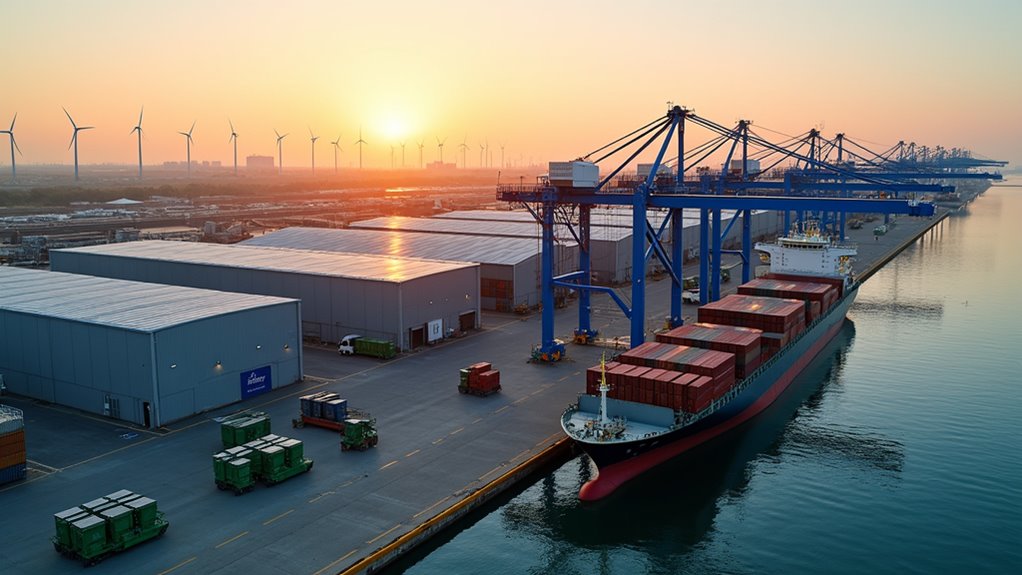
As the global shipping industry grapples with its significant environmental footprint, ports and maritime companies worldwide are commencing an unprecedented shift toward sustainability. With shipping accounting for 2-3% of global greenhouse gas emissions and ports contributing substantially to local pollution, the maritime sector is finally embracing thorough green initiatives that promise cleaner operations and reduced environmental impact. The industry currently contributes 940 million tons of CO2 annually.
The shift begins at ports, where innovative green initiatives are reshaping traditional operations. Ports are increasingly adopting renewable energy sources, particularly solar power, while implementing digitalization strategies to optimize energy consumption. The success story of Dar es Salaam Port demonstrates the potential for significant improvements in efficiency and environmental impact, with its remarkable 57% reduction in ship arrival times. Many facilities now successfully recycle up to 60% of their generated waste, marking a significant improvement in resource management. Ports adopting renewable energy sources contribute to the 28% of global electricity generated by renewables, aligning with a broader trend toward sustainable energy. The reimagining of ports for sustainable transport policy is vital for creating spaces that prioritize environmental efficiency and the well-being of surrounding communities. Sustainable aviation technologies have also been explored as a means of reducing emissions and improving efficiency in the aviation sector.
The installation of shore power connections allows docked vessels to plug into the local electricity grid rather than running their engines, substantially reducing both emissions and noise pollution.
Maritime companies are responding to these changes by investing in sustainable shipping technologies. While 98.8% of the current fleet still relies on fossil fuels, approximately 21% of vessels on order will operate on cleaner alternatives. Innovative solutions like wind-assisted propulsion systems and solar panel installations on cargo ships are becoming more common, while electric and hybrid vessels are increasingly deployed for shorter routes.
The adoption of Liquefied Natural Gas (LNG) as a cleaner fuel alternative represents another significant step forward.
The regulatory landscape is evolving to support these transformations. The IMO 2020 regulation has capped sulfur content in maritime fuels at 0.5%, while the organization aims for an ambitious 50% emission reduction by 2050. The implementation of the Ballast Water Management Convention and EU fees for excessive CO2 emissions further reinforces the industry’s commitment to environmental protection.
However, the shift comes with substantial economic implications. Decarbonizing the global fleet could cost between $8-28 billion annually, while developing infrastructure for carbon-neutral fuels may require up to $90 billion yearly. These expenses could potentially double annual fuel costs and increase maritime logistics expenses, particularly affecting small island developing states.
The development of green corridors represents a promising solution, creating designated routes for sustainable vessels and establishing necessary infrastructure for alternative fuels. Asian countries are leading this charge, dominating the top 20 list of best-performing green ports.
These corridors facilitate collaboration between ports and shipping companies while supporting vulnerable economies.
Despite the challenges ahead, the maritime industry’s shift toward sustainability appears irreversible. The combination of technological innovation, regulatory pressure, and market demands is driving meaningful change.
While the initial costs are substantial, the long-term benefits of reduced pollution, improved public health, and climate change mitigation make this shift not just necessary, but inevitable.
Frequently Asked Questions
What Is the Average Cost Difference Between Traditional and Green Shipping Methods?
The cost difference between traditional and green shipping methods varies considerably across different aspects of maritime transport.
On average, companies currently pay a 4% premium for zero-carbon shipping, though this figure is rising.
For specific products, the green premium ranges from minimal amounts (€0.003 for trainers) to more substantial costs (2.25x for electric yard trucks).
Long-term projections suggest premiums of 10-15% will be needed for complete decarbonization by 2050.
How Do Weather Conditions Affect the Efficiency of Green Shipping Technologies?
Weather conditions considerably impact green shipping technologies’ effectiveness.
Strong winds can reduce fuel efficiency and limit wind-assisted propulsion systems, while extreme precipitation affects solar panel performance on vessels.
Temperature fluctuations strain alternative fuel systems and affect temperature-controlled cargo.
Rough seas diminish the benefits of fuel-efficient hull coatings, and changing ocean currents force ships to adapt their routes, impacting overall sustainability efforts in maritime transport.
Which Countries Currently Lead the Implementation of Green Shipping Practices?
Several nations are spearheading green shipping initiatives globally.
Denmark leads with its ambitious 2050 net-zero emissions target for shipping, while Norway and the U.S. are jointly leading the Green Shipping Challenge.
In Asia, Japan and South Korea are pioneering green methanol and LNG technologies, respectively.
The Pacific Islands’ collective commitment through the Pacific Blue Shipping Partnership demonstrates regional leadership, while China’s Yangshan Port showcases operational efficiency in sustainable port management.
When Will Green Shipping Become the Standard for All Maritime Operations?
Based on current trajectories and regulatory frameworks, green shipping is expected to become the standard for maritime operations by 2050.
The IMO’s ambitious targets, coupled with EU regulations and technological advancements, are driving this change.
Industry experts predict a gradual shift, with major milestones in 2030 when ammonia and hydrogen vessels enter service, and 2040 when zero-emission technologies become economically competitive with traditional fuels.
How Many Jobs Could Be Created Through the Transition to Green Shipping?
The change to green shipping could generate millions of jobs across multiple sectors by 2050.
Industry projections suggest up to 4 million new positions throughout the energy supply chain, with significant opportunities in renewable energy, clean manufacturing, and port operations.
Coastal communities and developing nations with favorable conditions for green fuel production are likely to see the largest employment gains.
The shift requires extensive workforce reskilling and new expertise in alternative fuel technologies.


