

Aviation’s journey toward sustainability shows promising potential despite its current 2.5% contribution to global CO2 emissions. The industry is making significant strides through sustainable aviation fuels, which reduce emissions by up to 80%, alongside technological innovations in aircraft design and propulsion systems. While challenges like high costs and limited SAF production exist, the combination of policy frameworks, consumer awareness, and technological advances suggests a viable path to net-zero aviation by 2050. The road ahead reveals compelling solutions for this complex challenge.
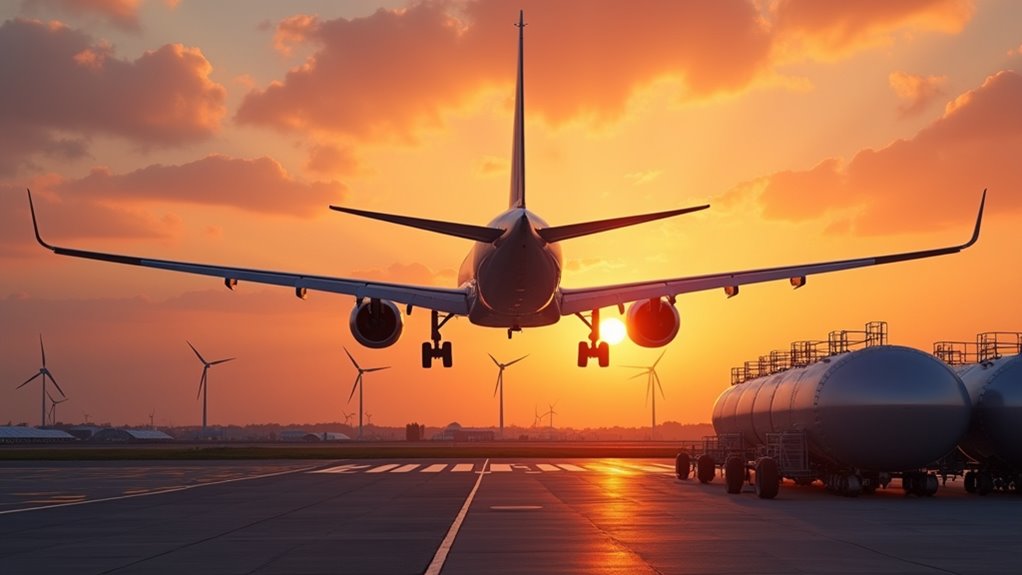
As the aviation industry grapples with its significant carbon footprint, a remarkable alteration is taking place in the skies above. Airlines and manufacturers are racing to develop sustainable solutions that could revolutionize air travel while addressing its environmental impact, which currently accounts for 2.5% of global CO2 emissions and approximately three times that when considering total climate effects. Transportation sector challenges make aviation particularly difficult to decarbonize due to its high power and energy demands compared to other modes of transport. Modern aircraft have achieved 85% better efficiency compared to those from the 1960s, demonstrating significant progress in technological advancement.
At the forefront of this alteration is Sustainable Aviation Fuel (SAF), which offers up to 80% reduction in carbon emissions compared to conventional jet fuel. With over 360,000 commercial flights already powered by SAF across 46 airports, the industry is gaining momentum towards its ambitious goal of consuming 3 billion gallons by 2030 in the United States alone. However, current limitations require SAF to be blended with traditional jet fuel at ratios between 10% and 50%.
SAF leads aviation’s green revolution, slashing emissions by 80% despite current blend restrictions with conventional jet fuel.
Technological innovations are providing additional pathways to sustainability. Aircraft manufacturers are implementing improved aerodynamics, lightweight materials, and more efficient engines. The development of hybrid-electric propulsion systems and hydrogen-powered aircraft concepts suggests a future where zero-emission flights might become reality. The role of policy and regulation is crucial in supporting these technological advancements and ensuring the industry meets its sustainability targets. Electric vehicles are proving to be a transformative force in the sustainable transport sector, inspiring similar advancements in aviation technology.
Meanwhile, next-generation air traffic management systems are optimizing flight paths to reduce fuel consumption. The industry has set bold targets, with global civil aviation aiming for net-zero carbon emissions by 2050. The International Civil Aviation Organization‘s CORSIA program aims to cap net CO2 emissions at 2020 levels through 2035, while individual countries like the UK are targeting domestic flight decarbonization by 2040. Investment in renewable energy is crucial for economic growth and can provide the financial backing needed for technological advancements in aviation.
Airlines are investing heavily in modern, fuel-efficient fleets, while airports are evolving to renewable energy and sustainable ground operations. Yet significant challenges remain. The high costs of sustainable technologies, limited SAF production, and the long lifespan of existing aircraft create substantial barriers to rapid change.
The complexity of international flights makes it difficult to assign emissions responsibility, while public concerns about new propulsion technologies must be addressed. Policy makers are responding with various measures, including carbon pricing mechanisms and potential SAF blending mandates. Some regions are considering bans on short-haul flights where rail alternatives exist, highlighting the need for integrated transportation solutions.
Meanwhile, consumers are becoming increasingly aware of their flight-related carbon footprints, driving demand for carbon offset programs and alternative transportation modes. The path to sustainable aviation requires a delicate balance between growing air travel demand and environmental responsibility. The transition to electric vehicles could provide insights and strategies to accelerate the adoption of similar technologies in aviation.
While complete sustainability may seem distant, the industry’s current trajectory suggests significant progress is possible. Through continued technological innovation, policy support, and market adaptation, aviation could potentially reduce its emissions by up to 94%. The question isn’t whether aviation can become sustainable, but rather how quickly this alteration can be achieved while maintaining the connectivity and economic benefits that air travel provides.
Frequently Asked Questions
How Much Noise Pollution Do Modern Aircraft Generate Compared to Older Models?
Modern aircraft generate markedly less noise compared to their predecessors.
Today’s planes are approximately 75% quieter than early jet models, with each new generation reducing its noise footprint by about 15%.
The latest large aircraft, like the Boeing 787 and Airbus A350, produce substantially smaller noise signatures thanks to technological advances such as high-bypass turbofan engines, improved aerodynamics, and sound-absorbing materials.
The aviation industry continues making progress in noise reduction.
Can Commercial Planes Run Entirely on Solar Power?
Commercial aircraft cannot currently run entirely on solar power due to fundamental technical limitations.
The energy density of batteries is 48 times lower than jet fuel, and solar panels would require more surface area than available on planes.
While small electric aircraft with solar augmentation are possible within 5-10 years, full solar-powered commercial aviation isn’t expected until 2040-2050.
Current solar technology’s efficiency (10-20%) simply can’t generate enough power for large passenger planes.
What Is the Average Carbon Footprint per Passenger on Long-Haul Flights?
Long-haul flights typically generate around 92 grams of CO2 per passenger kilometer traveled.
For perspective, a return flight from Paris to New York produces approximately 2 tonnes of CO2 equivalent per passenger.
The carbon footprint varies based on several factors, including aircraft type, seat class, and load factor.
The general estimate stands at about 250 kg of CO2 equivalent per passenger for each hour of flying time.
Are Electric Planes Viable for International Commercial Flights?
Electric planes currently face significant limitations for international commercial flights.
With battery energy density 40x lower than jet fuel and range constraints of around 30 miles with passengers, long-distance travel remains unfeasible.
While over 1,000 prototypes exist, they’re mainly suited for short regional routes.
Industry projections suggest that even by 2045, only 24% of aircraft will be battery-electric, with international routes requiring breakthrough battery technology developments for viability.
How Do Weather Conditions Affect the Fuel Efficiency of Aircraft?
Weather conditions greatly impact aircraft fuel efficiency in multiple ways. High temperatures reduce air density and engine performance, requiring more fuel for takeoff and cruise.
Headwinds force planes to burn additional fuel to maintain airspeed, while turbulence causes altitude changes that increase consumption.
Precipitation adds aircraft weight and may require de-icing procedures.
Even visibility issues affect fuel use by forcing longer routes or instrument approaches during challenging conditions.


