

Building effective EV charging networks requires a thorough approach addressing both infrastructure and accessibility. The U.S. currently maintains over 161,000 charging ports, yet experts project a need for 12.9 million by 2030. Key challenges include range anxiety, cited by 55% of potential buyers, and ensuring equitable access across urban and rural areas. Smart charging solutions, standardized connectors, and federal uptime requirements are reshaping how Americans power their EVs. The road to sustainable transportation holds promising developments ahead.
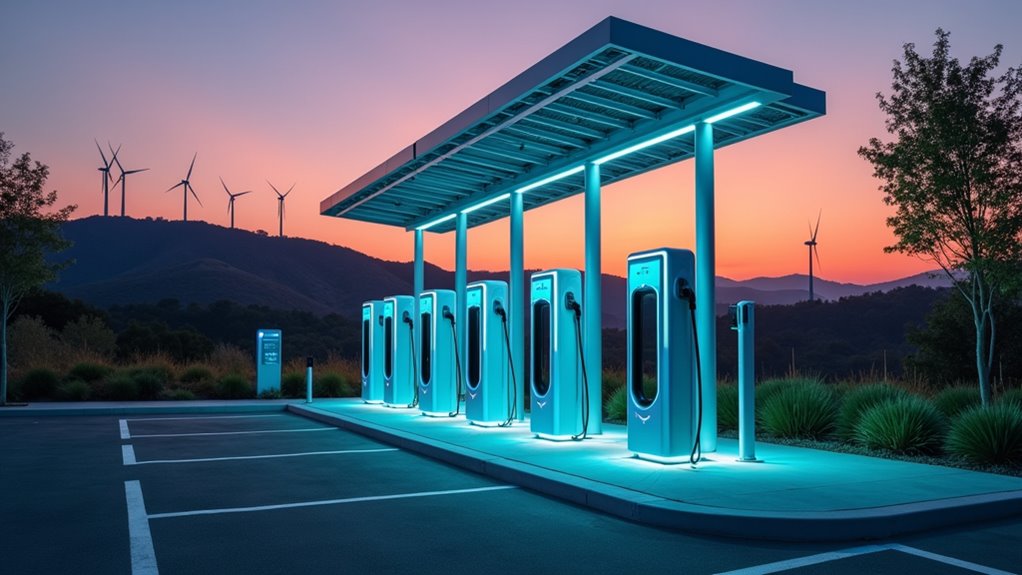
As the electric vehicle revolution accelerates across America, a robust network of charging stations has emerged to power the growing fleet of EVs traversing the nation’s highways and byways. With over 161,000 public and private charging ports nationwide, major networks like Tesla Supercharger, Electrify America, and ChargePoint are leading the charge in building critical infrastructure. These networks offer various charging speeds and connector types to accommodate different vehicle models and charging needs. For many urban residents without dedicated parking, smart charging stations provide essential access to reliable charging options.
The charging landscape consists of three main levels: Level 1 charging, which uses standard 120V outlets and provides 2-5 miles of range per hour; Level 2 charging, operating at 240V and delivering 10-20 miles per hour; and DC fast charging, capable of adding 100-200 miles of range in just 30 minutes. Federal regulations now require that Alternative Fuel Corridors maintain 24/7 accessibility to ensure continuous charging availability for travelers. This variety guarantees that drivers can find appropriate charging solutions whether they’re parked at home, work, or on a cross-country road trip. Embracing sustainable transportation not only reduces emissions but also leads to economic gains, as it stimulates job creation in the green sector. Cities that prioritize sustainable transport initiatives not only benefit from reduced traffic congestion but also improve overall quality of life for their residents.
Despite significant progress, challenges remain in creating truly accessible charging infrastructure. Range anxiety and charging logistics continue to be top concerns for potential EV buyers, with 55% citing range worries as their primary barrier to adoption. The Federal Highway Administration has set ambitious reliability standards, requiring 97% uptime for federally funded chargers, but maintaining consistent service across vast networks poses ongoing challenges. Sustainable transportation initiatives are crucial to addressing these concerns and ensuring that EV infrastructure effectively reduces emissions. As electric vehicles become more prevalent, charging station locations are increasingly important for ensuring coverage in both urban and rural areas.
Looking ahead, the industry faces substantial growth requirements to meet projected demand. Experts estimate that 12.9 million charge ports will be needed by 2030, including 140,000 DC fast charging ports, to support the anticipated surge in EV adoption. This expansion must address not only quantity but also quality and equity concerns, guaranteeing that charging access reaches all communities, including rural and underserved areas.
Network operators are responding with innovative solutions, including mobile charging stations for flexible deployment and wireless charging technology that promises convenience comparable to Level 2 charging. The recent standardization of the Tesla-inspired J3400 (NACS) connector represents a significant step toward greater interoperability, while networked stations provide enhanced features like real-time availability updates and simplified payment options through mobile apps.
The Northeast region has shown particular momentum, with a 13.2% increase in public charging availability in Q2 2024, while California maintains its position as the national leader in charging infrastructure. This growth reflects both public and private sector commitment to supporting the shift to electric vehicles.
As the industry continues to evolve, focus is expanding beyond personal vehicles to include charging solutions for medium and heavy-duty electric vehicles, representing the next frontier in sustainable transportation infrastructure development.
Frequently Asked Questions
How Much Does It Cost to Maintain a Home EV Charging Station?
Maintaining a home EV charging station typically costs between $200-$400 annually.
Basic Level 1 and Level 2 chargers require about $400 yearly for maintenance, while DC fast chargers can exceed $800.
Regular upkeep includes weekly cleaning, connection tightening, and safety checks.
Costs vary based on charger type, location (indoor/outdoor), usage frequency, and weather exposure.
DIY maintenance and prompt repairs can help reduce long-term expenses.
Can EV Charging Networks Handle Simultaneous Charging During Peak Holiday Travel?
Current EV charging networks face significant strain during peak holiday travel periods.
With a BEV-to-charger ratio approaching 100:1 and wait times reaching 90 minutes at popular locations, the infrastructure struggles to meet simultaneous charging demands.
However, solutions like Tesla’s mobile Megapack Chargers and increasing ultrafast charging stations are helping address these challenges.
The planned expansion to 1,400+ chargers by summer 2023/24 should improve capacity, though peak periods will likely remain challenging.
What Happens if My Electric Vehicle Runs Out of Power Mid-Journey?
When an EV’s battery depletes, the vehicle gradually loses power before safely coming to a stop.
Drivers should immediately activate hazard lights and pull over when they notice warning indicators.
Modern EVs provide multiple alerts and display remaining range well before critical levels.
If stranded, roadside assistance can tow to the nearest charging station or provide emergency power through mobile charging units.
Proper trip planning and monitoring range helps avoid this situation entirely.
Are There Mobile Charging Solutions for Emergency Situations on Highways?
Yes, several mobile charging solutions are available for stranded EVs on highways.
Services like Lightning Mobile and FreeWire Mobi provide high-capacity portable chargers that can deliver quick emergency power.
AAA is rolling out mobile EV charging in certain markets, while companies like SparkCharge offer portable units that provide 15 miles of range in just 15 minutes.
Many towing companies now carry mobile chargers, and some insurance providers include emergency charging in their roadside assistance packages.
How Long Do EV Charging Station Components Typically Last Before Requiring Replacement?
EV charging station components have varying lifespans based on their type and usage. Level 2 AC chargers typically last 5-10 years, while DC fast chargers may have shorter lifespans due to higher stress.
Charging cables can endure over 10,000 charges, lasting up to 27 years with daily use. Networking equipment needs updating every 5-7 years, and civil infrastructure can last around 20 years.
Regular maintenance greatly extends component life, though technological advances often prompt earlier upgrades.


