

The EU enforces environmental regulations across 27 member states through a thorough system of shared laws and oversight. Key initiatives include the European Green Deal‘s push for net-zero emissions by 2050, strict pollution controls, and the Nature Restoration Law targeting 90% habitat recovery. The “polluter pays” principle and coordinated enforcement mechanisms guarantee compliance, while programs like Natura 2000 protect vulnerable ecosystems. The EU’s evolving framework offers a blueprint for effective cross-border environmental governance.
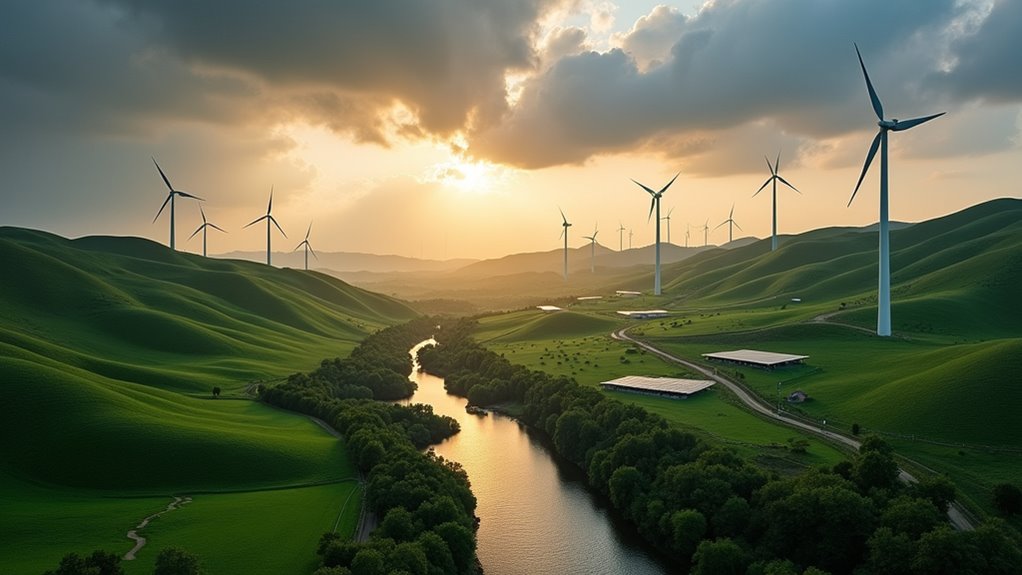
The European Union‘s environmental regulations represent one of the world’s most extensive frameworks for protecting nature and combating climate change. At its core, the EU’s approach rests on fundamental principles like prevention, precaution, and the “polluter pays” concept, which guarantees those who damage the environment bear the costs of cleanup and restoration. Since shared competence exists between the EU and member states in environmental matters, coordination is essential for effective policy implementation. The EU’s approach aligns with global efforts as extreme weather events continue to rise, driven by climate change impacts.
The ambitious European Green Deal, launched in 2019, marked a turning point in the EU’s environmental policy. This thorough framework aims to achieve net-zero emissions by 2050, with an interim target of reducing greenhouse gas emissions by 55% by 2030. The recently adopted Nature Restoration Law goes even further, setting an unprecedented goal to restore 90% of degraded habitats by 2050. The Green Deal ensures no place left behind in the transition to a sustainable economy. Renewable energy, which generates 28% of global electricity, plays a crucial role in meeting these targets by reducing reliance on fossil fuels. Environmental law basics are essential for understanding how such comprehensive frameworks are applied both globally and locally to protect ecosystems and public health. The EU’s efforts to combat climate change also address food and water security concerns, recognizing the interconnected nature of these issues.
The EU’s Green Deal represents a radical shift in environmental ambition, pushing for carbon neutrality while actively restoring Europe’s damaged ecosystems.
The EU manages environmental challenges through a complex web of regulations. REACH and CLP regulations control chemical substances, while RoHS restricts hazardous materials in electronics. The Waste Framework and Landfill directives guarantee proper waste management across member states. These regulations work together to create a unified approach to environmental protection that transcends national borders.
The EU’s commitment to biodiversity protection is exemplified by the Natura 2000 network, which creates a system of protected areas throughout member states. This network, combined with Special Areas of Conservation, helps shield vulnerable species and habitats from threats posed by infrastructure development, agriculture, and logging. The new EU Forest Strategy furthers these efforts by promoting deforestation-free value chains.
Pollution control remains a central focus, with the EU implementing strict air quality standards for pollutants like PM10, NO2, and PM2.5. Urban wastewater treatment requirements and drinking water regulations guarantee clean water access across the continent. The zero pollution ambition for 2050 demonstrates the EU’s determination to create a toxic-free environment.
Enforcement of these regulations relies on a robust governance system. The European Commission actively monitors compliance, while the European Court of Justice can impose financial penalties on non-compliant member states. This system is strengthened by increased transparency and public participation, allowing citizens and NGOs to play a significant role in environmental protection.
The EU’s circular economy initiatives aim to transform how resources are used and reused. Despite currently being off track to double circular material use, new labeling rules for sustainable products and emphasis on resource efficiency continue to push toward decoupling economic growth from resource consumption.
These efforts, combined with promotion of deforestation-free agricultural products, showcase the EU’s all-encompassing approach to environmental stewardship. Through these thorough regulations and initiatives, the EU has created a model for international environmental cooperation that balances economic development with ecological protection.
While challenges remain, the framework continues to evolve, adapting to new environmental threats and opportunities for sustainable development.
Frequently Asked Questions
How Do Non-Eu Countries Adapt Their Industries to Meet EU Environmental Standards?
Non-EU countries adapt their industries through multiple compliance strategies.
Companies invest in cleaner production technologies and implement farm-to-fork practices to reduce harmful inputs. They purchase carbon certificates and align with EU’s Corporate Sustainability Reporting Directive.
Manufacturing processes are modified to meet circular economy requirements, while supply chains adopt extended producer responsibility schemes.
Industries also embrace integrated pest management and sustainable landscape approaches to maintain market access.
What Penalties Do Companies Face for Violating EU Cross-Border Environmental Regulations?
Companies violating EU environmental regulations face substantial financial consequences.
Severe offenses can result in fines up to 5% of annual worldwide turnover or €40 million, while lesser violations incur 3% or €24 million penalties.
Beyond fines, companies must restore damaged environments, may lose licenses and public funding access, and risk closure in extreme cases.
Corporate leaders face personal criminal liability including imprisonment up to 10 years for deaths caused by violations.
Can Individual EU Member States Create Stricter Environmental Rules Than EU Regulations?
Yes, EU member states can establish stricter environmental regulations than EU-wide standards, but with important limitations.
While countries like Sweden, Denmark, and Germany have successfully implemented tougher rules on chemicals, emissions, and air quality, these measures must not obstruct EU single market principles or create unfair trade barriers.
All stricter national rules require European Commission notification and must remain proportionate, non-discriminatory, and compatible with EU treaties.
How Does Brexit Impact EU Environmental Regulations in the United Kingdom?
Brexit fundamentally changed environmental regulation in the UK.
While the EU Withdrawal Act initially preserved EU environmental laws, the UK is no longer bound by EU enforcement mechanisms.
The new Office for Environmental Protection replaced EU oversight but has weaker enforcement powers.
This creates potential risks of regulatory divergence across the UK nations.
However, Brexit also gives the UK flexibility to potentially exceed EU standards in certain areas.
What Role Do NGOS Play in Shaping EU Environmental Policies?
Environmental NGOs play several vital roles in shaping EU environmental policies.
They serve as policy entrepreneurs by setting agendas and providing expert advice to EU institutions. These organizations build coalitions to increase their influence and frame environmental issues to gain political attention.
NGOs also receive significant EU funding through programs like LIFE (€5.4 billion for 2021-2027) to support their work, though recent restrictions have limited their advocacy activities.


