

Coastal Zone Management shields shorelines through multiple coordinated strategies. Federal and state partnerships implement protective measures like seawalls, managed retreat from vulnerable areas, and ecosystem restoration projects. By monitoring shoreline changes with advanced technology, authorities can respond to emerging threats while balancing development with environmental protection. Modern approaches include raising infrastructure, restoring natural buffers like mangroves, and reducing ocean pollution. The evolving field continues to disclose innovative solutions for tomorrow’s challenges.
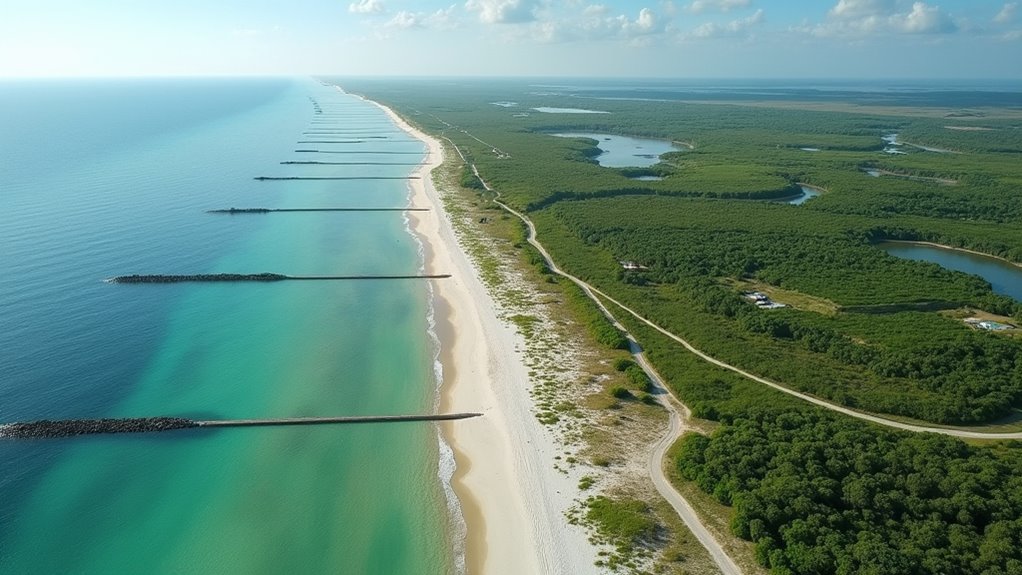
The delicate balance between human development and environmental protection plays out dramatically along the world’s coastlines, where over 40% of the global population meets the sea. With coastal populations growing faster than inland areas, the need for effective coastal zone management has never been more urgent. By 2020, 75% of people are expected to live within 60 kilometers of shorelines. Since 1972, the Coastal Zone Management Act has provided an essential framework for protecting these critical areas while supporting sustainable development.
The challenge of coastal management lies in its complexity – multiple economic sectors compete for limited resources while environmental pressures mount. Through integrated approaches, coastal managers work to balance these competing demands using a variety of tools and strategies. From video-based monitoring systems to wireless sensor networks, modern technology enables real-time tracking of coastal changes and early warning for potential hazards. The warming waters associated with climate change further complicate coastal management efforts, as they can disrupt marine ecosystems and exacerbate issues such as rising sea levels. Restoring coastal ecosystems such as seagrass and mangroves can also play a significant role in buffering shorelines against erosion and storm surges. Efforts to reduce ocean pollution further contribute to maintaining the health and resilience of coastal areas.
Modern coastal management requires balancing economic interests with environmental protection through sophisticated monitoring and early warning systems.
States play a pivotal role in this process, with 34 out of 35 eligible coastal states and territories participating in federal partnerships. These partnerships guarantee that federal actions remain consistent with state coastal policies, creating a coordinated approach to shoreline protection. When conflicts arise, established mediation processes help resolve disagreements between different levels of government. Water conservation is also crucial in supporting sustainable agriculture, which, in turn, impacts coastal management efforts by ensuring that water resources are used efficiently and responsibly.
The toolkit for protecting coastlines includes various strategies, each suited to different situations. Some communities choose managed retreat, gradually moving away from vulnerable areas. Others opt for armoring their shores with seawalls or constructing defensive structures offshore. Vertical adaptation – raising buildings and infrastructure – offers another solution for areas committed to maintaining their coastal presence.
Internationally, at least 107 coastal developing nations have embraced Integrated Coastal Zone Management (ICZM), recognizing that effective shoreline protection requires a multidisciplinary approach. This all-encompassing strategy brings together all stakeholders, from local fishing communities to urban developers, guaranteeing that decisions reflect diverse perspectives and needs.
The success of coastal management often depends on careful monitoring and analysis. Scientists track shoreline changes over time, integrating population data with environmental studies to predict future trends. These insights help communities make informed decisions about development, conservation, and adaptation strategies. Weather stations and buoys provide essential data about approaching storms, while sophisticated modeling helps predict long-term changes in sea level and coastal erosion patterns.
Despite the challenges, coastal zone management continues to evolve and improve. New technologies and better understanding of coastal processes enable more effective protection strategies. While some areas face tough choices about retreat or fortification, others are finding innovative ways to work with natural processes rather than against them.
Through careful planning and implementation of protective measures, communities can maintain their connection to the coast while guaranteeing these critical areas remain resilient for future generations.
Frequently Asked Questions
How Much Does Coastal Zone Management Implementation Typically Cost for Local Governments?
Local governments typically shoulder 35% of coastal zone management costs, with total project expenses ranging from tens to hundreds of millions over time.
Different approaches vary considerably in cost: seawalls average $5,628 per unit, while nature-based solutions cost around $1,300-$1,626 per unit.
Municipalities often fund these projects through bonds, fees, and taxes, while benefiting from federal grants that cover up to 65% of costs.
Regional cooperation helps reduce overall expenses.
What Career Opportunities Are Available in Coastal Zone Management?
Career opportunities in coastal zone management span multiple sectors.
Government positions at federal agencies like NOAA and EPA offer stable roles in policy and regulation.
Private consulting firms hire specialists for environmental assessments and engineering projects.
Research institutions need experts to study coastal processes and climate impacts.
Local governments employ managers for shoreline planning, while nonprofits focus on conservation.
Many positions require advanced degrees in environmental science or related fields.
How Do Private Property Owners Benefit From Coastal Zone Regulations?
Private property owners gain significant advantages from coastal zone regulations.
These rules help preserve property values by preventing erosion, reducing flood risks, and maintaining land stability. Setback requirements and construction standards protect structures from coastal hazards, while buffer zones filter pollutants and preserve wildlife habitats.
Property owners also benefit from reduced liability through access waivers, flood insurance programs, and storm damage prevention measures.
Additionally, regulations support sustainable economic development through tourism and recreation opportunities.
Which Countries Have the Most Successful Coastal Management Programs?
Several nations stand out for exemplary coastal management.
The United States leads with extensive coverage through the Coastal Zone Management Act, protecting 34 coastal states.
Palau’s innovative shark sanctuary and marine protected areas demonstrate strong conservation leadership.
The Philippines’ Tubbataha Reefs program shows successful balance between local fishing and ecosystem protection.
Namibia’s fisheries management system and Sri Lanka’s long-running coastal program have also gained international recognition for effectiveness.
How Long Does It Take to See Results From Coastal Protection Measures?
Coastal protection measures show results across different timeframes.
Initial impacts emerge within months, including visible shoreline changes and reduced erosion.
Within 1-5 years, vegetation expands and biodiversity increases in protected areas.
Medium-term results (5-10 years) reveal significant beach width improvements and mature vegetation establishment.
Long-term outcomes (10+ years) demonstrate full ecosystem integration, proven storm resilience, and substantial erosion reduction along protected coastlines.


