

Climate change is profoundly altering Earth’s oceans through multiple interconnected crises. Oceans have absorbed 90% of excess heat from global warming, causing temperatures to rise 0.14°F per decade since 1901. This warming triggers rising sea levels, increased acidification from CO2 absorption, and expanding oxygen-depleted “dead zones.” Marine ecosystems face unprecedented disruption as species relocate and coral reefs deteriorate. The economic toll on coastal communities and fisheries reveals deeper challenges beneath the surface.
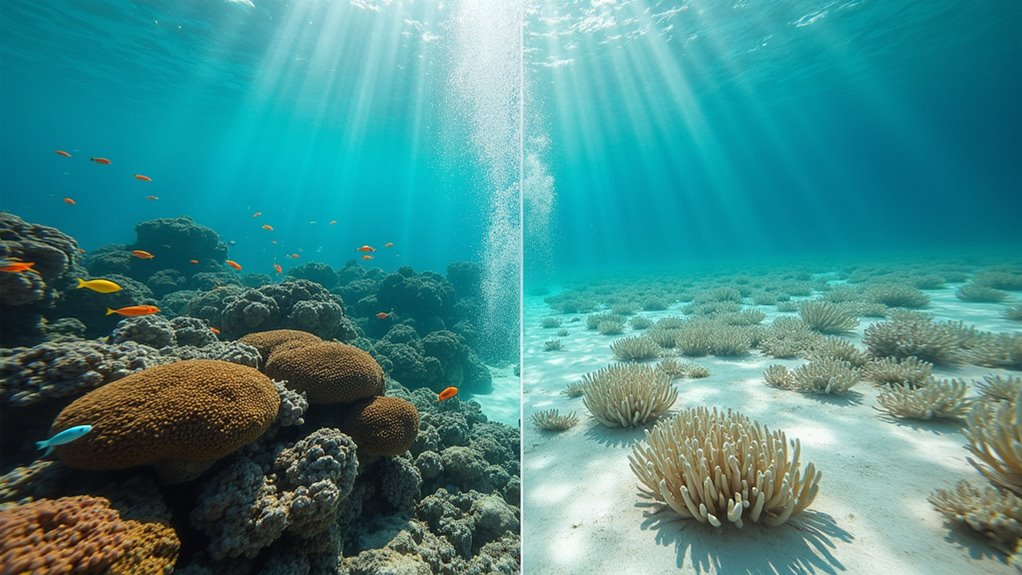
While the world’s oceans have long served as Earth’s primary defense against climate change, absorbing 90% of excess heat from global warming, these vast bodies of water are now showing unprecedented signs of strain. Global ocean temperatures have been steadily climbing at a rate of 0.14°F per decade since 1901, with 2023 marking record-breaking highs. This warming trend isn’t just a number on a thermometer – it’s fundamentally altering marine ecosystems and forcing species to relocate in search of more hospitable waters. Approximately one-third of CO2 from human activities is absorbed by the oceans, making them increasingly acidic.
Earth’s oceanic shield against climate change is weakening, as rising temperatures force marine life to flee their ancestral waters.
The consequences of ocean warming extend far beyond temperature changes. Since 1992, global sea levels have risen more than four inches, primarily due to thermal expansion and melting ice sheets. Scientists project an additional 12-inch increase by 2050, threatening coastal communities and ecosystems with increased flooding and erosion. These rising waters are already forcing some coastal residents to contemplate relocation, while others scramble to build protective infrastructure. Mangrove forests and wetlands are particularly vulnerable to these rising sea levels. The Arctic is warming at 2-3 times the global average rate, leading to significant biome shifts that affect polar marine life and habitats. Protecting ecosystems like coral reefs is vital for maintaining marine biodiversity. Many of these biodiversity-rich regions are considered marine biodiversity hotspots, areas with significant conservation value.
Perhaps most alarming is the chemical transformation occurring beneath the waves. As oceans absorb atmospheric carbon dioxide, their pH levels have dropped from 8.11 in 1985 to 8.05 in 2021, representing a 30% increase in acidity since pre-industrial times. This process, known as ocean acidification, poses a particular threat to shell-forming organisms and coral reefs, which struggle to build and maintain their structures in more acidic waters.
The situation is further complicated by deoxygenation, as warming waters hold less dissolved oxygen. This has led to the expansion of “dead zones” – areas where oxygen levels are too low to support most marine life. These zones, particularly prevalent in coastal waters, create underwater deserts where few species can survive, disrupting food webs and ecosystem balance.
The economic implications of these changes are staggering. By 2100, the loss in recreational benefits from coral reefs alone could reach $140 billion. Fishing communities worldwide are already experiencing the effects of shifting fish populations, while coastal tourism destinations grapple with eroding beaches and damaged reef systems.
However, the story isn’t without hope. Scientists and policymakers are actively developing strategies to address these challenges. Marine protected areas are being established to provide safe havens for vulnerable species, while innovative aquaculture practices are being developed to promote food security in a changing ocean. Improved monitoring systems are helping us better understand and predict ocean changes, enabling more effective adaptation planning.
The key to protecting our oceans lies in immediate action to reduce greenhouse gas emissions while simultaneously strengthening coastal community resilience. Through a combination of global cooperation, technological innovation, and local adaptation efforts, we can work to preserve these essential ecosystems that have sustained life on Earth for millions of years.
The oceans’ future – and by extension, our own – depends on the choices we make today.
Frequently Asked Questions
How Can Individuals Help Protect Marine Ecosystems From Climate Change Impacts?
Individuals can protect marine ecosystems through targeted actions that reduce their environmental impact.
Using energy-efficient appliances, choosing sustainable seafood with MSC certification, and minimizing single-use plastics creates meaningful change.
Participating in beach cleanups, supporting coral reef restoration, and making ocean-friendly lifestyle choices like eco-friendly sunscreens also helps.
Additionally, conserving water and proper chemical disposal prevents harmful runoff into marine environments.
What Marine Species Are Most Vulnerable to Extinction Due to Ocean Changes?
Several marine species face severe extinction risks due to ocean changes. The vaquita porpoise, with only 10 individuals remaining, stands at the brink.
Coral species are especially vulnerable, with 26 Atlantic species critically endangered and up to 99% projected to vanish with a 2°C temperature rise.
Multiple sea turtle species – hawksbill, leatherback, and loggerhead – face critical threats.
Bluefin tuna populations continue declining, while abalone species suffer from both climate impacts and poaching.
Can Coral Reefs Adapt Quickly Enough to Survive Rising Ocean Temperatures?
While some corals show promising signs of heat adaptation through genetic changes and shifting algae partnerships, current warming rates may be too rapid for widespread natural adaptation.
Research indicates that 99% of reefs could disappear by 2100 without emissions reductions.
However, certain resilient coral communities demonstrate adaptation potential if given time.
The key is reducing warming rates while protecting diverse reef networks that allow heat-adapted larvae to spread and repopulate damaged areas.
How Do Changing Ocean Currents Affect Coastal Communities and Economies?
Changing ocean currents greatly impact coastal communities through multiple economic and ecological pathways.
When currents shift, they alter fish migration patterns, disrupting local fishing industries and traditional catch zones. These changes affect tourism revenue, port operations, and shipping routes.
Communities face increased flooding risks and infrastructure damage from modified wave patterns. Local economies must often adapt by diversifying beyond fishing and tourism, while implementing new coastal protection measures.
What Technologies Are Being Developed to Monitor and Protect Ocean Health?
Advanced technologies are revolutionizing ocean health monitoring.
Autonomous underwater vehicles equipped with sophisticated sensors track water quality and marine life, while environmental DNA detection helps assess biodiversity.
Satellite systems measure sea surface temperatures and chlorophyll levels.
AI and machine learning analyze vast datasets, while citizen science apps enable public participation.
Global networks like NOAA’s IOOS and the Argo float system provide continuous, real-time monitoring of ocean conditions worldwide.


