

Marine wildlife conservation protects essential ocean ecosystems that generate $24 trillion in economic value and support billions of lives worldwide. Through Marine Protected Areas, which cover 7.74% of oceans, marine life abundance has increased by 21% within protected zones. Despite challenges like plastic pollution and overfishing threatening species like sharks and coral reefs, community-led conservation efforts and sustainable fishing practices offer hope. The future of our oceans depends on expanding these protective measures and exploring innovative solutions.
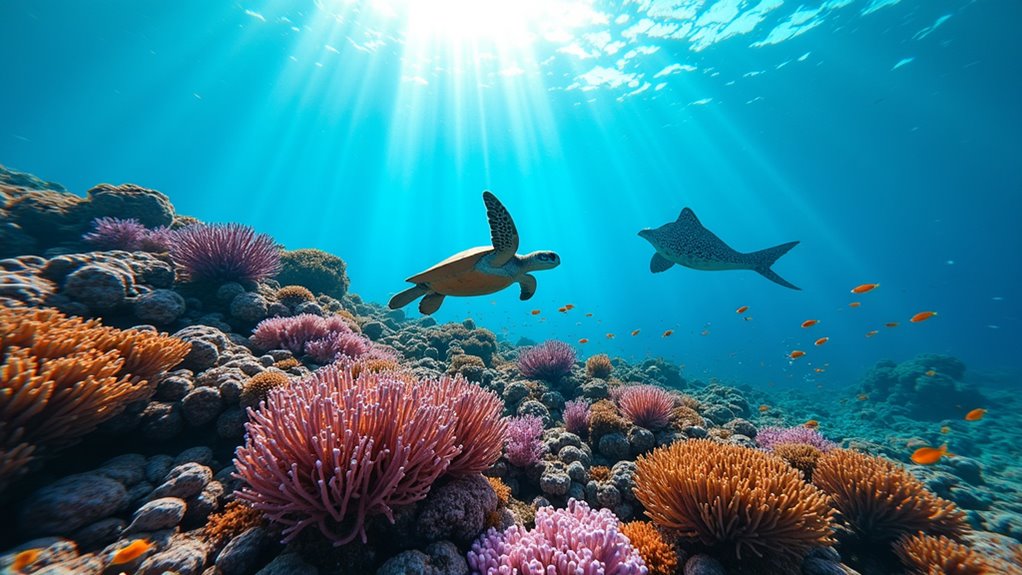
The delicate balance of our ocean ecosystems hangs in a precarious state, yet marine wildlife conservation efforts worldwide are showing promising signs of recovery and resilience. Marine Protected Areas, covering 7.74% of the world’s oceans as of 2020, have demonstrated remarkable success in safeguarding biodiversity and increasing marine life abundance by 21% within their boundaries. These protected zones serve as essential refuges for endangered species while enhancing ecosystem resilience against the mounting pressures of climate change. The establishment of conservation zones is crucial for preserving marine ecosystems and supporting biodiversity. Cultural traditions of indigenous coastal communities have long emphasized the importance of ocean conservation and sustainable resource management.
The challenges facing our oceans are formidable and diverse. Each year, approximately 9 million tons of plastic waste infiltrate marine environments, while destructive fishing practices continue to deplete fish populations. The situation is particularly dire for certain species – 30% of sharks and rays face extinction threats, while Hawaiian monk seals struggle with significant population decline. Climate change compounds these challenges, triggering ocean acidification and mass coral bleaching events that threaten entire marine ecosystems. Coral reef degradation is particularly severe in Southeast Asia, where up to 88% of reefs face serious threats. Sustainable fisheries management is essential in addressing these challenges, as it focuses on balancing the needs of human consumption with the health of marine ecosystems. Biodiversity hotspots, which are areas with extraordinary species diversity under threat, highlight the urgent need for global conservation efforts.
Ocean ecosystems face unprecedented threats from plastic pollution, overfishing, and climate change, pushing many marine species toward extinction’s edge.
Despite these sobering statistics, conservation strategies are yielding positive results through multi-faceted approaches. Sustainable fisheries management practices, coupled with artificial reef creation, are helping to rebuild marine populations. Local communities are increasingly engaged in conservation efforts, recognizing that healthy oceans are fundamental to their livelihoods. Global campaigns also play a crucial role in addressing ocean pollution, with initiatives focused on reducing plastic waste and promoting sustainable fishing practices.
The ocean economy, valued at an astounding $24 trillion, supports over 100 million people through small-scale fisheries alone, while marine tourism continues to be an important economic driver for coastal communities.
Legal frameworks have emerged as powerful tools in protecting marine life. The Marine Mammal Protection Act and Endangered Species Act collectively shield hundreds of species from exploitation, while international laws regulate potentially harmful activities like deep-sea mining. These protections, combined with regional initiatives such as California’s Marine Life Protection Act, create a robust foundation for conservation success.
Looking ahead, the future of marine conservation is focused on achieving nature-positive oceans by 2030. This ambitious goal involves expanding community-led resource management, developing sophisticated ecological forecasts, and integrating climate change mitigation strategies into conservation planning. The potential for discovery remains vast – marine ecosystems continue to yield promising possibilities for biomedical breakthroughs, highlighting the importance of preserving these underwater domains.
The path forward requires sustained commitment and innovation. While current protection measures have shown effectiveness, expanding Marine Protected Areas and strengthening enforcement mechanisms remains essential.
Success stories, such as the increasing abundance of marine life within protected zones, demonstrate that conservation efforts can yield tangible results when properly implemented and supported. Through continued scientific research, policy development, and community engagement, marine wildlife conservation stands as a proof of humanity’s capacity to protect and restore the natural systems upon which we all depend.
Frequently Asked Questions
How Do Marine Animals Adapt to Increasing Ocean Temperatures?
Marine animals employ multiple adaptation strategies to survive rising ocean temperatures. Their bodies adjust metabolically, developing heat-resistant proteins and modified enzyme activities.
Many species migrate to cooler waters or deeper depths, while others alter their feeding and breeding patterns. Through natural selection, heat-tolerant genetic variants emerge across generations.
Some species form new relationships within their ecosystems, modifying predator-prey dynamics and habitat use to guarantee survival.
What Role Do Marine Mammals Play in Maintaining Coral Reef Ecosystems?
Marine mammals play crucial roles in sustaining coral reef ecosystems through several key mechanisms.
Through the “whale pump” process, they transport and distribute essential nutrients like nitrogen and iron across ocean regions, stimulating phytoplankton growth that benefits reefs. Their movements help stir up ocean sediments, redistributing nutrients.
They also maintain biodiversity by controlling fish populations around reefs through predation, while their presence creates protected microhabitats and deters other predators, supporting overall reef health.
Can Extinct Marine Species Be Brought Back Through Genetic Engineering?
While genetic engineering techniques like CRISPR make de-extinction theoretically possible for marine species, significant challenges remain.
Scientists can potentially reconstruct partial genomes from preserved DNA, but creating exact replicas is unlikely. Instead, hybrid versions combining ancient and modern DNA could be developed.
Several marine candidates exist, including the great auk, though success would require addressing habitat loss and environmental changes that led to their original extinction.
How Do Shipping Routes Affect Whale Migration Patterns?
Shipping routes considerably disrupt whale migration patterns through multiple mechanisms.
The 300% increase in maritime traffic since 1992 has created busy corridors that intersect with 92% of large whale habitats. Ships generate underwater noise that doubles every decade, interfering with whales’ communication and navigation.
Additionally, rising ocean temperatures force whales to alter traditional migration paths, moving farther north to find food, while dodging increasingly congested shipping lanes.
What Percentage of Marine Species Remain Undiscovered in Deep Ocean Environments?
Scientists estimate that approximately 91% of marine species in deep ocean environments remain undiscovered.
With only about 243,613 marine species currently documented, researchers believe there could be 1-2 million species yet to be found.
This knowledge gap is largely due to the challenges of exploring deep-sea habitats, which make up 95% of Earth’s living space.
Limited technology and extreme conditions like high pressure and darkness make these areas particularly difficult to study.


