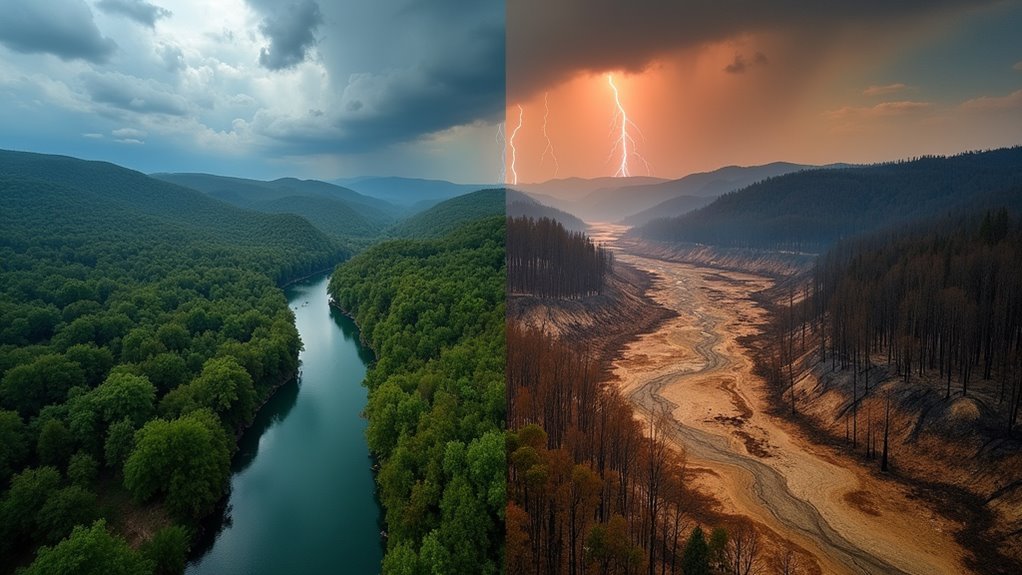

Climate change acts as a disaster multiplier, dramatically increasing both the frequency and intensity of extreme weather events. The U.S. now faces over 17 major weather disasters annually, compared to just 3.3 in the 1980s, with costs soaring to $2.77 trillion. Rising temperatures fuel stronger hurricanes, longer droughts, and deadlier wildfires, while vulnerable communities bear the heaviest burden. Addressing this growing threat requires understanding how these complex climate forces interact and reshape our world.
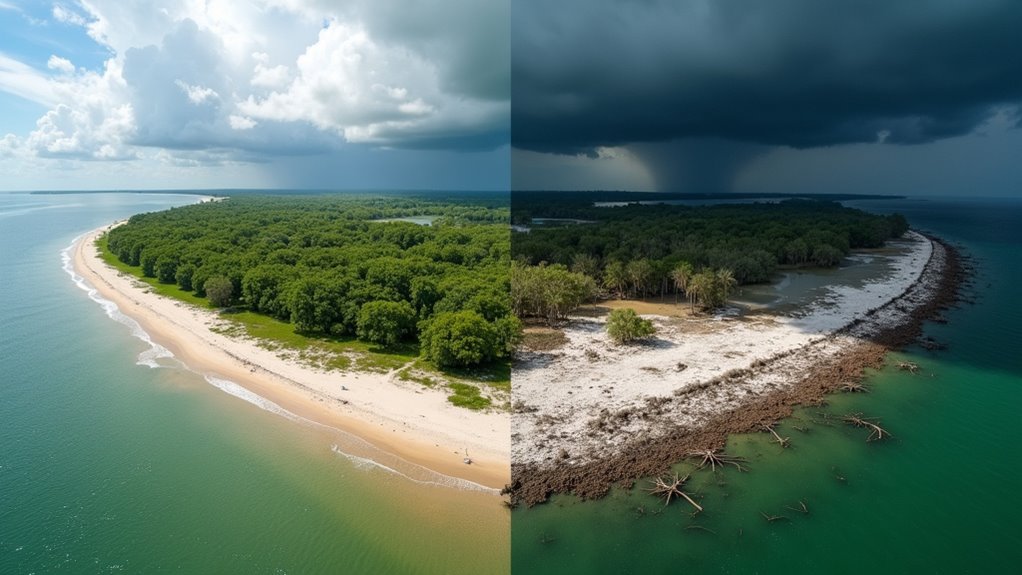
While scientists have long warned about the growing connection between climate change and extreme weather, recent data paints an alarming picture of just how quickly disaster risks are escalating. The frequency of weather-related disasters has skyrocketed from just 3.3 per year in the 1980s to more than 17 annually in recent years. This dramatic increase isn’t just about numbers – it’s translating into devastating human and economic costs across the globe. Shared Socioeconomic Pathways predict varying levels of challenges for future climate adaptation and mitigation efforts.
The United States alone has experienced 395 natural weather disasters exceeding $1 billion in damages since 1980, with 2023 setting a grim new record of 28 such events. These disasters have extracted a staggering toll of $2.77 trillion in total costs, with the last decade showing a particularly concerning acceleration. The five-year annual cost average has now surged to $120.6 billion, more than double the 44-year inflation-adjusted average. Tropical cyclones contribute the highest total costs and fatalities among all disaster types. Innovative farming practices are crucial in mitigating some of the economic impacts by ensuring a stable food supply amid climate variability. Climate models have accurately forecasted warming trends since the 1970s, helping us understand the potential for future extreme weather events. Implementing early warning systems can significantly reduce the human and economic toll by providing timely alerts and enabling proactive measures.
The geographic distribution of these impacts reveals certain regions bearing a disproportionate burden. Texas leads the nation with 186 billion-dollar disasters since 1980, while Florida and Louisiana have each sustained over $300 billion in damages. The South, Central, and Southeast regions consistently face the highest costs from these catastrophic events. Meanwhile, Alaska’s north coast is literally disappearing, retreating about 1.4 meters annually due to erosion. Increased rates of eco-anxiety and depression are also linked to these climate change effects, adding to the mental health burden.
The American South shoulders a crushing burden of climate disasters, with Texas, Florida, and Louisiana bearing the brunt of escalating environmental devastation.
These climate-driven disasters manifest in various forms, from intensifying hurricanes and prolonged droughts to devastating wildfires. Rising temperatures are creating perfect conditions for wildfires by drying out vegetation, while an intensifying water cycle leads to both extreme flooding and severe dry spells. Sea level rise compounds these challenges, particularly during hurricane storm surges.
The human toll is equally sobering. Europe currently experiences over 60,000 annual deaths from extreme weather events, with projections suggesting this number could quadruple to more than 250,000 by 2050. Heat waves are increasingly linked to acute renal failure, dehydration, and respiratory diseases, while cardiac problems and COPD cases rise with global warming. In the United States, billion-dollar disasters have claimed 16,500 lives since 1980.
Perhaps most troubling is how these impacts disproportionately affect vulnerable populations. Low-income communities often reside in high-risk areas and lack resources to cope with disasters. Rural communities face mounting pressure as their traditional livelihoods become less sustainable, leading to increased urban migration. This pattern creates a cycle where climate change magnifies existing social and economic disparities.
The message is clear: climate change isn’t just an environmental issue – it’s a threat multiplier that increases the frequency, intensity, and cost of natural disasters. As these risks continue to escalate, the need for thorough adaptation strategies and risk reduction measures becomes increasingly urgent. The data suggests we’re at a critical juncture where action isn’t just desirable – it’s essential for our collective future.
Frequently Asked Questions
How Can Individuals Reduce Their Personal Contribution to Climate Change?
Individuals can markedly reduce their carbon footprint through daily choices.
Switching to public transit, walking, or electric vehicles cuts transportation emissions.
Adopting a plant-based diet and minimizing food waste helps combat agricultural emissions.
At home, improving insulation, using energy-efficient appliances, and considering solar panels decreases energy consumption.
Smart consumption habits like buying less, choosing durable goods, and recycling further minimize environmental impact.
What Role Does Urban Planning Play in Minimizing Climate Disaster Risks?
Urban planning plays a critical role in building climate-resilient cities through strategic development and risk management.
By steering growth away from vulnerable areas and implementing green infrastructure like parks and permeable surfaces, cities can better handle extreme weather.
Smart zoning laws, early warning systems, and nature-based solutions help protect communities.
When planners integrate climate considerations into development decisions, they create safer, more adaptable urban spaces that can withstand future challenges.
How Do Insurance Companies Assess Climate-Related Risks for Property Coverage?
Insurance companies employ sophisticated data analytics and catastrophe modeling to evaluate climate risks for properties.
They analyze historical disaster data, integrate climate science projections, and utilize AI to process vast datasets from satellites and sensors.
Risk assessments consider property-specific factors like construction type, location, and existing mitigation measures.
Companies adjust premiums and coverage based on granular risk profiles, often implementing higher rates or coverage restrictions in vulnerable regions while incentivizing resilience improvements.
Which Regions Are Most Vulnerable to Climate-Driven Disasters in Coming Decades?
Several regions face heightened climate disaster risks in coming decades.
Southeast Asia and South Asia are particularly vulnerable to flooding and cyclones.
The Western U.S. and Mediterranean region will likely experience more severe droughts and wildfires.
Low-lying Pacific islands and coastal areas face existential threats from rising seas.
Sub-Saharan Africa’s drought risk continues to grow, while the Arctic faces rapid coastal erosion from thawing permafrost.
How Do Climate Disasters Affect Mental Health in Impacted Communities?
Climate disasters take a severe toll on mental health in affected communities.
Research shows 25-50% of survivors experience conditions like PTSD, anxiety, and depression. Vulnerable groups – including children, elderly, and low-income populations – face heightened risks.
Beyond immediate trauma, communities grapple with long-term effects like chronic stress, climate anxiety, and disrupted social networks.
While mental health services often become overwhelmed post-disaster, building community resilience remains essential for recovery.


