Companies are revolutionizing product design through circular economy innovations that eliminate waste. MUD Jeans’ rental programs and Re:newcell’s recycled cotton technology transform the fashion industry, while Beautycounter and Humankind pioneer refillable personal care items. Electronics manufacturers embrace modular designs and repair initiatives, as food companies like Imperfect Foods tackle food waste. These circular solutions prove that sustainability and profitability can coexist, creating regenerative cycles that benefit both business and planet. The transformation of waste into valuable resources is just beginning to unfold.
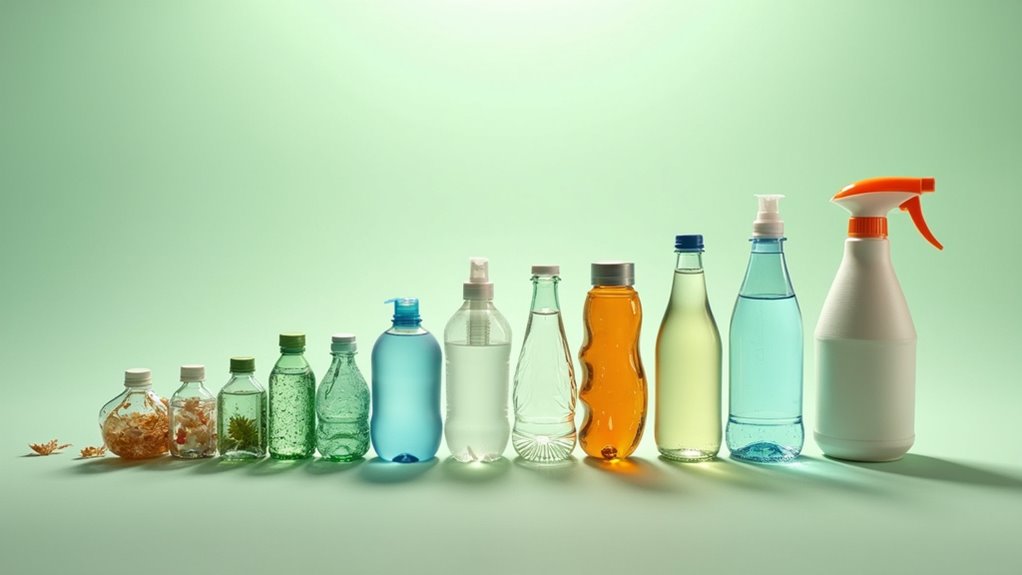
Innovation in circular economy products is revolutionizing how consumers interact with everyday items, transforming traditional take-make-dispose models into regenerative cycles of use and reuse. Companies across sectors are rethinking product design to eliminate waste and extend resource lifecycles. From personal care to electronics, pioneering brands are proving that sustainability and profitability can coexist. By transitioning to circular models, industries can slash trash volumes, creating a more sustainable future.
The fashion and textiles industry, traditionally known for its environmental impact, is experiencing a remarkable shift. Companies like MUD Jeans have introduced innovative rental programs for organic denim, while Re:newcell’s breakthrough Circulose® technology transforms worn cotton into new fibers. Napapijri’s Circular Series takes this concept further by creating jackets from single recyclable polymers, making end-of-life recycling more efficient. The industry’s carbon footprint could reach 60% of global emissions by 2030 without intervention. Renewable energy has the potential to decarbonize 90% of the power sector by 2050, which could significantly reduce emissions from industries like fashion.
Refillable packaging solutions are gaining momentum across consumer goods. Beautycounter’s refillable deodorant and by Humankind’s personal care products demonstrate how simple design changes can dramatically reduce plastic waste. The subscription model allows consumers to receive regular refill deliveries as needed. SodaStream’s home carbonation system eliminates the need for single-use bottles, while Everdrop’s concentrated cleaning tablets minimize packaging and transportation impacts.
Simple design solutions like refillable packaging and concentrated formulas are transforming consumer goods while dramatically reducing plastic waste and environmental impact.
The electronics sector is embracing circularity through modular design and repair initiatives. Dagoma’s Toy Rescue program offers 3D-printable replacement parts, extending product lifespans. The growing right to repair movement, supported by new legislation, is making it easier for consumers to fix rather than replace their devices. Refurbished electronics marketplaces are creating robust secondhand markets for smartphones, laptops, and other devices.
In construction, circular innovation is revolutionizing building materials. NaturalMat’s easily disassembled mattresses and bio-based insulation materials showcase how design can facilitate end-of-life recycling. The use of reclaimed wood, circular concrete, and cradle-to-cradle certified products is transforming construction practices. Resource recovery facilities play a crucial role in managing construction waste, diverting valuable materials from landfills and reintroducing them into the production cycle.
Food systems are being reimagined through waste reduction initiatives. Imperfect Foods tackles food waste by selling “ugly” produce, while composting services convert food scraps into valuable soil amendments. Vertical farming systems and plant-based alternatives are reducing agriculture’s environmental footprint. Innovative biogas systems transform food waste into renewable energy, closing the loop on organic materials. Waste-to-energy solutions are increasingly seen as effective ways to manage organic waste while generating power.
Industrial symbiosis represents perhaps the most ambitious implementation of circular principles. The Kalundborg Symbiosis industrial park demonstrates how one company’s waste can become another’s resource. Agricultural residues are being transformed into bioplastics and textiles, while captured CO2 finds new life in concrete curing and synthetic fuels. These innovations show that waste isn’t waste until we waste it.
Transportation systems are also embracing circular principles through car-sharing programs, electric vehicle battery recycling, and remanufactured auto parts. Bike-sharing initiatives are making sustainable urban mobility more accessible, while aviation maintenance practices increasingly focus on component reuse and repair.
Frequently Asked Questions
How Much Money Can Businesses Save by Implementing Circular Economy Practices?
Businesses can achieve substantial cost savings through circular economy practices.
Studies show up to 70% cost reduction for companies switching to circular models, with average savings of £24,000 per business.
Raw materials typically account for 30-50% of production costs, while water and energy efficiency can save 8% of turnover.
On a larger scale, the EU could realize €600 billion in annual savings through improved resource productivity.
What Certification Standards Exist for Circular Economy Products?
Several key certification standards validate circular economy products and practices.
Cradle to Cradle (C2C) certification evaluates products across five categories, offering Bronze through Platinum levels.
ISO’s circular economy standards provide frameworks for implementation and measurement.
The Circular Economy Institute (CEI) certification focuses on organizational commitment, while ISCC PLUS validates sustainable feedstocks and recycling processes.
These standards help businesses demonstrate their circular practices while ensuring accountability.
Which Countries Are Leading the Circular Economy Product Innovation?
Several nations are spearheading circular economy innovation.
The Netherlands leads with ambitious goals, targeting 100% circularity by 2050 and pioneering sustainable construction.
Germany excels in circular patents and startup acceleration, while France innovates through strict regulations on product repair and waste.
Japan’s long-standing focus on recycling and industrial innovation has produced remarkable results, and China’s integration of circular principles into national planning demonstrates growing commitment to sustainable product development.
How Long Does It Take to Develop Circular Economy Products?
The development timeline for circular economy products typically ranges from 6 months to 3+ years, depending on complexity.
Digital products are faster at 3-6 months, while physical consumer goods average 1-2 years.
The process involves key stages: research (1-3 months), design (2-6 months), testing (2-6 months), pilot production (3-6 months), and launch (2-6 months).
Companies can accelerate development through digital tools, rapid prototyping, and agile methodologies.
What Financial Incentives Exist for Companies Producing Circular Economy Products?
Companies developing circular economy products can access diverse financial incentives.
Government grants provide up to €20,000 for entrepreneurs, while tax breaks benefit businesses using recycled materials.
Extended Producer Responsibility schemes offer reduced charges for circular practices.
Market-based incentives include green bonds and preferential procurement policies.
Low-interest loans and R&D funding support sustainability initiatives, while tax credits reward verifiable carbon emission reductions and eco-design innovations.