

Modern municipal waste management combines smart technology and community action to handle the 292 million tons of annual U.S. waste effectively. Cities now prioritize source reduction and reuse before moving to recycling and composting, which currently recover 32.1% of materials. While 146.1 million tons still reach landfills yearly, innovative approaches like energy recovery and extended producer responsibility are transforming trash into valuable resources. Understanding these systems reveals promising solutions for cleaner cities.
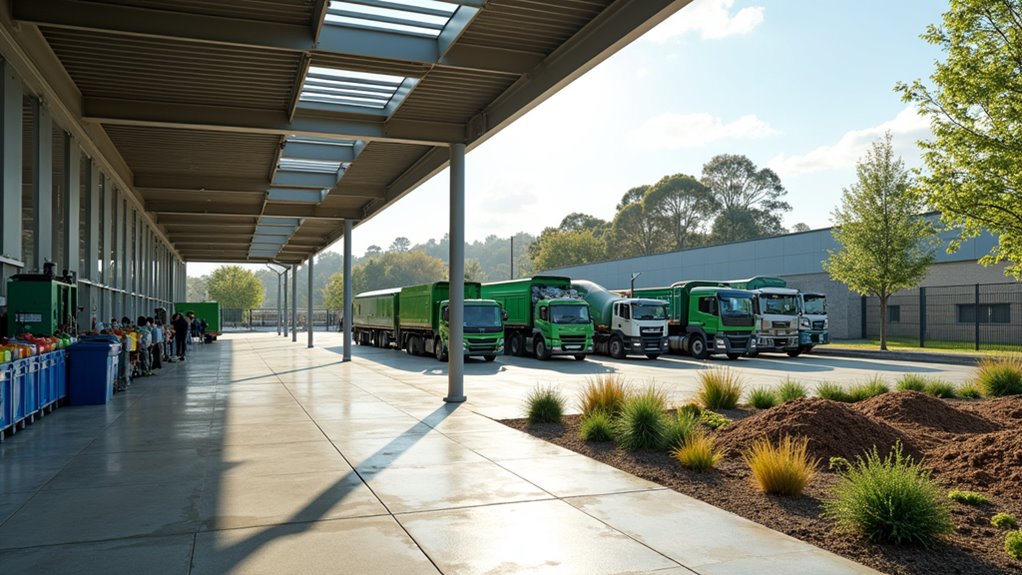
Mountains of waste – over 292 million tons annually in the United States alone – pose one of modern society’s greatest logistical and environmental challenges. With Americans generating nearly 5 pounds of trash per person each day, municipalities face an increasingly complex task of managing this massive stream of discarded materials. The composition of this waste tells a revealing story: paper and paperboard make up the largest portion at 23.1%, followed closely by food waste at 21.6%, while plastics account for 12.2% of the total. The waste-to-energy facilities have achieved over 99% reduction in dioxin emissions through recent technological advancements. Grassroots initiatives such as community waste initiatives have shown significant potential in complementing municipal efforts by fostering local engagement and environmental stewardship. Plastic waste reduction tactics, such as opting for refillable containers, can significantly contribute to the reduction of plastic pollution in our environment.
The waste management hierarchy provides an essential framework for tackling this challenge systematically. At its core, the approach prioritizes source reduction and reuse as the most effective strategies, followed by recycling and composting, then energy recovery, with treatment and disposal as a last resort. This hierarchy aims to extract maximum value from materials while minimizing environmental impact. The integration of extended producer responsibility policies can further enhance these efforts by holding manufacturers accountable for the lifecycle impacts of their products. The introduction of IoT-enabled trash bins can optimize waste collection routes, making the process more efficient and reducing unnecessary emissions.
Currently, the United States manages to recycle and compost about 94 million tons of waste annually, achieving a 32.1% recovery rate. Some materials show promising recovery rates – newspapers and mechanical papers reach 67%, while yard trimmings hit 60%. However, there’s still significant room for improvement, particularly considering that 146.1 million tons of waste still end up in landfills each year. The Data Explorer provides comprehensive statistics on municipal waste treatment across different regions.
Modern landfills are far more sophisticated than the dumps of the past, featuring engineered liner systems and environmental safeguards. However, at an average tipping fee of $53.72 per ton, landfilling represents a significant cost to municipalities. Additionally, landfills generate methane, a potent greenhouse gas, with food waste being the largest contributor at 24% of landfilled material.
Energy recovery offers another management option, with 34.6 million tons of waste currently being converted into usable heat, electricity, or fuel through combustion. While this process generates carbon dioxide emissions, it does provide a way to extract value from non-recyclable materials, with the added benefit of recovering metals and ash for commercial applications.
Local governments shoulder the primary responsibility for developing and implementing waste management plans. These plans must balance economic feasibility with environmental responsibility while meeting state-mandated materials management goals.
Success requires careful consideration of various factors, from collection logistics to processing infrastructure, and active participation from both government agencies and residents.
The path forward lies in embracing a more circular approach to waste management, where materials are viewed not as waste but as resources. By implementing more robust recycling programs, encouraging waste reduction at the source, and investing in modern processing technologies, municipalities can work toward cleaner, more sustainable waste management systems that benefit both their communities and the environment.
Frequently Asked Questions
How Can Residents Properly Dispose of Hazardous Household Chemicals?
Residents should first identify hazardous products by checking warning labels like “poison” or “corrosive.”
Safe disposal requires contacting local environmental agencies to locate collection facilities or special events. Never pour chemicals down drains or mix different products. Keep items in original containers with secure lids during transport.
Alternative options include using products completely, sharing with others who need them, or choosing less toxic alternatives when shopping.
What Happens to Electronic Waste After It’s Collected?
Electronic waste goes through a systematic recycling process.
First, items are sorted and hazardous components like batteries are removed. The remaining materials undergo mechanical shredding into smaller pieces.
Advanced separation techniques then extract different materials – magnets pull out ferrous metals, eddy currents separate non-ferrous metals, while water and optical sorting isolate plastics and glass.
Finally, these recovered materials are processed and refined for reuse in new products.
Can Contaminated Recyclables Still Be Processed?
Some contaminated recyclables can still be processed, depending on the level and type of contamination.
Modern recycling facilities can handle lightly soiled containers through cleaning processes, while advanced sorting technology helps remove certain contaminants.
However, heavily contaminated materials typically end up in landfills. Items with food residue, hazardous materials, or excessive non-recyclable mixing usually cannot be recovered.
The key is keeping contamination levels below 25% for successful processing.
How Are Waste Collection Routes and Schedules Determined?
Waste collection routes are determined through data-driven analysis of multiple factors.
Population density, waste volumes, and street layouts form the foundation for route planning. Route optimization software uses GPS and GIS mapping to create efficient paths while considering traffic patterns and vehicle capacities.
Regular adjustments account for seasonal changes and growth. Collection schedules are balanced across weekdays to maximize efficiency, with routes typically designed to achieve 70-80% truck capacity utilization.
What Role Do Landfill Gas Capture Systems Play in Waste Management?
Landfill gas capture systems play an essential role by collecting methane and CO2 produced during waste decomposition.
Using networks of wells and vacuum systems, these facilities can capture up to 85% of emissions from engineered landfills.
The collected gas is then converted into renewable energy or natural gas, generating electricity while reducing greenhouse gas releases.
This technology creates a dual benefit – preventing harmful emissions while producing valuable clean energy resources.


