

Biodiversity does far more than create pretty landscapes – it’s the foundation of human survival and economic prosperity. The variety of life on Earth provides essential services valued at over $150 trillion annually, from crop pollination and medicine development to natural disaster protection. With wildlife populations plummeting 68% since 1970 and one million species facing extinction, protecting biodiversity isn’t just about saving animals – it’s about preserving the intricate systems that keep our planet habitable. The deeper you explore this web of life, the more vital its preservation becomes.
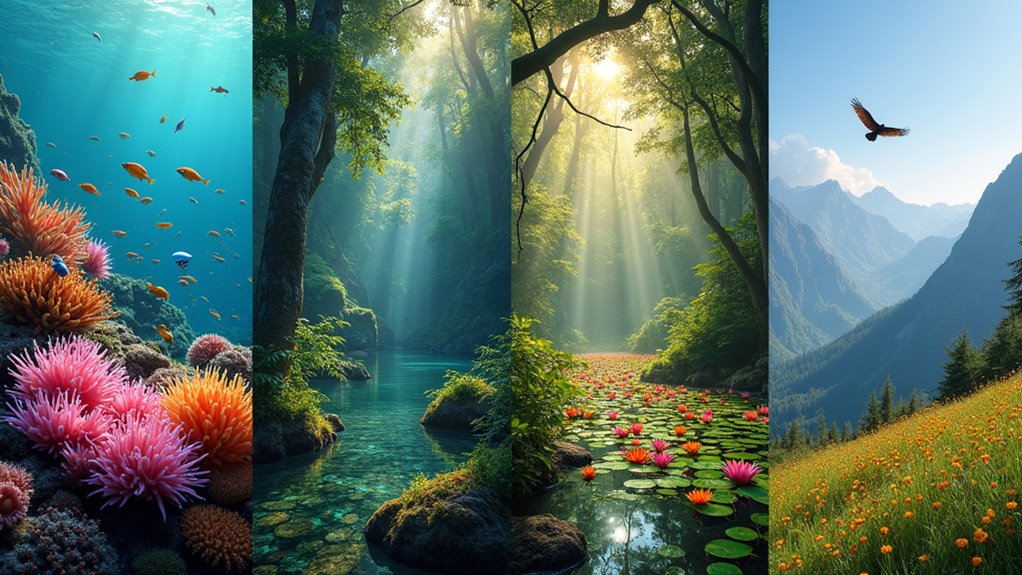
While the sheer complexity of Earth’s biodiversity can be difficult to fathom, its rapid decline threatens to unravel the very fabric of life that sustains both human civilization and countless other species. The numbers paint a stark picture: a staggering 68% decline in wildlife populations since 1970, with one million species now facing extinction. This isn’t just about losing magnificent creatures – it’s about the collapse of systems that keep our world functioning. Protected areas provide crucial safe havens for threatened species and ecosystems, helping to slow biodiversity loss.
The economic stakes are enormous, with biodiversity’s value estimated at over $150 trillion annually. From agriculture to pharmaceuticals, nature’s diversity drives innovation and prosperity. Consider that one-third of global crop production depends on pollinators, yet 37% of bee species are at risk. This threatens not just our food security but entire supply chains across multiple industries. Today, wild mammal biomass represents only 4% of global mammal biomass, while livestock and humans account for the vast majority. Additionally, deforestation continues to be a major threat to biodiversity, as it destroys habitats and contributes to climate change. Biodiversity hotspots worldwide are areas of extraordinary species diversity under threat, making their preservation crucial for maintaining global ecological balance.
The staggering economic value of biodiversity – $150 trillion annually – underpins global agriculture, medicine, and industry, yet remains critically endangered.
Research shows that extreme weather events, like hurricanes and wildfires, are becoming more frequent and intense, further threatening biodiversity by destroying habitats and disrupting ecosystems. Treaties like CITES play a vital role in protecting endangered species by regulating international trade and ensuring that it does not threaten their survival.
Medical science relies heavily on biodiversity for breakthroughs. The HIV/AIDS drug Azidothymidine, synthesized from sea sponges, exemplifies nature’s role as a pharmaceutical treasure trove. With 91% of marine species still unclassified, we risk losing potential cures before we even discover them.
Beyond medicine, research shows that simple exposure to nature improves both physical and mental health, reducing hospital admissions and lowering blood pressure in urban areas.
In the fight against climate change, biodiversity proves invaluable. Diverse ecosystems demonstrate greater resilience to environmental changes, with varied plant and animal communities better equipped to adapt and survive. Trees and plants act as natural carbon sinks, while coral reefs and mangrove forests protect coastlines from rising seas and intense storms. The loss of this natural infrastructure weakens Earth’s ability to regulate itself.
Recognition of biodiversity’s importance has sparked global action. The ambitious 30×30 initiative, supported by over 190 countries, aims to protect 30% of the planet’s land and oceans by 2030. Organizations like NatureServe have spent decades mapping critical areas for conservation, providing vital data for decision-makers and conservationists.
Perhaps most profound is biodiversity’s cultural and spiritual significance. Beyond its measurable benefits, nature’s variety holds intrinsic value that shapes human wellbeing and our collective sense of purpose. This relationship between people and biodiversity creates a powerful argument for conservation that transcends pure economics or science.
The science is clear: diverse ecosystems are more stable, more productive, and more resilient to change. As we face unprecedented environmental challenges, protecting biodiversity isn’t just about saving individual species – it’s about preserving the complex web of relationships that make Earth habitable.
The good news is that solutions exist, and conservation efforts are gaining momentum. Through decisive action and innovative approaches, we can still protect the remarkable diversity that makes our planet unique and guarantees its continued ability to sustain life.
Frequently Asked Questions
How Do Endangered Species Affect the Economy and Job Market?
Endangered species protection creates complex economic tradeoffs.
While regulations can impose costs on certain industries, like the $33-46 billion impact of spotted owl protection, biodiversity drives significant economic benefits.
Wildlife-related recreation generates $120 billion annually and supports 860,000 jobs.
Nature-based industries create substantial employment – salmon fishing alone provides 60,000 jobs in the Pacific Northwest.
The restoration economy actually outperforms many extractive sectors in job creation.
Can Artificial Ecosystems Replace Natural Biodiversity Effectively?
Artificial ecosystems cannot fully replicate the complex web of relationships found in natural systems that evolved over millions of years.
While artificial environments serve specific purposes, they typically support only 10% of ecosystem types and favor generalist species.
Natural ecosystems host 90% of threatened species and provide irreplaceable services like pollination, flood control, and coastal protection.
Their intricate biological interactions and genetic diversity remain impossible to artificially duplicate with current technology.
What Role Does Biodiversity Play in Developing New Medicines?
Biodiversity plays an essential role in medicine development, with over half of commercial drugs derived from natural sources.
Plant and marine organisms provide vital compounds for treating various diseases, including cancer. Indigenous knowledge of medicinal plants has led to breakthrough treatments like artemisinin for malaria.
The loss of species directly impacts drug discovery – scientists estimate we lose a potential medicine every two years due to biodiversity decline.
How Does Climate Change Specifically Impact Local Biodiversity Patterns?
Climate change fundamentally reshapes local biodiversity through multiple mechanisms.
Species are shifting their ranges northward and to higher elevations, with land animals moving about 3.8 miles per decade and marine species migrating even faster at 17 miles per decade.
It disrupts critical species interactions, causing mismatches in timing between predators and prey, altering plant-pollinator relationships, and enabling invasive species to spread.
These changes ripple through entire ecosystems, affecting everything from food webs to ecosystem services.
Does Biodiversity Loss in One Region Affect Ecosystems in Other Areas?
Biodiversity loss in one region creates far-reaching ripple effects across the globe’s interconnected ecosystems.
When keystone species disappear in one area, it disrupts food webs and ecological relationships thousands of miles away. For example, declining Arctic sea ice impacts polar bear populations, which affects seal numbers, ultimately disrupting marine food chains down to the Antarctic.
Similarly, the loss of migratory birds in one region affects pollination and seed dispersal across continents.


