

Integrated Pest Management revolutionizes agricultural pest control by moving away from heavy chemical pesticide use. This ecosystem-based strategy combines biological controls like natural predators and parasites with environmental modifications such as strategic irrigation and resistant plant varieties. IPM requires careful monitoring of pest populations and only applies minimal chemical treatments when absolutely necessary. The approach delivers superior long-term results while protecting beneficial organisms and reducing environmental impact. Understanding its core principles reveals sustainable solutions for modern agriculture.
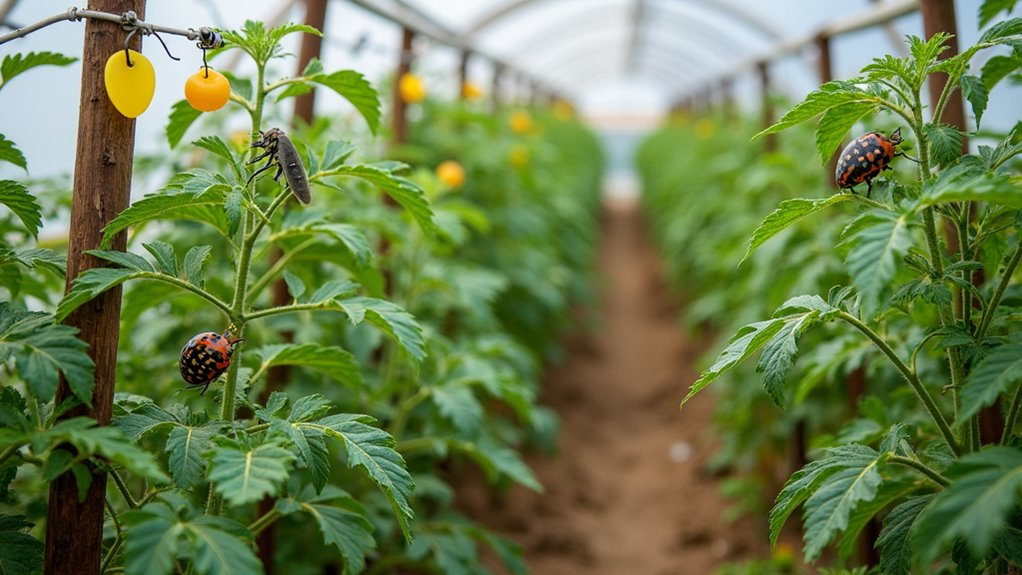
In an era of growing environmental consciousness, Integrated Pest Management (IPM) stands as a sophisticated yet practical approach to controlling unwanted organisms while minimizing environmental impact. This ecosystem-based strategy represents a significant shift away from conventional pest control methods that rely heavily on chemical pesticides, instead embracing a more holistic and sustainable approach to managing pest populations.
At its core, IPM combines various control methods – biological, cultural, mechanical, and chemical – in a systematic way that prioritizes environmental stewardship and human health. Rather than immediately reaching for pesticide sprays, IPM practitioners first identify and monitor pest populations, establishing clear thresholds for when action becomes necessary. This thoughtful approach guarantees that treatments target specific pests only when their numbers threaten to cause economic damage. Accurate identification helps IPM managers choose the most effective and environmentally-friendly control methods for each specific pest challenge. Simple but effective measures like hoeing and hand-pulling provide immediate control for many weed problems. Ecosystem changes due to climate disruptions emphasize the need for adaptive pest management strategies that align with these environmental shifts.
IPM empowers practitioners to make informed pest control decisions, balancing environmental responsibility with effective treatment through systematic monitoring and targeted intervention.
Biological control plays a pivotal role in IPM’s success. By leveraging natural enemies like predators, parasites, and pathogens, pest managers can achieve long-term control without relying solely on synthetic chemicals. These beneficial organisms work tirelessly to keep pest populations in check, often requiring little more than conservation efforts to maintain their effectiveness. Additionally, the strategic release of additional biocontrol agents can augment existing populations when needed. Drones that map crop health can also enhance IPM by providing precise data on pest distribution and severity, allowing for more targeted interventions.
Environmental modification serves as another powerful tool in the IPM arsenal. Simple adjustments to irrigation practices, planting times, and soil management can create conditions that naturally discourage pest proliferation while promoting plant health. Selecting pest-resistant plant varieties and implementing crop rotation schemes further strengthens these preventive measures, making it harder for pests to establish damaging populations. Government policies that encourage responsible resource use can further enhance the effectiveness of IPM strategies by promoting practices that align with sustainable agriculture goals. By integrating no-till farming practices, farmers can improve soil health and reduce pest habitats, aligning with regenerative agriculture principles.
When chemical controls become necessary, IPM guarantees their use is both judicious and strategic. Practitioners select the least toxic, most target-specific pesticides available and apply them only where needed, often as spot treatments rather than broadcast applications. This approach not only reduces environmental impact but also helps prevent the development of pesticide resistance among pest populations.
The benefits of IPM extend beyond immediate pest control. By reducing reliance on chemical pesticides, this approach promotes healthier ecosystems, protects beneficial organisms, and often proves more cost-effective over time than conventional methods. While IPM may require more initial planning and knowledge than traditional pest control, its thorough approach delivers superior long-term results.
Despite occasional challenges, such as slower initial results compared to conventional pesticide applications, IPM’s success in reducing chemical use while maintaining effective pest control has made it increasingly popular across agricultural and urban landscapes. As awareness of environmental issues continues to grow, IPM stands as a proven framework for achieving sustainable pest management while protecting both human health and natural ecosystems.
Frequently Asked Questions
How Much Money Can Farmers Save Annually by Implementing IPM Practices?
Research shows farmers can achieve substantial annual savings through IPM adoption.
On average, farms see a 46% reduction in total production costs, resulting in net profits of $81.50 per acre compared to $105 losses on conventional farms.
Specific crops demonstrate remarkable gains – peach growers save $12,515 per acre, while sweet corn farmers increase profits by $191 per acre.
Overall economic benefits reach millions, with Texas farmers alone seeing $6.06 million in returns.
What Training or Certification Is Required to Start Using Biological Controls?
Starting with biological controls typically requires a bachelor’s degree in agricultural or biological sciences, with coursework in entomology and pest management.
Most practitioners obtain certifications like the Certified Crop Advisor (CCA) or Certified IPM Practitioner (CIPM). State pesticide applicator licenses are often mandatory.
Hands-on experience through internships is valuable. Ongoing education through workshops and conferences helps practitioners stay current with new biological control methods and research.
How Long Does It Take to See Results After Switching to IPM?
Results from switching to IPM appear in phases over time.
Initial changes like reduced chemical use show within weeks, while cultural controls bring quick improvements in 0-6 months.
Medium-term results emerge in 6-18 months as biological controls establish and pest populations decline 30-50%.
Full benefits take 2-3 years, with pesticide reductions reaching 50-90% as the ecosystem stabilizes.
Patience during the shift guarantees long-term success.
Can IPM Methods Be Effectively Used in Urban Garden Settings?
IPM methods work exceptionally well in urban gardens. Research shows urban settings can achieve 50% reductions in pesticide use while increasing yields by 10-15%.
Key strategies include biological controls like beneficial insects, companion planting, and physical barriers. While limited space presents challenges, vertical gardening and container techniques provide solutions.
Urban gardeners can effectively implement IPM through proper monitoring, resistant plant varieties, and smart cultural practices that enhance natural pest control.
What Percentage of Crops Are Currently Grown Using IPM Worldwide?
Global adoption rates of IPM vary considerably, with an estimated 37% of vegetable farmers implementing these practices worldwide.
However, precise numbers are difficult to determine due to varying definitions and reporting methods.
Adoption tends to be higher in developed nations and large-scale industrial farms, while developing countries show lower rates.
High-value crops like fruits and vegetables see greater IPM usage compared to staple crops, with successful implementation particularly noted in corn production.


