

Modern landfills utilize sophisticated engineering and technology to safely manage waste while protecting the environment. Multi-layer liner systems prevent groundwater contamination, while advanced gas collection networks capture methane for energy production. Automated sorting systems, powered by AI, maximize recycling efficiency, and innovative treatment methods like plasma gasification handle hazardous materials. Sustainable practices transform closed landfills into community assets, such as parks and solar installations. The evolution of waste management reveals promising solutions for our growing disposal challenges.
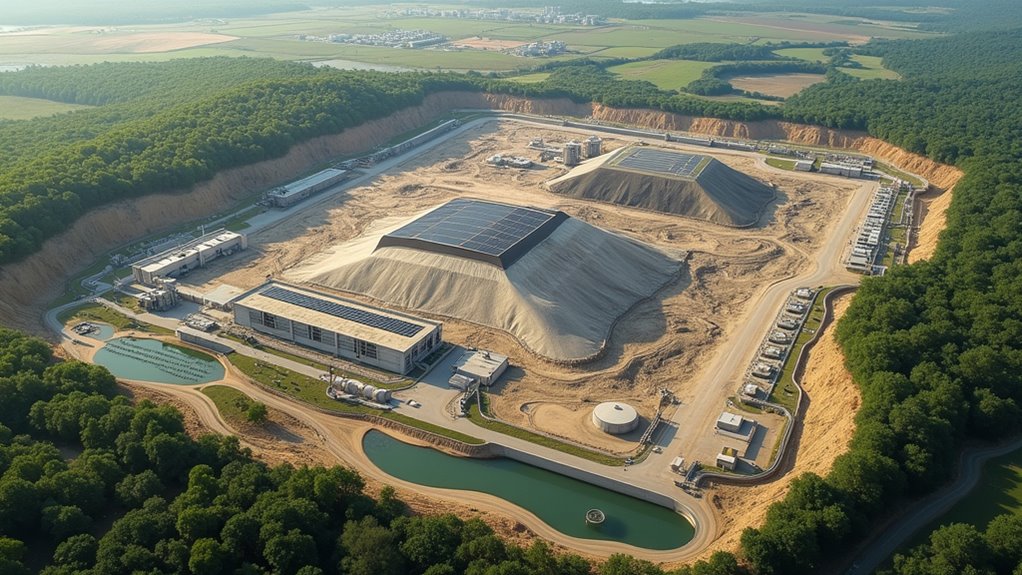
Modern landfill management has evolved far beyond the primitive garbage dumps of the past, transforming into sophisticated waste handling facilities that integrate cutting-edge technology with environmental stewardship.
Today’s landfills employ multi-layer liner systems constructed with clay and high-density plastics, effectively creating a protective barrier between waste materials and surrounding soil and groundwater. These facilities must be carefully designed to meet strict compliance regulations regarding their location, construction, and operation.
Modern landfill engineering utilizes sophisticated barrier systems to shield the environment from waste contamination, protecting vital soil and water resources.
These engineered facilities incorporate advanced leachate collection and treatment systems that prevent harmful liquids from contaminating local water sources. The collected leachate undergoes rigorous treatment processes, including air stripping, biological treatment, and carbon adsorption, before being safely managed or recirculated in bioreactor landfills. Without proper management, toxic leachate can severely contaminate groundwater and harm human health.
Sophisticated gas management systems capture methane emissions, which can be converted into electricity or fuel, demonstrating how modern landfills are becoming energy-generating assets rather than mere waste repositories. Extended producer responsibility is also shaping how waste is managed, ensuring that producers take part in the lifecycle management of their products, reducing the burden on landfills.
Real-time monitoring has become an integral component of landfill operations. Groundwater monitoring wells, gas probes, and computerized systems continuously track environmental impacts and operational efficiency. Some modern landfills also incorporate IoT-enabled trash bins to optimize waste collection and minimize environmental impact. Community solutions, such as curbside recycling programs, are also integral to waste management, reducing the load on landfills and promoting recycling efforts. This data-driven approach allows facility managers to identify and address potential issues before they become notable problems, while ensuring compliance with environmental regulations.
Innovation in waste processing technologies has revolutionized how materials are handled before reaching the landfill. Mechanical biological treatment stabilizes organic waste, while automated sorting systems powered by artificial intelligence separate recyclables with unprecedented accuracy. Waste-to-energy technologies, like incineration and gasification, are also gaining traction as effective methods to convert trash into usable power.
Plasma gasification and pyrolysis offer new solutions for treating hazardous materials, while anaerobic digestion converts organic waste into valuable biogas.
Waste diversion strategies have become increasingly sophisticated, with separate collection streams for recyclables, organics, and hazardous materials considerably reducing the volume of waste entering landfills. Construction and demolition debris finds new life through recycling programs, while food scraps and yard waste are transformed into nutrient-rich compost.
Some facilities even engage in landfill mining, extracting valuable materials from old sites and giving them a second life in the circular economy.
The sustainable practices employed in modern landfill management extend beyond waste handling. Closed landfills are being repurposed as parks and recreational areas, while their surfaces host solar panel installations.
Alternative daily covers conserve soil resources, and bioremediation techniques help restore contaminated areas. These innovations demonstrate how landfill management has become an integral part of broader sustainability efforts.
The integration of these technologies and practices represents a fundamental shift in how society manages its waste. Through careful engineering, continuous monitoring, and innovative processing methods, modern landfills are becoming sophisticated resource recovery centers that protect the environment while maximizing the value of discarded materials.
This evolution continues as new technologies emerge and circular economy principles become more deeply embedded in waste management strategies.
Frequently Asked Questions
How Much Does It Cost to Construct a Modern Landfill Facility?
Constructing a modern landfill facility requires substantial investment, typically ranging from $500,000 to $1 million per acre of capacity.
The total project cost varies greatly based on location and size. A thorough facility includes environmental assessments ($100,000-$500,000), liner systems ($295,000-$600,000 per acre), gas collection infrastructure, and operational equipment.
Additional costs include post-closure care funds, which add 15-30% to the total investment.
What Qualifications Are Needed to Become a Landfill Management Professional?
Becoming a landfill management professional requires specific qualifications and experience. A bachelor’s degree in environmental science or waste management is typically necessary, though some entry-level positions accept associate’s degrees.
Key certifications include HAZWOPER training and Manager of Landfill Operations (MOLO). Professionals need at least 5 years of industry experience, strong understanding of environmental regulations, and proficiency in modern waste handling technologies.
State-specific certifications may also be required.
Can Landfill Gases Be Converted Into Renewable Energy Sources?
Yes, landfill gases can be effectively converted into renewable energy.
The methane-rich gas produced through waste decomposition can power various energy systems. Using specialized collection networks, the gas is captured and utilized in internal combustion engines, turbines, or microturbines to generate electricity.
It can also be upgraded to renewable natural gas for pipeline injection. This process not only reduces harmful methane emissions but also creates a sustainable energy source while generating revenue.
How Long Does It Take for a Landfill Site to Decompose?
The complete decomposition timeline for landfills varies considerably based on the materials present and environmental conditions.
Most landfills take between 100-1000+ years to fully decompose. While organic materials like food waste break down in weeks or months, items like plastic bottles persist for 450+ years.
The active decomposition phase typically lasts 20-30 years, with peak gas production occurring 5-7 years after waste burial.
Some materials, like glass, may never completely decompose.
What Happens to Landfills During Natural Disasters or Extreme Weather Events?
Natural disasters can severely impact landfills, causing multiple environmental hazards.
During floods, excess water produces more leachate that can contaminate groundwater, while storms may scatter waste materials and damage protective covers.
Extreme heat increases risks of spontaneous combustion and accelerates decomposition.
However, modern landfills implement adaptive strategies like enhanced drainage systems, stronger covers, and emergency response plans to minimize these impacts and protect surrounding communities.


