

Environmental justice laws combat systemic inequities through powerful legislation like Executive Order 12898 and state-level innovations. New Jersey’s 2020 law requires cumulative impact analysis for new facilities, while California’s SB 1000 mandates environmental justice in local planning. Modern mapping tools like EJSCREEN help identify overburdened communities, and constitutional rights to clean environments are gaining momentum. Public participation requirements guarantee impacted communities have a voice in decisions. These evolving protections mark just the beginning of a more equitable environmental future.
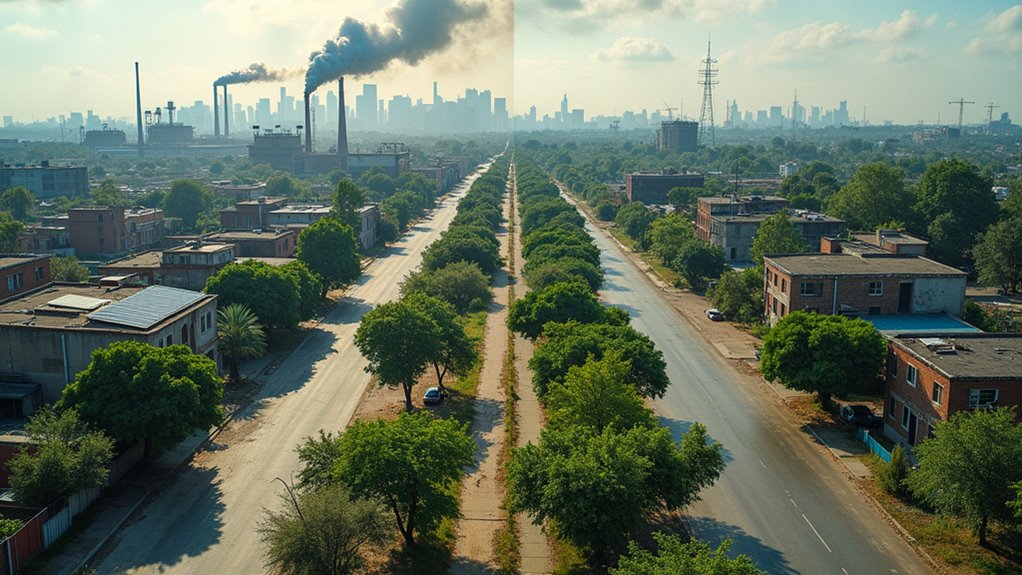
Environmental justice laws have transformed the regulatory landscape over the past three decades, creating a framework to protect vulnerable communities from disproportionate environmental burdens. Beginning with Executive Order 12898 in 1994, federal legislation has established vital protections, requiring agencies to address environmental justice in their actions and decision-making processes. The National Environmental Policy Act, Clean Air Act, and Clean Water Act work together to set pollution standards and safeguard public health. Climate justice connects human rights and sustainable development with climate action, forming a crucial part of these environmental justice frameworks. International environmental courts play a critical role in resolving disputes related to cross-border pollution and holding multinational corporations accountable for environmental impacts.
States have increasingly taken bold action to advance environmental justice through innovative legislation. Dr. Bullard’s groundbreaking research revealed that Black Houstonians faced vastly disproportionate waste dumping impacts. New Jersey’s groundbreaking 2020 law requires consideration of cumulative impacts when permitting new facilities in overburdened communities. Black and African American communities face 41% to 60% higher likelihood of living in areas with elevated premature mortality from particulate matter. California’s SB 1000 mandates that local governments incorporate environmental justice into their planning processes, while New York’s 2022 Environmental Rights Amendment goes further by establishing a constitutional right to a clean environment.
Modern environmental justice efforts rely heavily on sophisticated mapping tools to identify communities facing multiple environmental burdens. The EPA’s EJSCREEN and state-specific tools like CalEnviroScreen 4.0 combine environmental and demographic data to visualize where assistance is most needed. These tools support implementation of laws like New Jersey’s S232, which requires rigorous analysis of combined pollution impacts before approving new industrial facilities in vulnerable areas. Legal actions related to climate change law are increasingly being utilized to hold corporations accountable for their environmental impacts. Knowledge building initiatives are crucial in developing effective adaptation strategies that align with environmental justice goals.
Public participation requirements have become a cornerstone of environmental justice legislation. States increasingly mandate meaningful community involvement in environmental decision-making. New Jersey’s law requires public hearings for facility permits, while Massachusetts has enhanced participation requirements for state actions affecting environmental justice populations. This emphasis on community engagement helps guarantee that those most impacted have a voice in decisions affecting their neighborhoods.
The movement toward constitutional environmental rights represents another significant development. Following Pennsylvania’s early example, states like New York, Montana, and Hawaii have enshrined environmental rights in their constitutions. These amendments provide powerful legal tools for communities to challenge actions that threaten environmental quality.
Emerging trends in environmental justice legislation show a growing recognition of intersecting challenges. New laws increasingly address climate justice, expand analysis requirements across state agencies, and strengthen enforcement mechanisms. States are also working to clearly define environmental justice communities and establish specific criteria for identifying overburdened populations.
The integration of environmental justice principles into land use and zoning decisions represents a vital step toward preventing future disparities. Through these various legal mechanisms, environmental justice laws continue to evolve and expand, creating stronger protections for vulnerable communities.
While challenges remain, the growing body of legislation provides increasingly robust tools for addressing environmental inequities and working toward a more just and sustainable future.
Frequently Asked Questions
How Can Individuals Report Environmental Justice Violations in Their Community?
Individuals can report environmental justice violations through multiple channels. The EPA’s online violation form and regional offices accept detailed reports about incidents.
State environmental agencies, local health departments, and code enforcement offices also handle complaints. People should document evidence like photos, videos, and samples when safe.
Creating community environmental groups helps organize monitoring efforts and amplify concerns through collective action and partnerships with nonprofits.
What Legal Resources Are Available for Low-Income Communities Facing Environmental Discrimination?
Multiple free legal resources assist low-income communities facing environmental discrimination.
Organizations like Environmental Justice Legal Services Project and EarthJustice provide pro bono representation, while government programs offer grants up to $50,000 through the EPA.
The NAACP’s Environmental Justice Program and Lawyers for Good Government connect communities with legal expertise.
Additionally, federal laws like Title VI of the Civil Rights Act can be used to challenge discriminatory environmental practices.
How Long Do Environmental Justice Lawsuits Typically Take to Resolve?
Environmental justice lawsuits typically take 4.2 years from filing to final resolution.
While 39% of appealed cases reach closure within 3 years, the vast majority (84%) conclude within 6 years of initial permit publication.
Complex factors like scientific evidence requirements, number of involved parties, and court system backlogs affect timeline.
Alternative dispute resolution methods like mediation can help expedite cases, though some notable suits have stretched beyond 7 years.
Which States Have the Strongest Environmental Justice Protection Laws?
New Jersey currently leads with the nation’s strongest environmental justice protections, requiring thorough analysis of cumulative impacts and allowing permit denials in overburdened communities.
New York and Minnesota recently passed robust laws addressing cumulative impacts, while California has built a strong foundation through multiple EJ initiatives over two decades.
These states stand out for their specific requirements, enforcement mechanisms, and commitment to protecting vulnerable communities from disproportionate environmental burdens.
Can Tribal Nations Enforce Their Own Environmental Justice Regulations?
Yes, tribal nations can enforce their own environmental justice regulations, but with significant limitations.
Their authority primarily extends to trust lands and tribal members. While tribes possess inherent sovereign power to create and implement environmental codes, jurisdiction over non-Indians is restricted by Supreme Court decisions.
Many tribes successfully operate air and water quality programs, especially those with “Treatment as a State” status, though resource constraints and complex land ownership patterns often challenge enforcement efforts.


