

Urban pollution hotspots create dangerous concentrations of pollutants and excess heat in specific city areas, putting millions of Americans at risk. These zones, particularly in high-traffic areas, can see temperatures spike 8°F above surrounding regions while trapping harmful PM2.5 particles. Low-income communities and people of color face disproportionate exposure to these hazards. Modern urban planning employs sophisticated monitoring and targeted solutions like green spaces and traffic management to tackle these challenges. Exploring these strategies reveals promising paths forward.
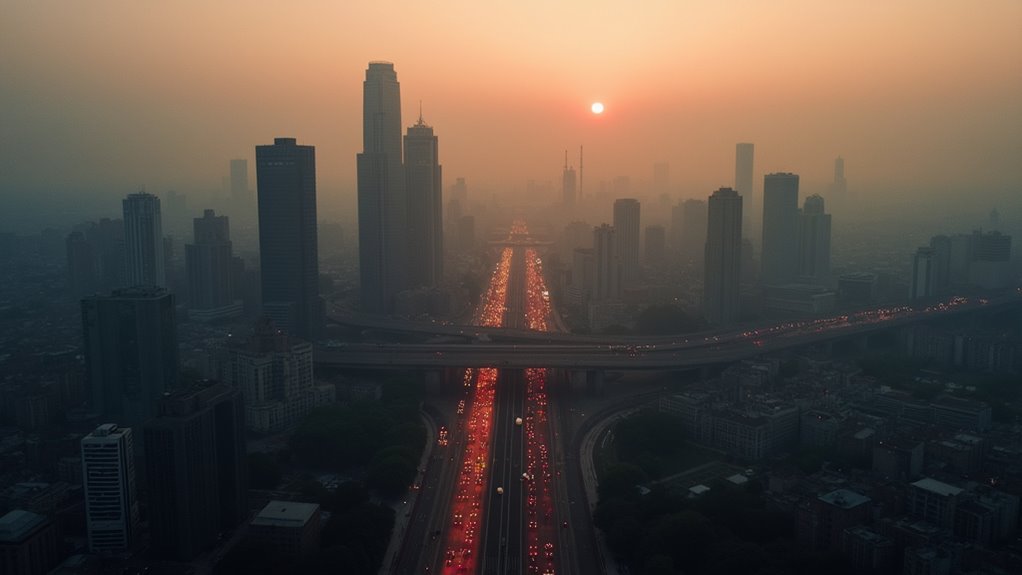
The invisible battle for cleaner air unfolds daily across America’s urban landscapes, where pollution hotspots create serious health and environmental challenges for millions of residents. In cities across the nation, where 80% of the U.S. population now resides, a complex web of pollutants threatens public health through various pathways, with traffic-related emissions and urban heat islands leading the charge. These urban pollution hotspots aren’t distributed evenly – they cluster in predictable yet concerning patterns. Within 300 feet of major roadways, pollutant concentrations spike dramatically, trapped by urban street canyons that act like pollution containers. The situation worsens during traffic congestion, when vehicle emissions can surge up to 75% higher than normal in these localized areas. Similar to historical patterns, wealthy residents relocate away from heavily polluted areas, perpetuating socio-economic divides.
For the 41 million Americans living in cities with notable urban heat island effects, temperatures can soar 8°F above surrounding areas, amplifying the impact of heat waves and creating deadly conditions for vulnerable populations. The combination of intense heat and concentrated pollution creates a particularly dangerous scenario. Communities of color and low-income residents face disproportionate exposure to these extreme conditions. Fine particulate matter (PM2.5) poses an especial threat, as these microscopic particles can travel deep into lungs and persist over greater distances than other pollutants. The intricate relationship between ecosystems and pollution highlights how deeply interconnected our environment is with human health. The increase in eco-anxiety is another consequence of living in these affected urban areas, as residents become increasingly aware of the potential health risks.
At low vehicle speeds – typical in congested urban areas – emission rates of these particles increase considerably, creating a vicious cycle of pollution in high-traffic zones. Modern urban planning has begun embracing sophisticated tools to combat these challenges. Using 3D visualization techniques and integrated data analysis, cities can now identify pollution hotspots with unprecedented accuracy. Air pollution and climate change are interconnected issues, and addressing one often contributes to solving the other. Policymakers are increasingly under scrutiny as they promise solutions that can sometimes fall short, highlighting the need for real action rather than empty promises.
This allows for targeted interventions, from strategic traffic re-routing to the creation of low-emission zones. The integration of mobile phone and GPS data has revolutionized our understanding of pollution patterns, enabling more effective responses. Perhaps most encouraging is the growing recognition that solutions to urban pollution often deliver multiple benefits. Efforts to mitigate climate change frequently reduce air pollution as a welcome side effect. Strategic placement of green spaces not only helps disperse pollutants but also combats the urban heat island effect. While the challenges are serious – with extreme heat ranking as America’s deadliest natural hazard and air pollution linked to numerous health conditions – the tools for addressing them continue to improve.
Success in this battle requires sustained attention to monitoring and analysis. High-resolution emissions inventories, combined with continuous monitoring systems, allow cities to track their progress and adjust strategies accordingly. While the task of cleaning urban air may seem intimidating, the evidence shows that targeted measures can lead to rapid improvements, particularly in reducing ozone pollution and other short-lived pollutants. The key lies in understanding these pollution hotspots not as insurmountable obstacles, but as opportunities for focused intervention and meaningful change.
Frequently Asked Questions
How Long Does It Take for Air Pollution to Dissipate Naturally?
Air pollution dissipation varies markedly depending on several factors.
Generally, particulate matter takes hours to weeks to clear, while common gases like nitrogen dioxide and sulfur dioxide typically dissipate within 2-7 days.
Carbon monoxide persists longer, lasting 1-4 months.
Weather conditions greatly influence these timeframes – strong winds and rain accelerate dispersal, while temperature inversions can trap pollutants.
Natural processes like plant absorption and ocean uptake also help remove pollutants from the atmosphere.
What Indoor Plants Are Most Effective at Filtering Urban Air Pollutants?
Research shows Peace Lilies, Spider Plants, and Snake Plants are top performers for filtering indoor air pollutants.
These plants effectively remove common urban contaminants like formaldehyde, benzene, and xylene.
However, it’s essential to highlight that you’d need hundreds of plants to notably impact air quality.
For best results, combine plants with proper ventilation and air purifiers – they work best as part of an all-encompassing air-quality strategy.
Can Pollution Hotspots Affect Property Values in Surrounding Neighborhoods?
Research shows pollution hotspots greatly impact nearby property values. Areas with high air pollution can see home prices drop by up to 15% compared to similar properties in cleaner locations.
Even a small 1 μg/m3 increase in PM2.5 pollution levels reduces rent by 0.7% in Las Vegas. Properties near hazardous waste sites face particularly steep devaluation.
However, neighborhoods that improve their air quality often see property values rebound, attracting more affluent residents.
Which Time of Day Has the Lowest Pollution Levels in Cities?
Research consistently shows that urban pollution levels reach their lowest point during afternoon hours, typically between noon and 6pm.
This pattern appears across major cities worldwide, with the safest window for outdoor activities occurring between 3:00-5:00 PM local time.
The afternoon dip is attributed to several factors: increased solar radiation helps disperse pollutants, morning rush hour emissions have dissipated, and atmospheric mixing is most effective during peak daytime hours.
Do Weather Conditions Influence the Formation of Urban Pollution Hotspots?
Weather conditions directly influence how urban pollution hotspots form and persist.
Wind patterns affect how pollutants disperse, with lack of wind causing stagnant air pockets where toxins accumulate. Temperature inversions trap pollution close to the ground, while rain helps cleanse the air.
Urban heat islands create unique microclimates that can worsen pollution buildup. Street canyons between tall buildings further trap vehicle emissions when weather conditions are unfavorable.


