

Nuclear waste disposal remains a critical global challenge, with over 250,000 metric tons of highly radioactive material requiring secure containment. Most waste currently sits in temporary storage at power plants, while nations race to develop permanent underground repositories 300-1,000 meters deep. Finland leads the way with its Onkalo facility, while other countries invest in reprocessing and vitrification technologies. Advanced solutions, from corrosion-resistant materials to waste-consuming reactors, offer promising paths toward solving this complex puzzle.
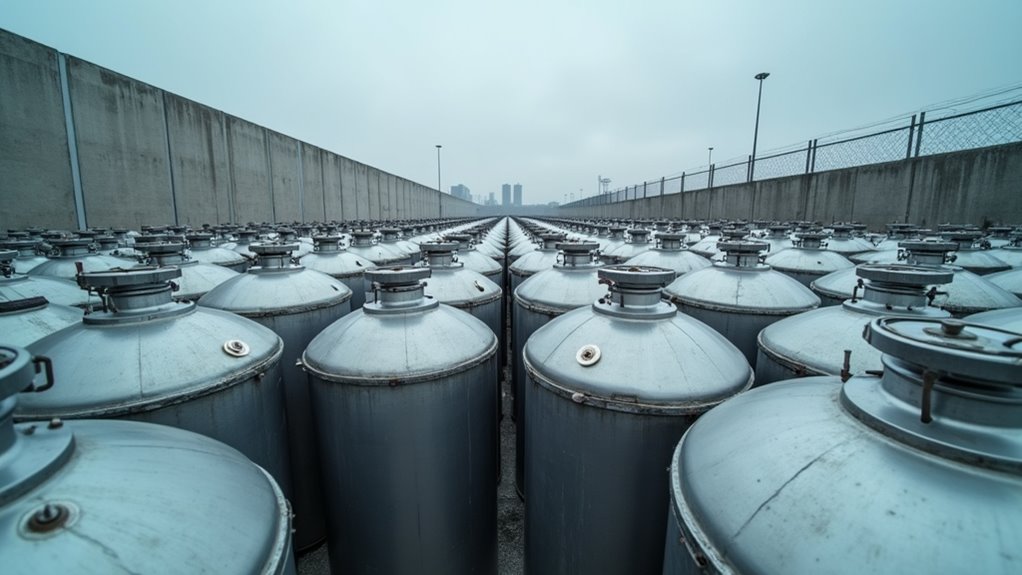
Nuclear waste disposal represents one of the most pressing challenges facing the atomic energy sector, with over 250,000 metric tons of highly radioactive material requiring safe containment worldwide. The United States alone accounts for more than 90,000 metric tons of this waste, which must be carefully managed for thousands of years due to its persistent radioactivity. Currently, most nuclear waste is stored in temporary facilities at power plants and processing sites, awaiting the development of permanent disposal solutions. The total volume of U.S. nuclear waste since the 1950s would fill just one football field to a depth of ten yards.
Safe disposal of nuclear waste remains a global challenge, with over 250,000 tons of radioactive material awaiting permanent storage solutions.
The nuclear industry categorizes waste into several distinct types based on radioactivity levels. High-level waste, primarily consisting of spent fuel and reprocessing byproducts, poses the greatest challenge. This waste initially requires storage in specialized cooling pools for at least five years before transfer to dry cask storage systems made of steel and concrete. Lower-level wastes, including contaminated equipment and materials, can be managed in surface or near-surface facilities. Each radioisotope in the waste presents unique challenges as biological half-lives vary significantly among different elements. Emerging technologies are being developed to address industrial carbon footprints, which could also inspire innovative approaches in nuclear waste management. Implementing climate change adaptation measures alongside nuclear waste strategies can enhance the resilience of communities near storage sites.
Scientists and engineers worldwide are developing innovative approaches to address the long-term storage difficulty. Deep geological repositories, planned at depths between 300 and 1,000 meters underground, represent the most promising solution. Finland leads the way with its Onkalo facility, which is approaching operational status. Other countries, including Sweden, Switzerland, and France, are following suit with their own deep disposal projects. Some nations, like France and Japan, have invested heavily in reprocessing technology to reduce waste volume and extract usable fuel. Climate models that predict environmental changes can play a role in assessing the long-term safety of these repositories. Rising sea levels could affect up to 3 billion people by 2070, underscoring the need for comprehensive environmental planning.
The technical hurdles in nuclear waste management are considerable. Engineers must account for heat generation from radioactive decay, prevent environmental contamination, and guarantee storage containers remain intact for millennia. Emerging technologies offer some hope – advanced reactor designs could potentially use existing waste as fuel, while improved vitrification techniques can stabilize waste in glass form. Research continues into corrosion-resistant materials and enhanced monitoring systems.
Despite these advances, significant obstacles remain. Public acceptance and political will often prove as challenging as the technical aspects of waste disposal. The high costs associated with long-term storage and disposal facilities require substantial investment and commitment. However, several countries are making progress. France has successfully implemented a thorough waste management strategy, including vitrification of high-level waste. The UK’s Sellafield site demonstrates the potential for centralized waste management and reprocessing capabilities.
Looking ahead, promising developments in accelerator-driven transmutation systems and advanced containment technologies suggest multiple pathways for addressing the nuclear waste challenge. While the problem is complex and long-term, the international community continues to develop and implement solutions. The success of projects like Finland’s Onkalo repository demonstrates that safe, permanent disposal of nuclear waste is achievable with proper planning, technology, and commitment.
Frequently Asked Questions
How Many Jobs Are Created by Nuclear Waste Management Facilities?
Nuclear waste management facilities create substantial employment opportunities across multiple sectors.
The US nuclear energy sector directly employs over 70,000 workers, with an additional 180,000 in secondary roles. Specifically, there are 12,710 nuclear engineers and 42,500 hazardous materials removal workers, with 79% working in waste management.
Jobs range from specialized engineers and waste specialists to project managers and environmental advisors, offering competitive salaries from $30,000 to $125,460 annually.
What Psychological Impact Does Living Near Nuclear Waste Sites Have on Communities?
Living near nuclear waste sites has significant psychological impacts on communities.
Research shows increased rates of PTSD, depression, and anxiety among residents. These effects often persist for decades, with people experiencing ongoing fears about health impacts and genetic effects on future generations.
Older populations and marginalized communities face heightened risks, showing more severe symptoms.
The psychological burden extends beyond immediate health concerns to include social stigma and property value worries.
Can Nuclear Waste Be Recycled Into Other Useful Materials?
Nuclear waste can indeed be recycled through established processes like PUREX, which extracts reusable uranium and plutonium from spent fuel.
About 96% of used nuclear fuel is recyclable, creating new MOX fuel for power plants. France already generates 10% of its nuclear electricity using recycled materials.
While the process faces economic and technical challenges, it considerably reduces waste volume and could potentially power the US for a century using existing waste stockpiles.
How Do Different Countries Compare in Their Nuclear Waste Disposal Methods?
Different countries take varied approaches to nuclear waste disposal.
Finland leads with the world’s first deep geological repository, while Sweden and France are following suit.
Many nations like the US rely on interim storage solutions such as dry casks at reactor sites.
Some countries, including France and Spain, operate surface facilities for low-level waste.
International collaboration through organizations like ERDO helps share expertise and explore shared solutions across borders.
What Role Does Artificial Intelligence Play in Monitoring Nuclear Waste Storage?
Artificial intelligence plays an essential role in modern nuclear waste storage through advanced monitoring systems.
AI-powered sensors continuously track radiation levels, temperature, and structural integrity while machine learning algorithms analyze vast datasets to detect anomalies.
Automated robotics, guided by AI, handle dangerous materials directly, reducing human exposure.
The technology also enables predictive maintenance, identifying potential issues before they become critical, and optimizes long-term storage strategies through data-driven insights.


