

Climate change poses serious challenges to global food security, with maize yields projected to drop 24% by 2030. However, agricultural adaptation strategies offer hope. Farmers are implementing crop rotation, developing drought-resistant varieties, and using controlled growing environments to combat extreme weather. While the sector faces threats from soil erosion and water scarcity, system-level solutions could reduce food prices by 16%. Combining technological innovation with traditional practices may hold the key to feeding Earth’s growing population under pressure. The path forward reveals promising possibilities.
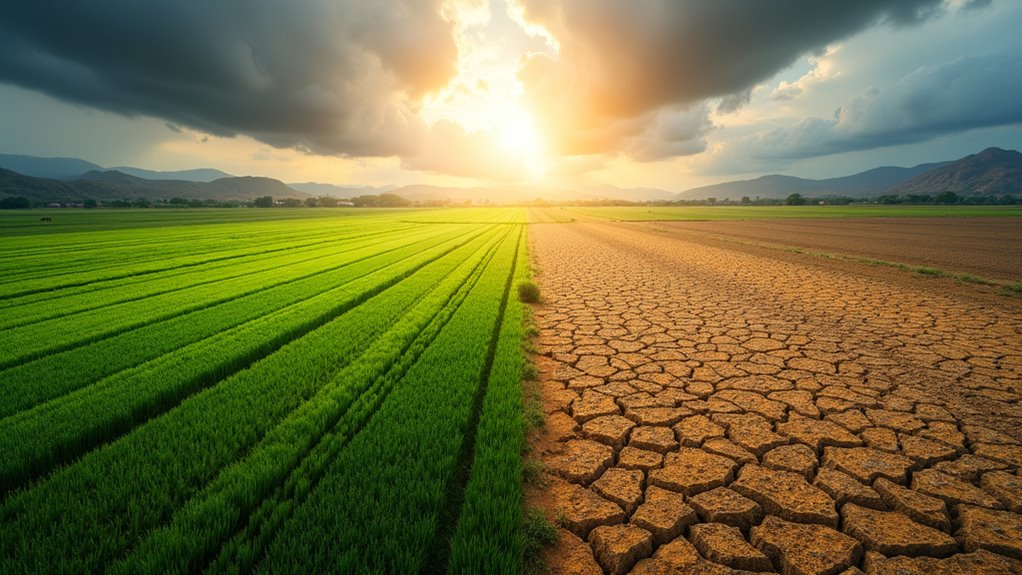
While global food security hangs in the balance, climate change is radically reshaping agriculture as it is understood. The agricultural sector faces unprecedented challenges as temperature fluctuations and extreme weather events become increasingly common. According to research, food systems contribute about 22-33% of total greenhouse gas emissions globally. Projections suggest devastating impacts on key crops, with global maize yields expected to plummet by 24% by 2030 under high emissions scenarios, though wheat yields might increase by 17% due to CO2 fertilization.
The economic implications are staggering. Climate change could inflict a $190 trillion blow to the global economy by 2070, with food production industries facing potential losses of $13 trillion. This financial burden isn’t distributed evenly – while developed nations struggle to maintain yields, lower-income countries might actually see a 12% GDP boost by adopting sustainable practices. Experts emphasize that proactive planning is crucial in mitigating these economic impacts, as it plays an essential role in safeguarding both the economy and public well-being. The dramatic effects of climate shifts on biodiversity further underscore the urgency of addressing climate change holistically.
Agriculture itself contributes considerably to the problem, accounting for 30% of global warming emissions – a figure that’s 18 times higher than in the 1960s. Nitrous oxide from excess fertilizer use packs a warming punch 300 times more potent than CO2, while methane emissions from rice paddies continue to rise with warming temperatures. The very act of clearing land for farming releases stored carbon, creating a troubling feedback loop.
Farmers aren’t standing idle, though. They’re implementing various adaptation strategies to weather these changes. Crop rotation, integrated pest management, and the development of drought-resistant varieties are becoming standard practice. Some are experimenting with high tunnels to create controlled growing environments, while others are diversifying their planting dates and crop selections to spread risk. Studies show that incremental and transformational adaptation will be essential for maintaining U.S. farm productivity in the coming decades.
The challenges extend beyond the obvious temperature increases. Soil erosion is accelerating due to extreme weather, while water scarcity threatens irrigation capabilities. Coastal farming areas are grappling with increasing salinity from rising sea levels. Meanwhile, pests and diseases are expanding their ranges, creating new threats to crop health and requiring additional control measures.
Yet there’s room for cautious optimism. System-level solutions could potentially decrease global food prices by 16%, making food more accessible despite climate pressures. Longer growing seasons in almost every U.S. state might create new agricultural opportunities, if managed correctly. The key lies in embracing both technological innovation and traditional wisdom – combining efficient irrigation systems with time-tested practices like crop diversification.
The agricultural sector stands at a crossroads, facing both unprecedented challenges and opportunities for transformation. Success will require a delicate balance of adaptation strategies, emission reductions, and innovative solutions. While the challenges are formidable, the agricultural community’s demonstrated resilience and adaptability suggest that feeding the world under pressure, while difficult, is not impossible.
Frequently Asked Questions
How Do Greenhouse Farming Methods Compare to Traditional Farming in Climate Adaptation?
Greenhouse farming demonstrates superior climate adaptation compared to traditional methods through controlled environments that shield crops from extreme weather.
While traditional farming remains vulnerable to droughts, floods, and temperature swings, greenhouses maintain ideal growing conditions year-round.
Their efficient resource use – consuming up to 90% less water – and consistent yields offset higher setup costs.
Despite requiring more energy, greenhouses provide greater reliability and resilience in an unpredictable climate.
Can Genetic Engineering of Crops Help Plants Survive Extreme Weather Events?
Genetic engineering has proven highly effective in helping crops withstand extreme weather.
Scientists have developed varieties with remarkable resilience: rice that survives two weeks underwater, corn that yields 5.5% more in drought, and wheat that produces up to 50% more in intense heat.
What Role Do Indigenous Farming Practices Play in Climate-Resilient Agriculture?
Indigenous farming practices play a crucial role in climate-resilient agriculture through time-tested methods that work with natural ecosystems.
Traditional techniques like the Three Sisters planting system maximize crop yields while preserving soil health. Indigenous communities manage 80% of Earth’s biodiversity using sustainable approaches like agroforestry and traditional fire management.
These practices minimize chemical inputs, conserve water resources, and maintain ecological balance – proving particularly valuable as climate pressures intensify.
How Does Urban Farming Contribute to Reducing Agriculture’s Carbon Footprint?
Urban farming greatly reduces agriculture’s carbon footprint through multiple pathways.
By growing food locally, it cuts transportation emissions and shortens supply chains. Advanced techniques like hydroponics use 90% less water than conventional farming, while rooftop gardens and vertical farms maximize limited urban space.
These systems also help absorb urban pollutants, create green spaces that counter heat island effects, and enable communities to recycle organic waste into compost, reducing methane emissions.
What Impact Does Soil Microbiome Health Have on Crop Climate Resilience?
Healthy soil microbiomes greatly boost crop climate resilience through multiple mechanisms.
These microscopic communities help plants access water and nutrients more efficiently, while producing compounds that enhance drought tolerance. Beneficial soil microbes also strengthen plant immune responses and buffer against temperature extremes.
Research shows that diverse soil microbiomes correlate with up to 20% higher crop yields during environmental stress events.
Management practices like cover cropping and reduced tillage help maintain these essential underground ecosystems.


