

Marine ecosystems, covering 90% of Earth’s habitable space, provide critical services worth trillions annually through biodiversity, climate regulation, and food security. These essential systems face unprecedented threats from climate change, overfishing, and pollution, with extinction rates now hundreds of times above historical averages. While 7% of oceans are protected and sustainable practices show promise, marine biodiversity continues declining rapidly. The future of ocean conservation holds both urgent challenges and promising solutions.
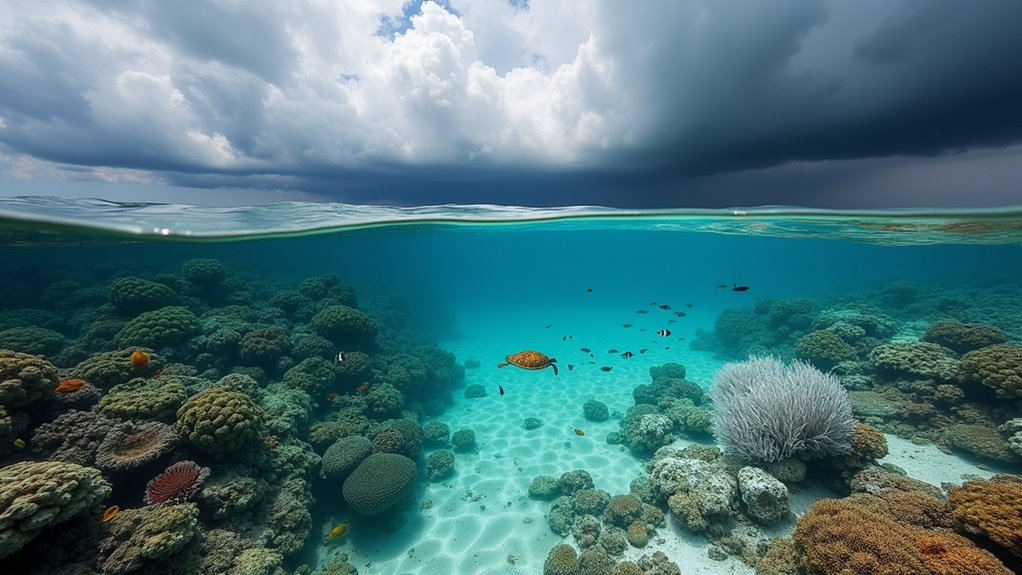
While marine ecosystems cover a staggering 90% of Earth’s habitable space, these vast underwater domains face unprecedented threats that are rapidly reshaping life beneath the waves. Home to more than 250,000 known species, from microscopic plankton to magnificent whales, marine biodiversity plays an essential role in maintaining Earth’s delicate balance, regulating climate, producing oxygen, and removing carbon from the atmosphere. This vital ecosystem has become increasingly endangered, with tens to hundreds of times higher extinction rates than historical averages. Just as freshwater ecosystems are crucial for maintaining biodiversity and climate stability, marine ecosystems also play a pivotal role in these processes.
The economic and social value of healthy oceans cannot be overstated. Marine ecosystems provide indispensable services that support sustainable development worldwide, yet these critical resources face mounting pressures from human activities. Overfishing stands as one of the most severe threats, with 37.7% of global fish stocks now depleted beyond sustainable levels. The impact extends far beyond commercial species – oceanic sharks and rays have experienced a catastrophic 71% decline since the 1970s, while approximately 9.1 million tonnes of marine life are discarded annually as bycatch. The decline in U.S. fisheries alone has resulted in massive job losses affecting hundreds of thousands of workers. Global campaigns and local projects aim to sustain marine ecosystems by promoting responsible fishing practices and reducing bycatch.
Marine ecosystems sustain global development, yet human activities threaten these vital resources through devastating overfishing and unsustainable practices.
Climate change compounds these challenges, fundamentally altering marine environments through rising temperatures and ocean acidification. Oceans have absorbed up to 30% of human-generated CO2, causing acidification that disrupts species’ behavior, migration patterns, and reproduction cycles. Marine heatwaves have become increasingly frequent, devastating coral reefs through bleaching events. Meanwhile, ocean acidification poses a particular threat to calcifying organisms like corals, mollusks, and plankton, which form the foundation of many marine food webs. Rising sea levels due to climate change also lead to saltwater intrusion into freshwater aquifers, impacting coastal ecosystems and human communities.
The destruction of coastal habitats presents another significant challenge. Since the 1870s, nearly half of the world’s coral reefs have vanished, while mangrove forests have shrunk by over 35% in just five decades. Seagrass meadows are disappearing at an alarming rate of 7% annually, eliminating essential nursery grounds for countless marine species. This habitat loss, coupled with coastal development and pollution, creates a perfect storm that threatens marine biodiversity.
Pollution, particularly from land-based sources, has reached every corner of our oceans. Plastic waste now pervades all ocean basins, even reaching the deepest trenches. Nutrient runoff triggers harmful algal blooms, while chemical pollutants accumulate in marine food chains, affecting entire ecosystems. Even noise pollution disrupts marine animals’ ability to communicate and navigate effectively.
However, conservation efforts offer hope for marine ecosystems. Currently, 7% of the ocean falls within protected areas, and sustainable fishing practices are gaining ground. International agreements addressing climate change and pollution, combined with ecosystem-based management approaches, demonstrate growing global commitment to ocean conservation.
Restoration projects focusing on significant habitats like coral reefs and mangroves show promising results, suggesting that with continued dedication and innovation, we can protect and preserve marine biodiversity for future generations.
Frequently Asked Questions
How Can Individuals Contribute to Protecting Marine Biodiversity in Their Daily Lives?
Individuals can protect marine biodiversity through simple daily actions.
Choosing sustainable seafood with MSC certification supports responsible fishing practices.
Reducing single-use plastics, properly disposing waste, and participating in beach cleanups prevents ocean pollution.
Energy-efficient choices and reducing carbon footprints help combat ocean acidification.
Supporting local conservation groups and citizen science projects creates direct impact.
Small individual actions collectively make significant difference in preserving marine ecosystems.
What Careers Focus on Marine Conservation and Protecting Ocean Ecosystems?
Several rewarding careers focus on protecting our oceans.
Marine biologists study sea life and ecosystems through research and experiments.
Marine policy advisors develop regulations and work with governments to protect ocean resources.
Marine educators inspire others through teaching programs about ocean conservation.
Marine protected area managers oversee reserves and enforce regulations.
These professionals work together to safeguard marine biodiversity for future generations.
How Do Marine Protected Areas Impact Local Fishing Communities?
Marine protected areas (MPAs) create mixed impacts on fishing communities. While they can lead to short-term economic challenges through fishing restrictions and displacement, well-managed MPAs often result in long-term benefits.
Communities near protected areas show 33% higher wealth indices and improved fish populations in adjacent waters. MPAs also create alternative income opportunities through tourism and research.
However, success depends heavily on community involvement in planning and equitable benefit distribution.
Which Countries Have the Most Successful Marine Conservation Programs?
Several nations stand out for their exceptional marine conservation achievements.
Monaco leads globally, protecting 100% of its waters, while Slovenia follows closely at 98.5%.
Ecuador’s program has successfully preserved 75.7% of its marine territory.
Among larger nations, Germany and France show impressive results, protecting 64.8% and 62.9% of their waters respectively.
Australia’s Great Barrier Reef management and Indonesia’s community-based conservation approaches serve as influential models for other nations.
What Role Does Traditional Ecological Knowledge Play in Marine Biodiversity Conservation?
Traditional ecological knowledge plays an essential role in marine conservation by providing centuries of accumulated indigenous wisdom about marine ecosystems.
This knowledge helps identify critical habitats, understand species behavior, and develop sustainable fishing practices.
TEK complements Western scientific methods by offering detailed local insights and holistic perspectives on marine environments.
When integrated with modern conservation strategies, it enhances biodiversity protection and supports more effective resource management approaches.


