

Sustainable fertilizer alternatives are revolutionizing agriculture through proven natural solutions. Organic composts enhance soil health and microbial activity while reducing input costs for farmers. Biochar improves water retention and provides habitat for beneficial microorganisms, offering carbon sequestration benefits. Marine-derived products and biofertilizers containing living microbes boost nutrient availability and crop yields by 6-15%. With the organic fertilizer market projected to reach $13.5B by 2028, these innovations open up powerful pathways to agricultural sustainability.
Growing environmental concerns and rising fertilizer costs have sparked a revolution in sustainable agriculture, with farmers and researchers exploring an array of natural alternatives to conventional synthetic fertilizers. At the forefront of this transformation are organic fertilizers derived from plant, animal, and mineral sources, which release nutrients gradually through microbial breakdown while improving soil structure and water retention. The organic fertilizer market’s projected growth to $13.5 billion by 2028 reflects the increasing adoption of these sustainable alternatives. These innovations are crucial as global population growth drives the need for more sustainable agricultural practices.
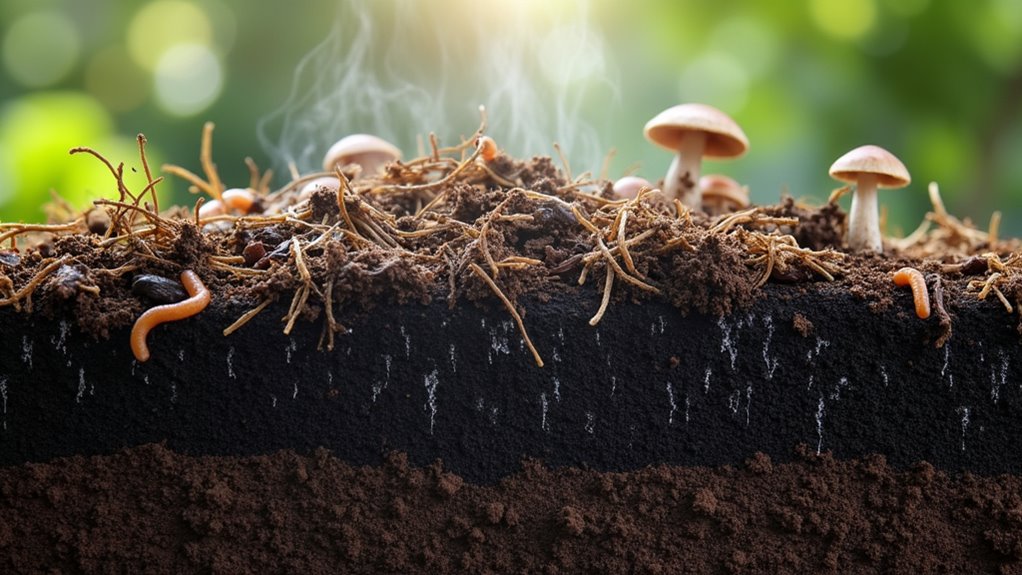
Compost and manure have emerged as cornerstone solutions, providing essential nutrients while enhancing soil microbial activity and fertility. These materials notably improve soil structure and water-holding capacity, creating a more resilient growing environment. Nutrient values typically range from 9-20 g/kg nitrogen in quality composts. Farmers who produce their own compost can considerably reduce input costs while decreasing dependence on synthetic fertilizers. Transforming kitchen scraps into nutrient-rich compost contributes to this sustainable cycle, ensuring healthier soils. Farmers also embrace chemical-free agriculture by using compost and manure, which helps in maintaining soil health and protecting wildlife.
Compost and manure serve as nature’s recyclers, enriching soil life while helping farmers break free from costly synthetic fertilizer dependence.
The introduction of biochar, produced through pyrolysis of organic materials, represents another notable advancement. This innovative material not only improves soil water retention and nutrient availability but also provides a stable habitat for beneficial soil microorganisms. Drip irrigation, as a water-efficient technique, can be paired with biochar to enhance water conservation in farming. Perhaps most importantly, biochar’s ability to sequester carbon for extended periods offers a promising approach to combating climate change while improving agricultural productivity.
Biofertilizers containing living microorganisms have revolutionized nutrient management by colonizing soil and plant roots. These microscopic allies increase nutrient bioavailability and uptake, enabling farmers to reduce fertilizer applications while maintaining or improving yields. The integration of nitrogen-fixing and phosphate-solubilizing bacteria has proven particularly effective in enhancing soil fertility naturally.
Cover crops and green manures offer multiple benefits beyond mere nutrient provision. Leguminous cover crops fix atmospheric nitrogen, while all cover crops contribute to soil organic matter content and reduce erosion. Their ability to suppress weeds and disrupt pest cycles provides additional advantages, with potential fertilizer cost savings reaching $40 per acre.
Seaweed and fish-based fertilizers have gained prominence for their rich micronutrient content and growth-promoting hormones. These marine-derived products enhance plant stress tolerance and root development while stimulating soil microbial activity. Studies have shown yield increases of 6-15% when these products are properly applied.
The recovery of nutrients from waste streams represents a vital development in sustainable fertilizer alternatives. Technologies like struvite precipitation enable the recycling of nutrients from wastewater and organic waste, addressing the finite nature of phosphorus resources while reducing environmental pollution. This approach closes nutrient loops in agriculture, creating more sustainable and efficient farming systems that benefit both producers and the environment.
Frequently Asked Questions
How Long Does It Take for Biochar to Improve Soil Quality?
Biochar begins improving soil quality within days of application, with rapid changes in pH and water retention.
The first 1-3 years see significant boosts in microbial activity, nutrient availability, and crop yields averaging 10% increases.
Medium-term benefits continue for 3-10 years, including sustained water retention and enhanced soil fertility.
Long-term effects persist for centuries, maintaining improved soil structure and continuing carbon sequestration for over 1000 years.
Can Organic Composts Be Harmful to Pets if Ingested?
Yes, organic composts can be dangerous if pets ingest them. The decomposing materials contain tremorgenic mycotoxins that can cause severe symptoms within 30 minutes to several hours after consumption.
Common signs include tremors, seizures, hyperthermia, and vomiting. Even small amounts can be toxic.
Pet owners should secure compost in closed bins, fence off compost areas, and seek immediate veterinary care if ingestion occurs.
Using plant-based materials and proper containment helps prevent accidents.
What Is the Shelf Life of Microbial Fertilizers?
Microbial fertilizers typically maintain their effectiveness for 2 years when stored properly in cool, dark conditions between 60-80°F.
Some products can last 8-10 years with ideal storage, while granular formulations may remain viable indefinitely if kept dry.
Factors like heat, moisture, and sunlight exposure greatly reduce shelf life.
For best results, products should be kept in airtight containers and used within the manufacturer’s recommended timeframe after opening.
Do Sustainable Fertilizers Work in All Climate Zones?
Sustainable fertilizers show varying effectiveness across different climate zones.
While they can work in all climates, their performance depends heavily on local conditions. Hot climates accelerate organic matter breakdown, while cold regions see slower decomposition rates.
Moisture levels also play an essential role – too much can cause nutrient leaching, while too little limits microbial activity.
Success requires adapting fertilizer choices and application methods to specific regional climate patterns.
How Much Money Can Farmers Save by Switching to Sustainable Fertilizers?
Farmers can achieve significant cost savings by adopting sustainable fertilizer practices.
For corn crops, savings range from $10-$40 per acre after implementing cover crops for several years, while soybean farmers see $5-$10 per acre reductions.
Variable-rate application techniques cut fertilizer costs by 4%.
Over time, as soil health improves, fertilizer needs gradually decrease, leading to compounding savings.
The organic fertilizers market is expected to grow from $9.7B to $13.5B by 2028.


