

Desertification threatens to displace 135 million people by 2045 as fertile lands transform into arid wastelands. This global crisis impacts food security, economic stability, and social cohesion through a complex cycle of soil degradation, water scarcity, and ecosystem collapse. While the annual economic losses reach billions, solutions like climate-smart agriculture and sustainable land management offer hope. Communities worldwide are already witnessing these changes, but understanding the full scope reveals promising pathways forward.
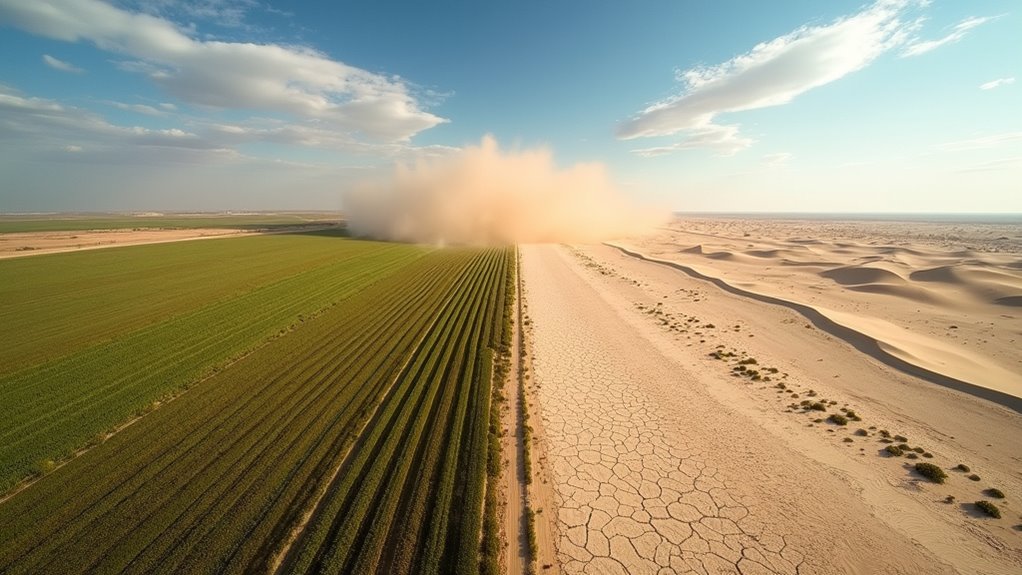
The silent spread of deserts across Earth’s fertile lands represents one of humanity’s most pressing environmental challenges, threatening both human communities and natural ecosystems worldwide. This process, known as desertification, currently affects 250 million people globally and could force as many as 135 million to abandon their homes by 2045. As fertile lands transform into arid wastelands, the implications for food security, economic stability, and social cohesion become increasingly dire. Climate-resilient crops may offer a buffer against these drastic changes, ensuring that food production remains viable even in challenging conditions.
The drivers of desertification form a complex web of natural and human-induced factors. While climate change intensifies droughts and disrupts traditional rainfall patterns, human activities like deforestation, overgrazing, and unsustainable farming practices accelerate the degradation of once-productive lands. Rising temperatures also contribute to increased evaporation rates, which further deplete water resources and exacerbate soil degradation. Smart farming methods can help prevent further land degradation through techniques like no-till farming and regenerative agriculture. The overexploitation of water resources compounds these problems, leaving soils vulnerable to erosion and unable to support vegetation. Poor irrigation practices contribute significantly to soil salinization and further land degradation.
The environmental consequences ripple throughout entire ecosystems. As soil quality deteriorates, biodiversity plummets, and essential ecosystem services disappear. Dust storms become more frequent, while the land’s ability to retain water diminishes considerably. This creates a devastating feedback loop – as vegetation dies off, the soil becomes even more susceptible to erosion, which further reduces its capacity to support plant life. Maximizing water efficiency in agricultural practices can play a critical role in breaking this cycle and preserving soil health. Water-efficient techniques such as drip irrigation and mulching can significantly improve the resilience of crops against drought conditions.
Regions across the globe are experiencing the harsh realities of desertification. Africa’s Sahel region stands as perhaps the most stark example, but the problem extends far beyond. From Central Asia to the Mediterranean basin, from the American Southwest to vast stretches of China and India, communities are watching their lands transform before their eyes. The economic impact is staggering, with annual losses reaching billions of dollars.
However, solutions exist and are being implemented with varying degrees of success. Sustainable land management practices, combined with reforestation efforts and improved irrigation techniques, offer promising pathways to combat desertification. Climate-smart agriculture and crop diversification help communities adapt to changing conditions while protecting soil health. Early warning systems for droughts enable better preparation and response.
The international community has recognized the urgency of addressing desertification. Since the establishment of the United Nations Convention to Combat Desertification in 1994, global efforts have intensified to tackle this challenge. Yet the implementation of large-scale restoration projects faces considerable hurdles, including funding constraints and the need for better coordination between stakeholders.
The future of our relationship with Earth’s lands hangs in balance. While the challenge of desertification is immense, the combination of traditional knowledge, modern technology, and international cooperation provides hope. Success will require sustained commitment from governments, businesses, and communities, along with a fundamental shift in how we manage and value our land resources. The costs of inaction far outweigh the investments needed to protect and restore our planet’s essential soils.
Frequently Asked Questions
How Do Traditional Indigenous Practices Help Prevent Soil Degradation?
Indigenous agricultural practices effectively combat soil degradation through multiple proven techniques.
Agroforestry systems combine trees and crops to improve soil structure, while traditional terracing reduces erosion by up to 90% on slopes.
Crop rotation and fallow periods, like the Iroquois “Three Sisters” method, replenish nutrients and boost yields by 10-25%.
Ancient water management approaches, such as qanats and flood-recession farming, help maintain soil moisture and prevent erosion.
Can Desertified Land Be Fully Restored to Its Original Fertile State?
While complete restoration of desertified land is theoretically possible, achieving the original fertile state is extremely challenging.
The process requires decades or even centuries of dedicated effort and substantial resources – typically $4,500-$6,500 per hectare.
Natural and technological approaches can facilitate partial recovery, but factors like climate change and invasive species complicate restoration.
Most experts agree that preventing desertification is far more effective than attempting to reverse it.
What Role Do Earthworms Play in Preventing Soil Erosion?
Earthworms are nature’s soil engineers, playing an essential role in preventing erosion through multiple mechanisms.
Their burrows create channels that increase water infiltration by up to 10x, reducing surface runoff and soil loss. They process tons of soil annually, producing nutrient-rich castings that bind soil particles together, making them more resistant to erosion.
Their mucus-lined tunnels form stable pathways for water movement, while improving soil structure and stability.
How Does Urban Development Contribute to Increasing Rates of Desertification?
Urban development accelerates desertification through multiple interconnected processes.
Cities expand into natural areas, stripping away protective vegetation and disrupting soil structures.
Construction activities compact soil, reducing its ability to retain water and support plant life.
The urban heat island effect raises local temperatures, while excessive groundwater extraction depletes moisture reserves.
These combined factors create increasingly arid conditions in urban peripheries, converting fertile land into desert-like environments.
Which Crops Are Most Resistant to Growing in Desertification-Prone Areas?
Several crops demonstrate remarkable resilience in desertification-prone regions.
Sorghum and pearl millet excel in high-temperature, low-moisture conditions.
Drought-resistant legumes like cowpeas and tepary beans not only survive but improve soil quality through nitrogen fixation.
Among fruits and vegetables, cassava and prickly pear cactus show exceptional adaptability.
Deep-rooted forages such as buffelgrass and alfalfa provide reliable options for livestock feed while helping prevent further soil degradation.


