

Renewable energy financing employs diverse funding mechanisms, from traditional bank loans to innovative blockchain solutions. The sector saw $167.6 billion in green bond issuance in 2018, while project finance structures maintain healthy debt coverage ratios of 1.4-1.6x. Commercial banks, institutional investors, and crowdfunding platforms provide capital, backed by government guarantees and insurance products. AI and big data enhance risk assessment, as the market evolves toward merchant projects. The renewable investment landscape offers promising opportunities for those ready to explore sustainable returns.
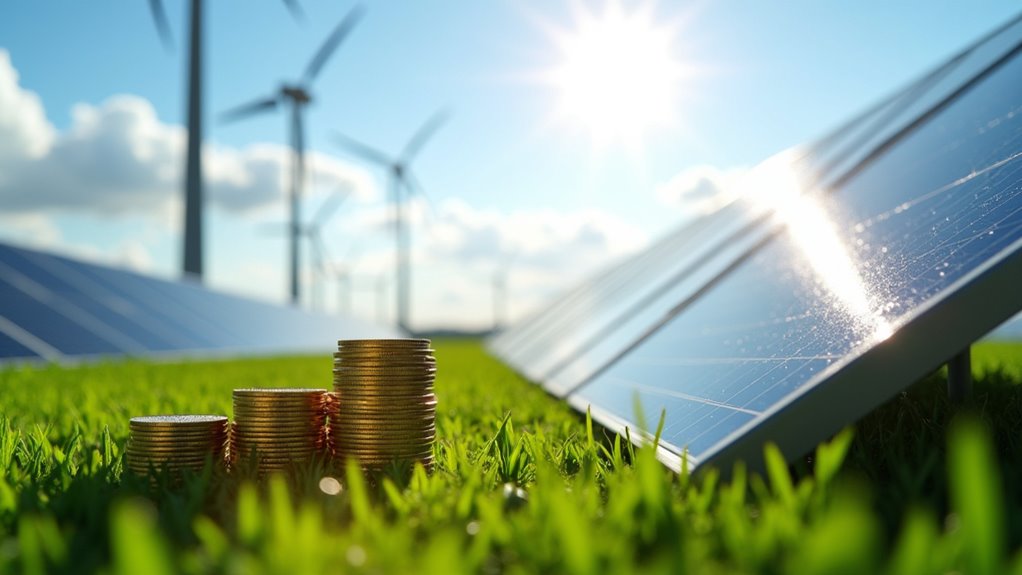
As renewable energy continues reshaping the global power landscape, innovative financing mechanisms have emerged as the critical bridge between ambitious clean energy goals and real-world implementation. Financial institutions, governments, and private investors are deploying diverse funding tools to accelerate the shift to clean energy, from traditional bank loans to cutting-edge blockchain-based solutions. Environmental and social concerns often drive investment decisions in the renewable sector.
The financing landscape has evolved considerably, with commercial banks and development finance institutions leading the charge alongside institutional investors like pension funds and insurance companies. These players recognize the potential for stable, long-term returns from renewable projects, particularly through power purchase agreements that secure predictable revenue streams. Project viability assessments are crucial for determining investment potential and mitigating risks for stakeholders. Addressing water scarcity through sustainable water management solutions is becoming increasingly important in renewable energy projects, especially in areas facing climate-induced water shortages.
Green bonds have gained remarkable traction, with global issuance reaching $167.6 billion in 2018, providing a dedicated funding channel for sustainable energy initiatives. The transition to clean power sources is also boosting local industries and reducing reliance on unstable fossil fuel markets.
Project finance structures have become increasingly sophisticated, utilizing special purpose vehicles and non-recourse financing to isolate and manage risk. Successful projects typically maintain debt service coverage ratios between 1.4 and 1.6 times, ensuring robust financial health.
Risk mitigation strategies have also evolved, incorporating government guarantees, insurance products, and geographic diversification to protect investments against various uncertainties.
Innovation continues to reshape the sector, with energy savings performance contracts and green banks emerging as specialized funding vehicles. Crowdfunding platforms are democratizing renewable energy investment, allowing smaller investors to participate in the green shift. Meanwhile, blockchain technology is enabling the tokenization of renewable assets, creating new possibilities for fractional ownership and improved liquidity.
Despite the sector’s impressive growth, challenges persist. High upfront capital costs remain a considerable barrier, particularly in emerging markets. Regulatory uncertainty in some regions can deter investment, while technical challenges like grid infrastructure limitations and intermittency issues require careful consideration.
However, these challenges also present opportunities for innovation and potentially higher returns for early movers.
The integration of artificial intelligence and big data is revolutionizing investment decisions, enabling more precise risk assessment and project optimization. This technological evolution, combined with the sector’s increasing maturity, has attracted a broader range of investors, including traditional institutional players who previously viewed renewable energy as too risky or specialized.
Looking ahead, the renewable energy financing landscape continues to evolve toward more merchant projects in mature markets, while maintaining structured finance approaches in developing regions. The growing importance of energy storage solutions is creating new financing needs and opportunities, while innovative funding mechanisms are emerging to address the sector’s unique characteristics.
As governments worldwide strengthen their commitment to clean energy targets, the financial ecosystem supporting renewable energy development becomes increasingly robust and sophisticated, promising attractive returns while driving the global shift to sustainable power generation.
Frequently Asked Questions
What Are the Minimum Credit Score Requirements for Renewable Energy Project Loans?
Most renewable energy loans require FICO scores between 650-680, though some lenders accept scores as low as 580.
Borrowers with 720+ scores typically qualify for the best interest rates.
Alternative options like PACE programs and FHA PowerSaver loans offer more flexible requirements, with minimums as low as 500.
Credit unions and community development institutions often provide more lenient terms, while green banks may consider factors beyond credit scores.
How Long Does the Renewable Energy Project Approval Process Typically Take?
Renewable energy project approvals typically take 2.5-4 years for utility-scale facilities, with transmission lines requiring up to 10 years.
Environmental impact statements average 2.5 years, while grid interconnection now takes over 1,000 days.
Recent reforms aim to expedite this – New York targets 1-year permitting, while California caps environmental reviews at 270 days.
However, challenges persist, with 79% of wind projects currently stuck in the permitting process.
Are There Tax Penalties for Early Withdrawal From Green Energy Investments?
Tax penalties for early withdrawal from green energy investments depend on the specific investment vehicle.
For Investment Tax Credits (ITC), selling within 5 years triggers recapture requirements.
Traditional IRA withdrawals face a 10% penalty before age 59 1/2, regardless of investment type.
However, some green energy investments structured as direct ownership or through certain qualified opportunity zones may avoid early withdrawal penalties altogether, though specific terms vary by program.
Which Countries Offer the Highest Incentives for International Renewable Energy Investors?
China, Germany, and the USA lead in renewable energy incentives for international investors.
China offers massive market access and subsidies, investing $546B in 2022.
Germany provides attractive feed-in tariffs and aims for 80% renewable power by 2030.
The USA features multiple tax benefits, including the 30% Investment Tax Credit and accelerated depreciation through MACRS.
Spain and India also offer compelling incentives through guaranteed pricing and solar initiatives.
Can Small Businesses Combine Multiple Green Energy Grants for Single Projects?
Yes, small businesses can combine multiple green energy grants for single projects, particularly through the USDA’s Rural Energy for America Program (REAP).
They can stack various funding sources, potentially covering up to 75% of project costs when combining grants and loans.
However, businesses must avoid double-funding the same project elements and meet specific sustainability standards.
Federal grant shares are typically limited to 50%, and a minimum 25% matching fund is required for grant-only applications.


