

Advanced ocean cleanup technologies are making significant strides in combating marine pollution. The Ocean Cleanup Project‘s System 002 “Jenny” has already collected 28,000 kg of trash, while their latest System 03 spans 2.5 kilometers with five times greater capacity. Solar-powered Interceptors target pollution at river sources, removing over 2.2 million pounds of waste. Combined with AI-driven vessels and innovative bacterial decomposition methods, these solutions offer promising pathways toward cleaner oceans. The future holds even more groundbreaking developments in marine conservation.
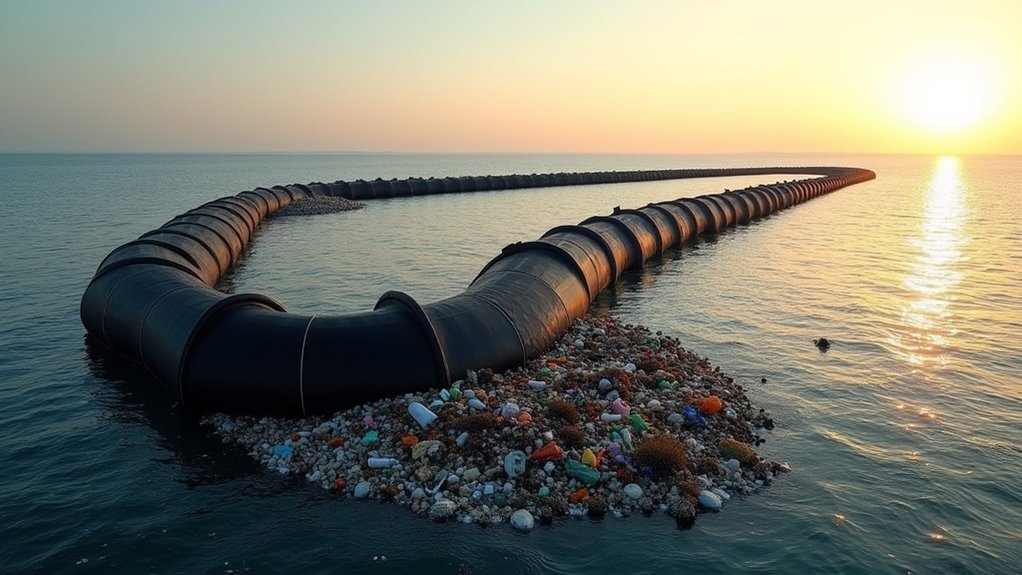
Innovative ocean cleanup technologies are revolutionizing humanity’s fight against marine plastic pollution, with ambitious projects now deploying everything from massive floating barriers to AI-powered vessels. At the forefront of this battle stands the Ocean Cleanup Project, founded by Boyan Slat in 2013, which aims to remove half of the Great Pacific Garbage Patch within five years. After initial setbacks with System 001, the project achieved a breakthrough with System 002, nicknamed “Jenny,” successfully collecting 28,000 kg of trash in 2021.
Ocean cleanup efforts have entered a new era, as innovative technologies tackle marine plastic pollution with unprecedented scale and sophistication.
The latest iteration, System 03, represents a notable leap forward, spanning an impressive 2.5 kilometers and boasting five times the capacity of its predecessor. These systems utilize U-shaped floating barriers equipped with underwater skirts that passively collect plastic using ocean currents and wind. Extended producer responsibility has become increasingly vital to sustainable product design and waste reduction. Solar-powered monitoring systems guide these massive structures while support vessels periodically remove concentrated plastic for recycling into durable products onshore. With an estimated 5 trillion pieces of plastic currently polluting our oceans, these cleanup efforts are more crucial than ever. Sustainable fisheries management is also crucial in ensuring that the balance between human consumption and ecosystem health is maintained, indirectly supporting the success of ocean cleanup initiatives.
Complementing ocean-based efforts, river interception technologies target pollution at its source. Solar-powered catamaran-like vessels called Interceptors have already removed over 2.2 million pounds of trash from some of the world’s most polluted waterways. The ambitious goal is to deploy these systems in 1,000 of the most polluted rivers by 2025, greatly reducing the flow of plastic into our oceans. Ocean acidification, caused by increased CO₂ emissions, is another challenge for marine life, further underscoring the importance of these cleanup efforts. Marine Protected Areas (MPAs) can play a crucial role in supporting these efforts by acting as conservation zones that help safeguard biodiversity and boost ocean resilience.
The integration of autonomous vessels marks another technological breakthrough in ocean cleanup efforts. These unmanned ships, powered by AI and smart sensors, can operate for extended periods without human intervention, covering vast ocean areas while gathering essential data about plastic concentration and system performance. This innovation reduces human risk in dangerous marine environments while maximizing cleanup efficiency. Global campaigns and local projects are crucial in maintaining the health of marine ecosystems, as they work alongside technological advancements to address ongoing challenges.
Meanwhile, scientists are making notable strides in developing biodegradable alternatives to traditional plastics. From wheat and barley-based rings to seaweed-based sachets, these innovations offer promising solutions to prevent future pollution. Research has identified bacterial species capable of breaking down polyethylene, while hydrolytic enzymes show effectiveness in degrading various plastic types.
Despite removing 15 million kg of marine trash since 2019, these technologies face several challenges. Critics raise concerns about potential harm to marine life and neuston ecosystems, while others point to the limitations in addressing microplastics and the high operational costs involved.
However, the combination of ocean cleanup and river interception technologies, coupled with ongoing research and development, continues to drive progress toward the ambitious goal of cleaning up 90% of floating ocean plastic by 2040.
Through increasing partnerships with corporations and governments, these technologies are scaling up their impact while addressing environmental concerns. As these systems evolve and improve, they represent humanity’s most promising tools in the ongoing effort to restore our oceans’ health and prevent further plastic pollution.
Frequently Asked Questions
How Long Does Plastic Waste Typically Take to Decompose in the Ocean?
Plastic decomposition rates in oceans vary dramatically based on the type of plastic and environmental conditions.
Single-use bags break down in 10-20 years, while plastic bottles persist for 450 years. More durable items like disposable diapers and coffee pods can take 500 years to decompose.
Factors like UV exposure, water temperature, and microbial activity influence degradation speeds.
Most concerningly, even when plastics break apart, microplastic particles remain indefinitely in marine environments.
What Percentage of Ocean Waste Comes From Land-Based Sources Versus Ships?
Research shows that land-based sources account for approximately 70-80% of plastic waste in our oceans. This includes litter, inadequate waste management, and plastic debris carried by rivers and drainage systems.
The remaining 20-30% comes from marine sources like ships, with fishing vessels and cargo ships being major contributors.
Rivers play an especially important role, with just 1,000 rivers responsible for about 80% of plastic waste entering oceans from land.
Which Countries Contribute the Most to Ocean Plastic Pollution?
According to recent data, Asian nations dominate ocean plastic pollution, with the Philippines leading at 36.4% of global contributions.
India follows at 12.9%, while Malaysia, China, and Indonesia contribute 7.5%, 7.0%, and 5.6% respectively.
Together, Asian countries account for 81% of plastic entering the oceans.
The high pollution rates stem from dense coastal populations, inadequate waste management systems, and heavy reliance on single-use plastics in these regions.
Can Marine Life Adapt to Living Among Floating Garbage Patches?
Marine life has demonstrated remarkable adaptability to garbage patches, with over 46 coastal species now thriving in these artificial environments.
They’re using plastic debris as makeshift habitats, with sea anemones, mollusks, and crustaceans successfully reproducing in these areas.
However, this adaptation raises concerns – coastal species are competing with native ocean organisms for limited resources.
This new “neopelagic” community shows both nature’s resilience and the complex consequences of ocean pollution.
How Much Does It Cost Annually to Implement Ocean Cleanup Technologies?
The annual costs of implementing ocean cleanup technologies vary considerably, but current estimates range from $4-7.5 billion for targeted cleanup of major areas like the Great Pacific Garbage Patch.
Operational expenses include vessel deployment, equipment maintenance, and waste processing. While initial investments are substantial, newer systems like System 03 prove more cost-effective per kilogram of plastic removed.
The technology’s efficiency improves as operations scale up, potentially reducing long-term costs.


