

Energy storage technologies are rapidly evolving to support renewable power generation. Lithium-ion batteries lead the grid-scale market with 75-80% efficiency, while pumped hydro storage dominates global capacity at 95%. Alternative solutions include thermal storage, compressed air systems, and emerging gravity-based technologies. Modern innovations like solid-state batteries and flow batteries show promise for extended grid storage. The future of sustainable power depends on these advancing storage solutions, each offering unique advantages to explore.
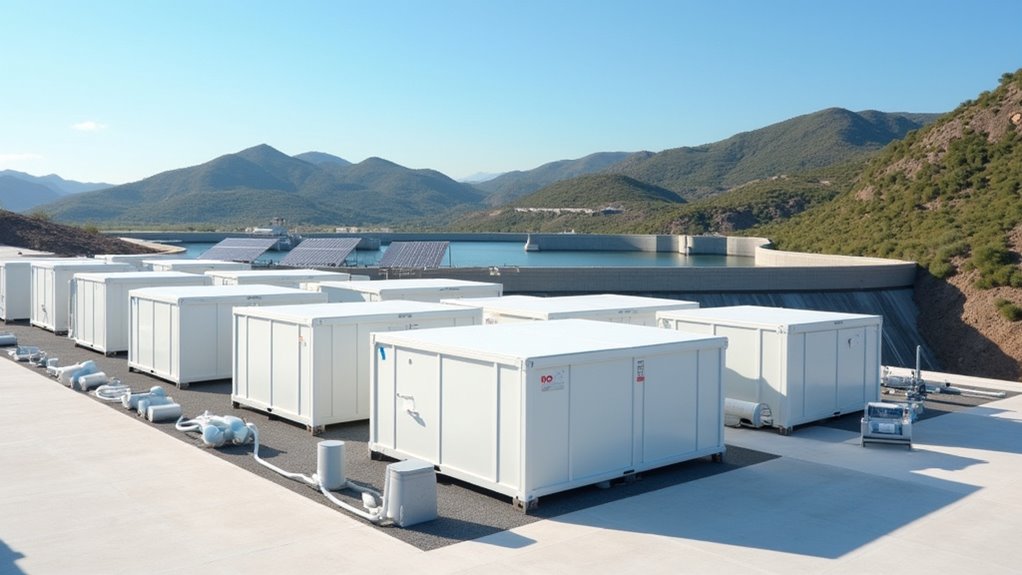
As the global shift to renewable energy accelerates, energy storage technologies have emerged as the important backbone of a sustainable power grid. The race to store clean energy effectively has spawned diverse solutions, each with unique capabilities and applications in our evolving energy landscape.
Leading the charge are lithium-ion batteries, which dominate the grid-scale storage market. The largest such facility, located in Monterrey County, California, boasts an impressive 550 MW capacity. Battery Energy Storage Systems (BESS) are revolutionizing the way we manage power, with their capacity in the United States expected to double in 2024. These systems achieve a remarkable 75-80% round-trip efficiency, making them ideal for short to medium-duration storage needs. The widespread adoption of these storage solutions has led to reduced greenhouse emissions across power generation sectors. However, integrating these energy sources into traditional grids presents challenges due to fluctuating power sources like solar and wind. Additionally, the integration of renewables into power grids is transforming global energy networks by reducing reliance on fossil fuels.
Lithium-ion batteries lead the energy storage revolution, with massive facilities and expanding capacity transforming our power management capabilities nationwide.
While batteries grab headlines, pumped hydro storage (PHS) remains the heavyweight champion of energy storage, accounting for more than 95% of global capacity. China leads this sector with a staggering 50 GW of operational capacity, representing 30% of worldwide installations. PHS excels at long-duration storage, though its deployment requires specific geographical features that limit its potential locations. Modern pumped hydro systems demonstrate storage efficiency between 70-85%.
Thermal energy storage offers another fascinating approach, utilizing both heat and cold to bank energy for future use. Molten salt storage has become a cornerstone of concentrated solar power plants, while ice storage systems help buildings reduce their air conditioning loads during peak hours. These innovative solutions are helping to bridge the gap between when energy is generated and when it’s needed.
The mechanical storage sector brings its own unique solutions to the table. Flywheels harness kinetic energy in rotating wheels for rapid-response applications, while compressed air energy storage utilizes underground caverns to store potential energy. These systems, now operational in multiple countries including China, Canada, Germany, and the United States, are known for their exceptional operational longevity.
The future of energy storage looks even more promising with emerging technologies on the horizon. Solid-state batteries are poised to deliver higher energy density, while flow batteries show potential for extended grid storage durations. Some companies are even developing gravity-based storage systems using weighted trains or blocks – proving that innovation in this field knows no bounds.
These advancements don’t come without challenges. Proper management is essential to mitigate fire risks in battery systems, and noise reduction remains important for installations near residential areas. Environmental impacts, particularly during PHS construction, must be carefully considered. Additionally, the industry must address end-of-life recycling and disposal, especially for battery systems.
Despite these hurdles, energy storage technologies continue to evolve and improve, providing the fundamental foundation for a renewable energy future. As costs decrease and efficiency increases, these solutions are becoming increasingly essential in our change to a more sustainable power grid.
Frequently Asked Questions
How Long Does It Take to Fully Charge Different Types of Grid-Scale Batteries?
Grid-scale battery charging times vary greatly by technology.
Lithium-ion systems typically need 1-4 hours for a full charge, though fast-charging can reach 80% in under an hour.
Flow batteries require 4-12 hours depending on tank size.
Emerging technologies show promise, with solid-state batteries potentially charging in 15-30 minutes, while liquid metal batteries take 2-4 hours.
The charging speed ultimately depends on system size and infrastructure capabilities.
What Happens to Energy Storage Systems During Extreme Weather Conditions?
Extreme weather greatly impacts energy storage systems in multiple ways.
Cold temperatures can reduce battery capacity by up to 50% at -22°F, while excessive heat accelerates battery degradation and shortens lifespan. For every 15°F above 77°F, battery life is cut in half.
Pumped hydro facilities face freezing risks in extreme cold.
However, new technologies like betavoltaic batteries and advanced thermal management systems are improving storage resilience across temperature ranges.
How Much Does It Cost to Maintain Pumped Hydro Facilities Annually?
Annual maintenance costs for pumped hydro facilities typically range from 1% to 4% of initial capital costs.
Large facilities benefit from economies of scale, averaging 2-2.5%, while smaller projects can reach 6% or higher.
Specific examples show costs varying from $1.90 to $5.64 per kilowatt-year.
Factors affecting costs include facility size, age, usage rates, and location.
Despite these costs, pumped hydro remains cost-effective due to its long lifespan and reliable performance.
Can Residential Energy Storage Systems Work During Power Grid Failures?
Yes, residential energy storage systems can provide reliable backup power during grid failures.
Modern battery systems automatically detect outages and switch to backup mode within milliseconds. When paired with solar panels, these systems can continue powering essential home appliances for hours or days, depending on battery capacity and energy usage.
The systems operate silently and require no refueling, offering homeowners energy independence during blackouts and grid disruptions.
What Is the Environmental Impact of Disposing Large-Scale Energy Storage Components?
The disposal of large-scale energy storage components poses significant environmental challenges.
Lithium-ion batteries can release toxic chemicals into soil and water when improperly disposed, while their volatile nature creates fire risks in landfills.
Pumped hydro facilities impact local ecosystems and water systems during decommissioning.
However, emerging recycling technologies and improved battery designs are helping mitigate these issues, though specialized facilities remain limited and processes energy-intensive.


