

Effective forest conservation combines traditional knowledge with modern science to protect woodland ecosystems. Key techniques include sustainable management practices, controlled burning, and satellite monitoring to detect illegal logging. Protected areas and buffer zones help preserve biodiversity, while community-led initiatives often achieve better results than conventional methods. Reforestation and afforestation efforts combat soil erosion and create wildlife habitats. Understanding these strategies reveals how local action supports global forest preservation.
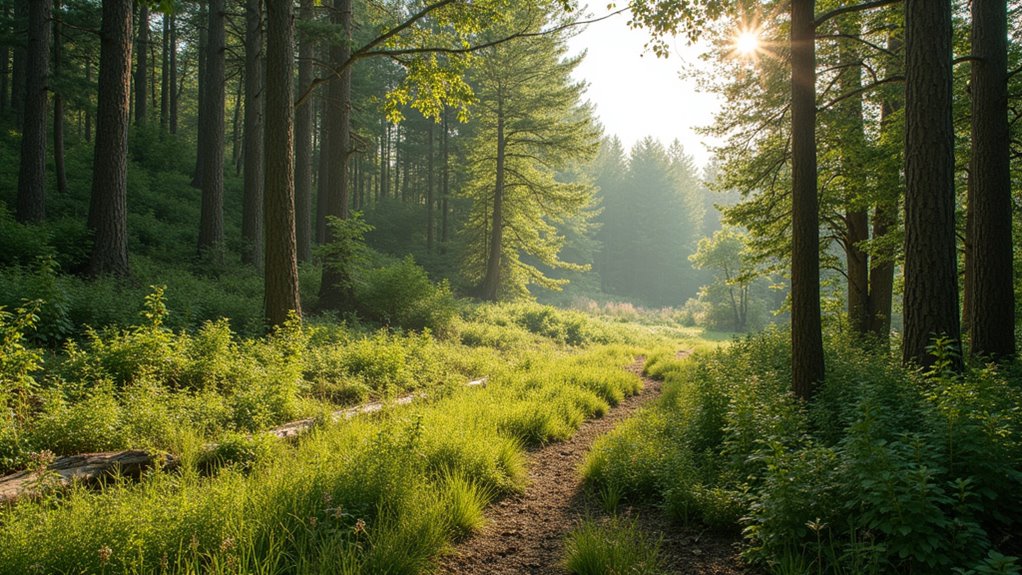
Modern forest conservation blends time-tested wisdom with cutting-edge techniques to protect our planet’s essential woodlands. At the heart of these efforts lies sustainable forest management, which carefully balances ecological needs with economic realities while ensuring social justice. This thorough approach maintains biodiversity and forest health while respecting indigenous peoples’ rights and promoting gender equality in forestry operations. Satellite monitoring aids in detecting illegal logging activities and tracking forest health in real-time.
The significant practices of reforestation and afforestation serve as powerful tools in the fight against climate change. While reforestation focuses on restoring previously forested areas, afforestation creates entirely new woodlands on bare land. With approximately 33% of U.S. land covered by diverse forest types, these initiatives provide crucial templates for global conservation efforts. These initiatives not only offset carbon emissions but also provide important wildlife habitats and combat soil erosion in degraded areas. Protecting wildlife is a key component of these efforts, as it ensures the balanced ecosystem necessary for both animals and human communities to thrive.
Reforestation and afforestation combat climate change by creating carbon sinks while restoring wildlife habitats and preventing soil degradation.
Protected areas and buffer zones form the backbone of forest preservation, though they currently cover just 5% of tropical forests. These zones create physical barriers against human encroachment while allowing sustainable harvesting in designated areas. The concept of multiple-use forest management has emerged as a practical alternative to strict protection, enabling local communities to benefit from forest resources through carefully managed extractive reserves. Indigenous leadership has been pivotal in these efforts, as traditional knowledge often outperforms conventional methods in preserving habitats. Habitat corridors, which connect isolated patches of forest, also play a significant role in maintaining biodiversity and allowing species to adapt to changing climates.
Fire management remains a key component of forest conservation, with controlled burning at the beginning of dry seasons proving particularly effective. Each year, agricultural fires affect between 300 and 500 million hectares of land, highlighting the importance of community education and participation in fire prevention. While mechanical fire control methods often prove costly, addressing sociological factors has shown to be more essential in preventing forest fires. These efforts are bolstered by empowering communities to take the lead in preventing fires through education, resources, and shared decision-making.
Watershed management requires careful attention to road layout and harvesting techniques, particularly in steep terrain. Successful programs consistently demonstrate that consulting with local communities leads to more effective natural regeneration. In Asia, terraced farming has become an exemplary model of soil and water conservation, protecting important forest watersheds.
Selective harvesting and thinning represent sophisticated approaches to forest management that mirror natural processes. By removing only mature trees and leaving younger ones to grow, these techniques create diverse forest structures while preventing disease spread and improving overall forest health. This approach has proven particularly effective in maintaining long-term forest productivity.
Community engagement stands as the cornerstone of successful forest conservation. By involving local stakeholders in management decisions and promoting environmental literacy, conservation efforts gain important support and sustainability. Effective programs develop thorough management plans with landowner input, ensuring that community needs align with conservation goals.
This collaborative approach has demonstrated remarkable success in balancing human requirements with environmental protection, creating a model for future conservation efforts worldwide.
Frequently Asked Questions
How Long Does It Take for a Reforested Area to Become Self-Sustaining?
Reforested areas typically take 2-3 years to achieve basic self-maintenance, with full self-sustainability reached within 3-5 years under ideal conditions.
However, developing into a mature, biodiverse ecosystem requires 10-20 years. The timeline varies greatly based on soil quality, climate, species selection, and management practices.
Key indicators of self-sustainability include natural seedling recruitment, canopy closure, wildlife return, and increased soil microbial activity.
What Impact Do Invasive Species Have on Forest Conservation Efforts?
Invasive species pose severe challenges to forest conservation, disrupting native ecosystems and causing significant economic damage. They outcompete local species, alter soil chemistry, and can increase fire risks.
The annual cost exceeds $2.1 billion in lost forest products in the U.S. alone. While management strategies like early detection and biological controls exist, invasives spread rapidly and are difficult to eradicate once established, requiring sustained, long-term intervention efforts.
How Do Different Climate Zones Affect Forest Conservation Strategies?
Different climate zones require distinct conservation approaches based on their unique challenges.
Tropical zones focus on preserving biodiversity hotspots and indigenous land rights, while temperate regions prioritize habitat connectivity and urban forest management.
Boreal forests need strategies for permafrost protection and fire control.
Montane zones demand attention to altitudinal corridors and water resource management as species migrate upslope due to warming temperatures.
What Role Do Indigenous Communities Play in Forest Conservation?
Indigenous communities play an essential role in forest conservation through centuries-old ecological knowledge.
Their traditional land management practices, including controlled burning and rotational farming, have proven highly effective – Indigenous-managed lands show 26% lower deforestation rates and harbor 80% of global biodiversity.
These communities protect critical carbon sinks, with their forests sequestering twice as much carbon per hectare compared to other areas.
Their holistic approach to conservation produces remarkable results.
Can Damaged Forest Ecosystems Ever Return to Their Original State?
While damaged forests can recover considerably, returning to their exact original state is extremely challenging.
Ecosystems can heal through natural regeneration or assisted recovery methods, but the process often takes decades. Some elements, like extinct species or altered soil compositions, may be permanently lost.
However, with proper conservation techniques, forests can achieve a new healthy equilibrium that closely resembles their original state, though not identical.


