

Modern sustainable farming harnesses advanced technologies to revolutionize agricultural practices. Drones equipped with multispectral imaging detect crop health issues early, while precision GPS-guided machinery enables targeted application of fertilizers and pesticides, reducing waste by up to 90%. Smart sensors monitor soil conditions and optimize irrigation, achieving water savings of 50%. AI and machine learning algorithms predict yields with 90% accuracy, while robotic systems boost efficiency. These innovations represent just the surface of agriculture’s technological transformation.
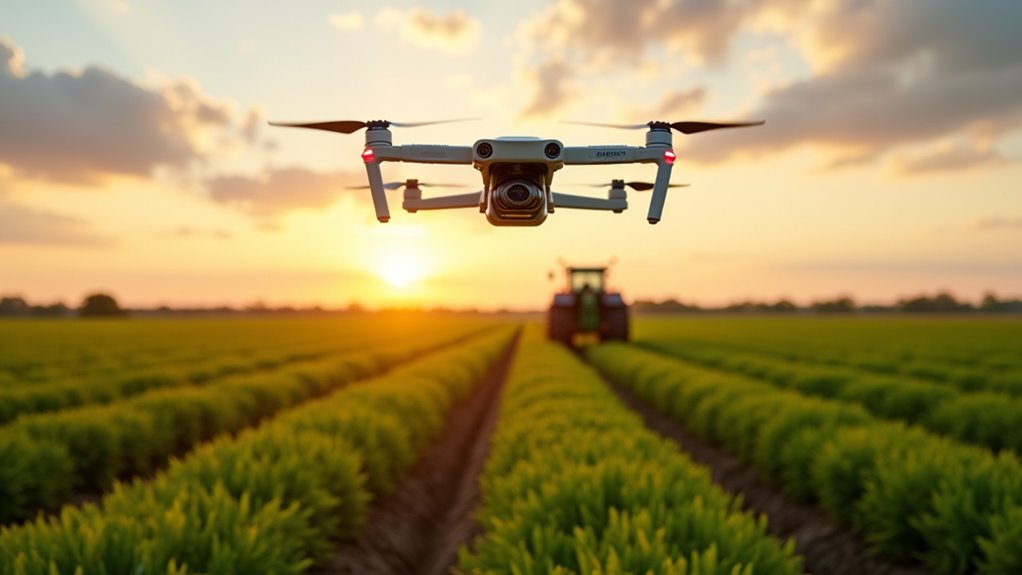
A technological revolution is transforming modern agriculture, ushering in an era where sustainability meets cutting-edge innovation. The integration of precision agriculture technologies, powered by GPS-guided machinery and sophisticated sensor systems, is fundamentally changing how farmers manage their resources. These advanced tools enable targeted application of fertilizers and pesticides, while real-time soil sensors provide vital data about moisture and nutrient levels, leading to more efficient and environmentally conscious farming practices. These technologies have enabled farmers to achieve a 7% increase in fertilizer efficiency through precise placement and application methods.
Integrated pest management approaches have revolutionized sustainable pest control methods, reducing environmental impact while maintaining crop protection. Drones have emerged as game-changing tools in sustainable agriculture, equipped with multispectral imaging and thermal cameras that can detect crop health issues and water stress before they become visible to the naked eye. These aerial platforms have demonstrated remarkable efficiency in precision spraying, reducing pesticide use by up to 90% while creating detailed 3D topographic maps of agricultural lands. The technology has also revolutionized livestock monitoring, streamlining herd management and improving animal welfare. Replicable models of these technologies in different regions have shown that they can be adapted to local conditions, enhancing their effectiveness and sustainability.
The power of data analytics and artificial intelligence is driving unprecedented advances in agricultural efficiency. Machine learning algorithms now predict crop yields with 90% accuracy, while AI-powered decision support systems optimize resource allocation across farming operations. Through the collection and analysis of big data from IoT devices, farmers can identify patterns and adapt their practices to changing climate conditions with remarkable precision. Additionally, implementing water-efficient techniques such as drip irrigation and rainwater harvesting can significantly enhance water conservation, contributing to more sustainable farming practices. Smart irrigation systems, a crucial component of sustainable farming, have the potential to save up to 50% of water usage by using advanced soil moisture sensors and weather forecasting technology. International public financing for clean energy has reached USD 15.4 billion in 2022, which could support further development and integration of energy-efficient agricultural technologies.
AI and data analytics revolutionize farming by predicting yields and optimizing resources with unprecedented precision through IoT-enabled smart technology.
Smart irrigation represents another cornerstone of sustainable farming technology. Advanced systems incorporating soil moisture sensors and weather-based scheduling have achieved water savings of up to 50%. Drip irrigation technology has pushed water use efficiency even further, reaching 90% improvement in some cases. These systems work in concert with automated controls that adjust watering based on real-time plant needs and integrate rainwater harvesting technologies.
Biotechnology and robotics are working hand-in-hand to create more sustainable farming practices. CRISPR gene editing has produced drought-resistant crops, while biopesticides have cut chemical usage in half. Autonomous tractors and robotic weeders are reducing both fuel consumption and herbicide use, while automated harvesting systems minimize food waste. In dairy operations, robotic milking systems have boosted production by up to 15%.
The integration of sustainable energy solutions has become increasingly essential in modern farming. Solar-powered irrigation pumps, biogas digesters, and wind turbines are reducing the agricultural sector’s carbon footprint while providing reliable power for farm operations. Energy-efficient LED grow lights in greenhouse operations have achieved 40% reductions in electricity consumption. These technologies, combined with geothermal systems for climate control, are creating a new paradigm of energy-independent, sustainable agriculture that points the way toward a more resilient and environmentally conscious future for farming.
Frequently Asked Questions
How Much Training Do Farmers Need to Operate Agricultural Drones Effectively?
Farmers require substantial training to operate agricultural drones effectively.
The process includes obtaining an FAA Part 107 Remote Pilot Certificate (16-24 hours study), completing hands-on flight training (10-20 hours), and learning pesticide application techniques.
Additional requirements include software training for mapping and data analysis (8-16 hours), plus ongoing education to maintain certifications.
State-specific licenses for aerial chemical applications are also mandatory for many operations.
What Is the Average Return on Investment for Precision Farming Technologies?
The average return on investment for precision farming technologies shows impressive numbers, reaching 295% over an 8-year period with an internal rate of return of 54%.
Some farmers achieve payback within a single high-yielding season.
Specific technologies deliver varying returns: guidance systems offer 0.38-1.10% higher return on assets, while variable rate technology can cut input costs by 20-30%.
Drones and AI solutions typically generate 15-30% ROI.
Can Small-Scale Farmers Afford to Implement These Sustainable Farming Technologies?
Small-scale farmers face significant financial barriers to implementing sustainable farming technologies.
With initial drone investments ranging from €1,000 to €50,000, plus additional costs for sensors and software, the upfront expense is often prohibitive.
However, various solutions exist – government grants, microloans up to $50,000, and resource-sharing cooperatives make adoption more feasible.
Farmers can also start small, gradually implementing technologies as their returns grow.
How Do Weather Conditions Affect the Reliability of Agricultural Sensors?
Weather conditions greatly impact agricultural sensor reliability in multiple ways.
Extreme temperatures can drain batteries faster and affect measurement accuracy. High humidity and rainfall risk damaging electronic components through corrosion and short circuits.
Strong winds may misalign sensors or clog them with debris. Solar radiation gradually degrades sensor housings and affects optical readings.
These environmental challenges require farmers to regularly maintain, calibrate, and sometimes replace their sensor systems.
Are There Government Subsidies Available for Adopting Sustainable Farming Technologies?
Multiple government subsidies support sustainable farming technology adoption.
The USDA invested $46M in Sustainable Agriculture Research and Education in 2023, while programs like PAL offer financing for precision agriculture equipment.
The Agricultural Climate Resiliency Program funds innovative projects at $1.275M each.
International initiatives include Australia’s $10M Digital Agriculture Investment Scheme and Canada’s support for variable-rate fertilizer technology.
These programs aim to reduce cost barriers for farmers.


